Showing posts with label drypoint etching. Show all posts

Monday, 12 June 2017

MA Week 72 – selling work at the Art Market and looking ahead to hand in


Reflection on the past week, 12th June 2017

 The Art Market

As I mentioned a couple of weeks ago (see this week 70 blogpost) ), the College holds an Art Market as part of the end of year show and I had decided to submit some work. It was quite exciting preparing for this. I took the best 5 prints of the gentrified office building (now titled 'Gentrification'), plus I decided to take the prints I did for the Manchester Metropolitan University (MMU) PGR conference back in February (see this week 58 blogpost) . I wrapped them in cellophane and they looked pretty professional. I decided to price the work for that particular market, especially as the College were not taking a percentage.
 
Prints packed and ready to go to the Art Market
 
Friday was the opening night of the show and of the Art Market. As mention below, I met Michelle beforehand and the Art Market was in full swing by the time we got there and met some of my fellow students. I was thrilled when the sister of one of my classmates bought a 'Gentrification' print plus one of the MMU prints. It made all that time in the print room seem worthwhile. 

On Saturday morning it was my turn to do a stint on the till at the Art Market and I was joined in this task by a student I didn't know but who was very pleasant and easy to work with. I'd not been there long when my lovely tutor, Sharon, appeared. She also bought a print of 'Gentrification' and I was secretly very pleased although I pretended to be tut at her! It was really interesting to see what people were buying - a real mix of stuff, it wasn't the case that one particular genre or medium was flying off the shelves. 
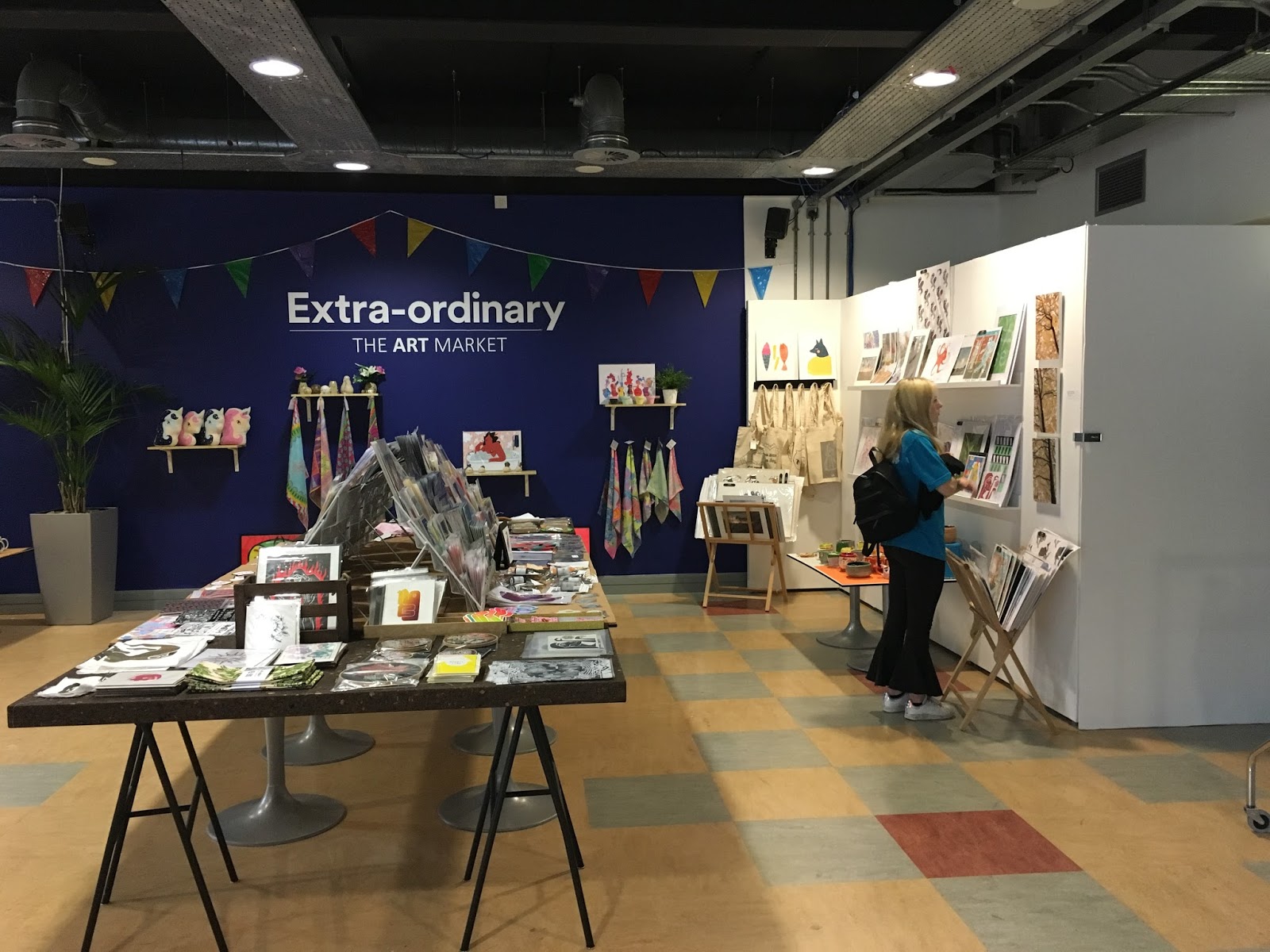
 
View of the Art Market - my prints are the green ones above where the girl is standing
 
I had a quick look when I went in for my tutorial today (more on this below) and could only find one 'Gentrification' and two of the MMU prints left – looking quite exciting!

Printing

After dropping off the prints at the Art Market on Thursday, I went back into the Print Room, and I was in there on Friday too. I’ve been doing some further work on the Burley drypoint (see this week 69 blogpost ). I worked further into the plate, to try to get some lighter and darker marks. Then I tried it drypoint with a painted monoprint on top. I experimented with mixing the coloured ink (cobalt blue) with a transparent ink extender to give a lighter background. This worked OK, as did variable inking of the background. However, most of my efforts at the painted monoprint were rather too indefinite, and the drypoint seemed to come too far to the foreground in the print.  On Friday I tried the transparent ink again, this time with a very high proportion of it, but it got quite sticky and difficult to work with. It did give slightly better results than the previous day, but I’m not sure if these are really two separate prints that I'm trying to put together. I don’t know where, if anywhere, this is going to go next. A possibility might be another drypoint plate as the foreground, or perhaps trying a different colour foreground or mixing some transparent ink into the black so the two layers might “equalise”.


Experimenting with inking the Burley drypoint

I also took the first prints of the aquatint of Royal Park that I was working on a couple of weeks ago (see this week 70 blogpost). There were supposed to be three tones within the print – it had been bitten three times after applying the aquatint solution - but it seems that all the tones had rather collapsed into one. After discussing with Mike, I put another liquid ground onto the plate and worked back into it to try to get some darker contrast into it. However, the result now looks rather too dark – I haven’t been able to get a satisfactory print and basically the plate looks over-worked. I was disappointed with myself but I can learn from this. Really I need to do a test strip beforehand for the aquatint and possibly print it at each stage, although the thought of all that stopping out fills me with dread.

 
The aquatint before I worked into it again - should've left it there!

Catching up 

As I mentioned above, I met Michelle beforehand to catch up with what's happening in her practice. As always it was a good conversation and we discussed opportunities. She had previously encouraged me to submit some of the work based on our dérive for the group show at Left Bank on the theme of 'Movement'. I showed her some of the work I’ve mentioned above and we talked about whether these would be suitable and how I could develop them.

Another catch up was with my tutor, Sharon, at my tutorial on 12th June. As ever, there was lots of food for thought. A large part of the discussion was around what I will submit, as the deadline is now only two months away. There was also a lot of discussion around the idea of the Royal Park aquatint as a journey. Further ideas were around embossing the paper on the Burley monoprint instead of having two layers of print. Much to do!

Tuesday, 23 May 2017

MA Week 69 - Pressing on with printmaking and Frances Morris talk


Reflection on the past week, 23rd May 2017

Pressing on with printmaking and Frances Morris talk

Developing the drypoint

I’ve developed my drypoint following the circles I etched with the dividers last week. As well as the dividers, I'd bought a circle stencil which proved ideal for drawing the circular shapes both on paper and ultimately on the plate. I sketched out a series of shapes from the mini-dérive, working to relate the shapes to each other and to balance the sketch with a variety of shapes and sizes. I also experimented with textures and shading, and was quite pleased with the result. I then flip-photocopied it and drypoint etched it into Perspex.  As always I found curved shapes difficult to draw - seems the trick is to move the plate rather than the needle.  The idea of this is to form an underneath layer of a two or three layer drypoint of the walk. It gave a reasonable result but I will probably work further into it to try to get a bit more variation in depth, following on from last week’s results. I printed it in blue (process cyan) as I wanted to take one of the colours of the walk, namely that of the railings outside the former Burley Library.
 
The shapes of the overlooked urban environment


Yesterday I went out at lunchtime and did a couple of very quick sketches which might act as a “top layer” to this plate. I’d drawn outdoors previously but taken quite a bit of time over each sketch. These were done quickly, and I was amazed at the amount of visual information you can get down within 5 minutes.
 

Houses; visual note
 
More soft ground troubles.

Following on from last week's experiment, I tried again with pressing plant materials into a soft ground. Last week I used an old plate that I'd acquired and stripped back. This week I used a similar plate plus a brand new one. I sanded them both back equally and cleaned them to within an inch of their life following my hunch of last week. However... still no joy. The ground still came away. So it isn't the plate, given I’d used an old and a new one, and it can’t be the cleaning either. It must be something to do with the preparation and/or the etching. More investigations needed.
 

“Troubling Time” conference paper

I've started to write the paper for the "Troubling Time" conference in Manchester on 1st June. I am going to introduce my research and my practice, then invite the participants to produce a visual work which "troubles time". This is based on the organisers' encouragement of contributions which “engage practically with their duration, with the aim of fostering methodological diversity”. I don’t know if people will engage with it, and it’s already pushing me out of my comfort zone, but that’s probably a good thing.

On a related note, I've just heard that the walking event scheduled for 1st June has been postponed for a couple of reasons. This is a shame but it does mean that I will be able to attend the whole day at the conference which will be good.

Frances Morris talk

Finally I went to an excellent talk by Frances Morris, director of Tate Modern, last night. She is a very engaging, interesting speaker and I learnt a lot about "behind the scenes at museums" from her Talk. I've summarised the points most salient to my own practice in this blogpage.


Monday, 15 May 2017

MA Week 68 - Successful exhibit and failed experiment


Reflection on the past week, 15th May 2017

Etching experiments

It’s now May and I need to start to focus on the final project and the hand-in, 3 months away but fast approaching. After enjoying etching so much, I’ve decided to concentrate on intaglio printing to produce my final pieces (so no surprise there, then).

I’ve finally started to work up some of the ideas after the April mini-dérive. I’ve been sketching abstracts of shapes from the walk, and I’m still playing with how they might work together. I’ve also been trialling how best to drypoint circles, as previously pondered. I’ve done a test plate which has given interesting results. I bought a pair of dividers but I think they are a bit light weight for this task. However, the rather faint mark they made gives depth to the plate as it contrasts with some of the deeper marks, so perhaps there is something to pursue there. I’ll continue to work on this.

 
Playing about with circles and acetates

A disappointment was a failure with grounding a plate. I’d applied soft ground to a previously-used copper plate, which I’d re-prepared according to what I’d learnt so far. I wanted to press it onto the grates I photographed to try to get some surface texture. I tried this but it didn’t work – I think the two surfaces were too flat, and Mick (the Print Room manager) said this was probably the case. By this stage I was already unconvinced by the ground, but tried making some further marks into it and biting it. When I came to rinse it, the ground rinsed off. As far as I can tell, it hadn’t adhered to the plate properly. I can only think I didn’t clean the plate enough before I applied the ground, but I’d spent quite a lot of time soaping and re-soaping it. Back to the drawing board with that one, but at least this setback is early on in the proceedings and I can rethink the idea.
 

Exhibition exposure

I forgot to mention a couple of weeks back that I had had a piece accepted for the “Framework” exhibition at the Old Red Bus Station bar in Leeds. The exhibition is to raise money for Leeds Women’s Aid and the organisers (coincidentally also students at Leeds College of Art) wanted pieces that would be suitable for viewing by children. As that rules out a lot of my current rather darker work, I submitted a painting of some lilies that I did a couple of years ago and was delighted to get it accepted. Even better, I met up again with Michelle before the opening last Thursday and we talked more about developing our work together. There were a few other familiar faces from the MA course too and it was a really lovely occasion.
My piece is the flowery one at the top. Honestly.
 
Academic thoughts

I also met up with Zoë again to chat more about how the walking event will work on 1st June. As always it was an interesting and insightful discussion. It set me thinking in much more detail about how it is going to work. I think the paper I’m giving in the morning in Manchester will have some overlap with it, as I’ve been working on the basics of that, too. More thinking to do on both those topics.
 
Looking at this blogpost – I have actually done quite a lot over the past week! It didn’t feel like it at the time. That’s the value of reflective practice, I guess.

Monday, 3 April 2017

MA Week 63 - Psychogeography, printing and collage


Reflection on the past week, 3rd April 2017


Psychogeography

It was good to meet up once more with Zoë and Lynne to talk further about the planned walking event. It’s now scheduled for June 1st, 5-7pm. We’ll do a short walk and take some rubbings and drawings of our environment, then collage these and anything else we find back at “base”. I took along a few rubbings I’d done around the area and both Zoë and Lynne thought they were fine. I’m really looking forward to this event and I just hope it doesn’t rain! It’s such a pleasure to chat with these two people I’ve only recently met and who share some of my quirky interests! More on this when I have more details. 

Printing

As usual the print room isn’t freely available when I am, but I manged to get in on Thursday afternoon and spent most of the time printing the small copper plate from last week on various papers. At the moment the Canaletto paper seems to give the best results. I did try some Somerset paper too, but I think I left it to soak for too long and I wasn’t as happy as I’d hoped with the results.

I’m also experimenting with how much to polish the plate. I’m forming the opinion that you can polish it quite a lot more than the plastic. Then there’s the issue of the pressure on the press. I was getting quite grey whites, so to speak, but by loosening the pressure slightly I got a cleaner white. Mike put the etching blankets on for me and these really help. So really I think that to get a finished result I would have to experiment with combinations of pressure, polishing and soaking time but use the proper etching blankets.

 
Mabgate plate inked and ready to go


I also printed the Mabgate drypoint again, on Canaletto paper. Thinking back to the demo by Cath Brooke (see this week 50 blogpost ), I remembered her using a similar weight of press on these thinner plastic plates, so I gave it a go and was pleased with the result. A nice definite print, better quality than from the smaller Hawthorn press. It was only afterwards that I realised my memory was false and Cath had used a smaller press! But hey, I got a decent result, and that’s for my fab friend Larissa.


Collage

When I’d reflected on the crit last week, I wasn’t sure what I’d got out of it. However, I took the advice and I colour photocopied some parts of the MMU paintings onto acetate and onto paper. I then did a bit of action research, playing around with these and also with some leftover squares from the “tiles”. I did quite a lot of rearranging and overlaying but in the end I cut things up into squares… you knew this would happen… and the two images show the results I liked best. There were just some nice juxtapositions of colour and texture. I put these out on Twitter and was pleasantly surprised with the reaction. A couple of followers retweeted and I got some likes from people I’d not come across before. I took this to be an affirmation that there’s something here for further development.


Moans

In the past six weeks I submitted ideas for an exhibition piece and an abstract for a conference paper. I’ve heard nothing. Fine, if my submissions are not what the organisers want – not everything is going to be successful – but in these days of mailmerges and automatic replies, why can’t they have the courtesy to send a “thanks but no thanks” email? Grrr.


Monday, 27 March 2017

MA Week 62 - Etching, processes, crit… and London


Reflection on the past week, 27th March 2017

 
Printing and processes

Following on from last week’s blogpost, I updated my overall plan but decided I needed more tactical, day by day plans, to allow me to focus and get something done. I decided that I should work around being able to get into the Print Room on Friday. I wanted to restart etching but felt unsure about how to do so.

It’s amazing what a bit of thinking time can do. A few strands came together, somehow. A couple of weeks back I had a discussion with one of my fellow students about how my health difficulties impact on my ability to produce work. I seem to have intense phases of activity followed by days or weeks of inability to do anything, even blog. She said, “that’s your practice. Work with it”. This quite obvious piece of information came as both a revelation and a relief. Within creative practice there always seems to be a driver to do work on a grand scale. Realising that smaller pieces of work can also be valid suddenly opened up new ways of working.

Allied with this, I’d been reading and pondering upon a newspaper that I’d received at the MMU conference. The illustrated paper is by Howard Read, whom I’d met and talked with briefly, and it describes his visual and academic research into the gentrification of Elephant and Castle in London. The subject material was of obvious interest to me. Alongside considerations of the removal of social housing and the creeping gentrification, Howard had discussed in detail the purpose of sketching and drawing. Again, a real insight: not all drawings have to be finalised. Indeed many drawings should not be finalised as they are a contribution to a future, finalised piece. A sketch can be just that – a visual note, so to speak.

Original photo....
These two strands manifested themselves in a realisation that I didn’t need to rush anything; I could work on a smaller scale with a more robust process. I therefore got an A5 sketchbook and did a (reversed) sketch of one of the Mabgate photos. It isn’t perfect, but it is allowed to be like that. I also moved some things around in the composition to suit my purpose. I let myself enjoy the sketching rather than pressurising myself and it worked so much better. The following evening, I found the little copper plates that hadn’t worked in the Summer, and found I’d re-ground them. I freehand-etched the same image into one of them.

 
Etching based on photo

I hadn’t been in the print room for so long that I felt slightly nervous returning. By happy coincidence, Mike (the technician) had been doing some etching so had up-to-date experience of how long to bite the plates. I bit it for 29 minutes, inked it, printed it and… it worked! 7 x 4.5cm of wonderful scratchy black marks. I spent the rest of the session working with different papers (Canaletto and Zerkel) and different levels of polishing, to get used to using the copper. The plate’s previous biting (from the Summer) has left it pitted and this gives an interesting undertone, so this is possibly something to do more deliberately as I move on. I also sanded and inked another of the little plates from the Summer ready for the next piece.

 
Crit

The same day, five of us got together for a crit. I’d brought in the paintings I did for the MMU conference plus the Mabgate office print (see this week 51 blogpost) , but by this time I’d printed the little plate and had become quite immersed in that. Ignoring this, my classmates gave me plenty of input!
Details of "tiles" from work for MMU conference
 
Again, as at the conference, there was interest in the “tiles”. There was a suggestion to introduce colour into the tiles, or to try strips. They suggested using photocopies and copies onto acetate to help composition. Another wake-up call around process. I know this – so why haven’t I been doing it? It’s been the time pressure that I’ve put myself under, of course. There was a feeling that the map elements might be too literal an interpretation of the journey, and it was suggested I consider cropping some of the work – effectively using a little square viewfinder to find points of interest. This tied in with ideas I’d had to do a few smaller pieces – paintings, prints, drawings, photos –based on the Mabgate photographs. A really interesting idea was to take a “slice” of work – why does everything have to be square, or rectangular.  

I particularly like the idea of basing something on the “tiles” but using colour and using strips so this is a probable area for experimentation.


London

The next day, the same five of us went to London. I’ve written reflections about the galleries we visited in this London Galleries page. However, there is something more to relate. We were all feeling pretty tired at about 4.30pm outside our last gallery, the Drawing Room, and after some discussion set off to walk to Elephant & Castle tube station to get the tube back to King’s Cross. We hadn’t go far when by chance we saw a bus going to King’s Cross so we boarded. This meant a top-deck view of Elephant & Castle, including the very development that Howard Read had been recording. I’ve never been to Elephant & Castle before in my life. It was such a heavy coincidence that it intuitively confirmed to me that my approach of the past week was the correct direction at this point.

 
Visiting galleries is thirsty work

Monday, 6 February 2017

MA Week 55 - a fruitful start to February


Reflection on the past two weeks, 6th February 2017  

At last, some definite progress to report! First things first, though – I finally got my marks back for my dissertation and I got a very good mark. I was really pleased. My tutor also seemed to “get” what I was trying to say and the way I was trying to say it. That gave me a real boost, which was much-needed, and I felt all my efforts last term had been recognised.

I had a good tutorial towards the end of January which helped to confirm the viability of an idea I’d had, to base an abstract painting on a map of the Mabgate area. Sharon (my tutor) liked some of the marks I’d made, and the plan is to incorporate at least some of these into the painting. There will, hopefully, be the usual method of choosing colours based on what I saw (see this week 46 blogpost for more info on what I actually did see), and incorporating the shapes I encountered into layers within the painting.

I’ve gone for 300gsm cartridge paper which is now stretched and which I’ll gesso to help me use charcoal and graphite on it. I like the acrylic paper but I didn’t think this would work so well if I were to try to use charcoal. We’ll see! This is all a learning curve for me – I’ve only stretched one sheet of paper since I left school – and I was unsure how long to soak this paper for. I’ve not used cartridge paper of this weight, but one of the things I want to do this term is to learn more about paper, so this is a good opportunity to learn something.

I’ve started a sketch of the proposed piece (it’s in two parts) and I feel quite happy with the shapes which are based on the streets. I have experimentation to do with the layering, and the colours I’ve put down so far aren’t right, but that’s the point of making a sketch. I have another tutorial in a couple of days so the next two evenings will be spent applying further colour to the sketch so I can talk this through with Sharon. I feel much happier working with this methodical approach although I am still concerned about time.

Colours in progress
 

I finally managed to get back into the print room last Thursday and I spent a good day in there. I printed the office block that’s being gentrified several times. Susie, one of the technicians, helped me get a better print by packing on top of the paper/plate with tissue paper. I did some experimental inking, some of which worked and some didn’t. I’m not sure where next with this plate but some of the latest prints are OK. These are all on 140 gsm cartridge paper but I’ve been recommended to use Snowdon paper so I will be giving this a try in due course.

 
An experiment that probably didn't work

On Thursday lunchtime I laser cut some shapes that I’d drawn based on the map of the Mabgate area. I also cut out the word “self”. There is a self-storage place next to the gentrifying office block and I kept coming back to the idea of “self”… storing some of yourself, or leaving some of yourself behind perhaps? Then it was back to the print room for an afternoon shift of monoprinting. I used the resists that I’d laser cut and I was quite pleased with the results. I didn’t clean the plate at all during the afternnon and this gave some nice layering. I used cadmium yellow and process cyan (my super favourites). This is because the self-storage place signs are blue and yellow, and also I wanted to get to a green that was reminiscent of the old City of Mabgate pub’s sage green exterior tiles. The colours mixed up to a nice leaf green – not exactly the colour of the tiles, but a nice Spring-like colour for the time of year.

 
self discovery

Using text in the monoprint was probably something that I’d resisted for a long time but I liked the result. I thought it gave a bit more interest to the prints. There were three that will be suitable for use at the MMU PGR conference although the registration could have been better! I think these prints represent a little development step compared to the work I did last Summer and I really want to work with more laser-cut shapes.
 
It was a bit of a downer that the print room was booked for a class on Friday as I’d got my print groove on and would have liked to continue where I left off on Thursday. However, there was a silent crit in class so I joined in with that. I worked with two first-year students, whom I’d not previously met, Diane and Hattie. Their comments were mighty useful. I showed two of the monoprints and two prints of the gentrifying office block. They felt that the colourful prints were reminiscent of nature and the organic, whereas the office block prints were hard and represented the physical. This was insightful for me as I am grappling with how to present the two types of prints together, and this could provide an entry point; the static and the chaotic, perhaps? They also recognised that the monoprints were based on map shapes, which was great! When I explained that the prints were based on the Mabgate area and why I’d used the colours, Hattie immediately mentioned the green tiles of the former pub, which was really encouraging. The only thing they didn’t “get” was the text. Perhaps it needs a bit more thought as to exactly how I deploy it.

 
Crit time: working with Hattie and Diane, enjoying looking at each others' work

It’s been good to be so productive after rather a fallow time. I promised myself February would be fruitful, and so far, so good.


Monday, 9 January 2017

MA Week 51 - Restarting ... for the final time


Reflection on the past week, 9th January 2017

 
It feels really odd to think that I’m starting the final module of the MA, although it is seven months until I need to hand in. I’ve now taken back all the library books from before Christmas, except one, and I have to re-start the visual.

 No prizes for guessing I was immediately back into the print room. It was good to be back. I’ve started a print based on the technique demonstrated by Cath Brooke back in December (see this week 50 blogpost). It’s a drypoint of one of the Mabgate photos into a thin, transparent plastic plate. It’s taken a bit of working out how to ink and wipe it, and I’m still experimenting on that score, but below is an image of progress so far. I want to work further on it, learning more about selective inking and wiping, which hopefully I can do this coming week. There are also some issues about whether I should hatch some more of the plate. I think possibly not, but I need to have a good look at it.

 
Mabgate prints

Another thing I did was a pretty basic drawing of the same building in charcoal on acrylic-paint paper. Both this and the prints were also experiments to see if I could paint into them with some acrylic paint. The results are inconclusive so far, but I have other ideas for working into them.

I need to get inspired and active pretty quickly as I have a deadline of 22nd February, which is the date that I’ll hopefully be able to exhibit a couple of pieces of work at the Manchester Metropolitan University PGR conference. The theme is “Changing Lives” and I discussed this in my tutorial today. I’ve based my abstract submission on that premise that telling my own story using visual means has changed the way I view my own life, and that by encouraging others by showing my work, they could tell their story too. It goes back to the concept of the everyday being important and speaking truth to power.

 The building that’s the subject of my drypoint surely has stories to tell – as far as I can recall, it was an office building, and I thought they were pulling it down. Parts of it are now swathed in thick plastic so I imagine it is being refurbished. There are elements of decay, repurposing, layering. I expect it will feature in some way in my submission to the PGR conference.

Tuesday, 6 December 2016

MA Week 50 - a fantastic drypoint demo and the end of the dissertation


Reflection on the past week, 6th December 2016

Urban printing

Something visual at last, after what feels like years but really is “only” about six weeks of writing. I went to a “Printmaker’s Toolkit” one-hour session by Cath Brookes at the West Yorkshire Print workshop, entitled “Printmaking in the Urban Landscape” – so obviously right up my street.

Cath is inspired by the industrial and has done a lot of work around Redcar, around the chemical plants and the now-closed steelworks (see Cath’s website). She sketches outdoors and then works from the sketches. She brought one of her sketchbooks and there were some lovely thick black lines in there (possibly conte sticks?). She demonstrated the printing of a thin acetate plate which she’d etched previously, first inking it in black then selectively wiping it, rolling ink back onto it, and re-wiping it. This gave a very industrial feel to the outcome.

Cath with the first print
 
She then inked and selectively wiped a second plate with a blend of orange and blue inks and printed this on top of the first print. The technique was fairly simple (though obviously Cath has finessed it over time) but gave such an impressive outcome, with a toxic orange in the sky and pools of water in the foreground. Finally, she demonstrated a chine collé, using some Chinese Paper onto which she had previously printed textures. This transparent paper blended into the overall image and gave fantastic texture.

 
The first print overprinted with a selectively coloured plate - super industrial!

Cath managed to gallop through all of this in an hour, but I took nearly all of it in as I have spent the past year working with the same techniques and subject matter. There were two really interesting points. Firstly, the use of thin, transparent plates. These allow you to trace an image using a Sharpie marker prior to etching it, and they also assist with the selective inking of the monoprint stage. Secondly, Cath is working the opposite way round to the way I did it, as I’d done the monoprint layer first. I’ve bought some of the transparent acetate with a view to having a go with Cath’s technique as soon as possible.

The dissertation is done

The dissertation is now finished, printed and in for binding. I’ve also finally managed to publish a few notes about Ann-Marie Bathmaker’s seminal book chapter on Life Histories. The dissertation took some beating into submission over the past weekend. Thursday went well; I took Sharon’s advice of last week (see my week 49 blogpost) and restructured the discussion about the chosen artists along the lines she’d suggested. This seemed to open up the essay and somehow remove other blockages. It was a long but successful day. On Friday I went into College and sorted out all the images, which took about 5 hours, then came home for an evening shift tidying up the bibliography and various other loose ends. So far so good. Saturday and Sunday were not so good. I knew I had to cut it off and tidy it up, but I was tired and I’ve read and written the damned thing so many times that I could recite it off by heart so I’ve no idea if what I’m reading is on the screen or in some previous version. The conclusion, in particular, proved much more difficult to write than I expected. I can only go back to the fact that this is my first piece of writing of this style.

Anyway, what’s done is done, all 130 hours of it. It has been a steep learning curve, frustrating at times, but for the most part enjoyable. I feel I have risen to the academic challenge and could have written more with more words and more time. I’m going to keep some of the psychogeography books out of the Library over Christmas in the hope of being able to read a bit of them. However my desire to do something visual has been absolutely fuelled by this morning’s demo. Although I haven’t given much thought to what I’ll do for the Final Project, I know it will have industrial-style black lines in it. Watch this space.

Tuesday, 4 October 2016

MA Week 41 - Printing and Perusing


Reflection on restarting – 4th October 2016
 
So, back in the thick of things. Since I gave the paper a couple of weeks ago I’ve made a start on my dissertation and done a bit of printing.
 
I’ve spent quite a bit of time poring over books and perusing papers. My dissertation will have the same theme as my paper but obviously will need more academic rigour, so there’s quite a bit of referencing to do. There was a lot of food for thought about identity and heritage in the symposium itself and some of this has been borne out in the reading I’ve done.
 
I’ve also gone back into the print room. It was strange, restarting, and I made some of the same stupid mistakes I made last term – doh! On Thursday I did some monoprinting. I decided to use grey and black as a change from red and black, but the grey didn’t work brilliantly well. I mixed some white into Payne’s grey and it went really thick. When I scratched into it with the comb, it gathered at the edges of the paper.
 
Some of the Vernon Street staff are now in the Blenheim Walk print room and this means I am getting some additional views and information as obviously everyone has different experiences. This is even better than before! Mick Welbourn advised the use of cobalt drying drops. I completely forgot to put them in the grey but put them in the red. The red ink definitely dried quicker – by the afternoon it was difficult to roll whereas the grey was still going strong. It also dried better on the paper.
 
Rack of monoprints. Happy days!
 
I tried two different types of paper: a coated paper and my usual cartridge paper. The red didn’t work very well on the cartridge at all. On the other hand, it worked really well on the coated paper. Susie (a technician) told me that this paper is used for commercial printing as it’s glossy and takes up the ink really well. You need to do at least one pull on cartridge paper first or the ink overwhelms the (coated) paper. So this is all fodder for my desire to experiment with paper this academic year.
 
On Friday I started to etch a photo I’d taken looking up a pylon. It’s gone a bit astray in places but so far so good. Mick showed me how to ink it using oil paint. You apply the paint onto the plate with a cardboard square then scrape it away and polish it – no scrim. It’s a lot cleaner but I missed the scrimming. And there was no black, just bl**dy Payne’s grey. So I’ll ink it properly when it’s finished.
 
Pylon drypoint - WIP
 

Friday, 12 August 2016

MA Week 40 - Practice 1 : summary of the module

Practice 1: Progress and Reflection


This was a very practical module which had the potential to drift as it was double the length of the previous module in terms of time. It was typified by times of little activity due to personal issues (with the health of both myself and my partners elderly mother, both taking a lot of time and energy) and times of intense and enjoyable activity.

It was hard to restart in April but taking a number of photographs of pylons provided some good source material and I was back on track after some drawn monoprints of these. I’d made a conscious decision to try drawn monoprinting as I thought it would loosen up my cramped practice. I was right, and also the pylons have been constants in my source material since then.

As always, pivotal moments come when you least expect them. In early May I did a piece of free writing, about writing, over a monoprint of a pylon. It seemed to settle that the writing and visual were in fact two sides of the same coin. After that I felt like Id wrestled the writing into its place, and this was confirmed by the points made and discussed at the “Tall Tales and Crooked Yarns” research forum on 15th June, when artists discussed the use of the visual (as opposed to written) narrative. Also in early May, in a lecture by Adam Stone, he commented to the effect that you are only one actor in the creative process. This statement has kept coming back to me, and was particularly noticeable when I was monoprinting, which I’ll talk about later in this summary.

Etching a drypoint of the pylon around the same time was another key point in this module. This plate built upon the experience of the two plates Id produced previously within the MA, and I really liked the blackness of the marks Id made. To no small extent, I think I am learning to draw via drypoint.

For the end of year show, I decided to fall back on that with which I am more familiar, acrylic painting, and produced four abstracts. It was a risk averse strategy as I didnt know what I could manage in terms of printing. I asked my classmates for a crit which eventually took place via Whatsapp, on the train to the drawing symposium in Salford in May, and in the symposium itself. This plus further prototyping and going back to my trusty “Encyclopedia of Acrylic Painting” meant I was well able to produce the pieces. I used two definite, limited palettes, one based on my usual Socialist black/red and the other a combination of blue/yellow/silver based on pylons under a stormy sky. This set my palette for the rest of the term, which was concerned with printing.

The opening night of the End of Year show was fantastic. Although I was very aware that my work was a definite work in progress, it was such a buzz and so much fun. This was followed by my submission of the postcards to the 1000 secret postcards exhibition in Frome, Somerset. I followed this on Twitter and it was also uplifting, positive and resulted in a few new Twitter connections in the South West. These two events represented steps forward with my professional development.

After the show, I undertook some further planning and an analysis of the time still available to me, and realised I couldnt do both the acrylic painting and the printing that I would have liked to. I therefore took a conscious decision to concentrate on printing. I started to monoprint using the geometric shapes of the pylons and this is where Adam’s statement about being merely one actor became very apparent. I was led by the loose, visually driven process that is monoprinting. This was exciting and opened up a realisation that creativity can come when you loosen the control, as well as when you exert as much control as possible.

I used the black/red and blue/yellow/silver palettes for the printing work. This followed on from a nascent methodology from the last module, of using a palette which derives from what youve seen, and I like this idea. It also tied in with another couple of pivotal moments. Reading Annemarie Murland’s paper, Migration and Sense of Place: re-contextualising felt experience through creative practice, made me realise that you can allow a place to channel itself through your creative practice by your choice (or its choice??) of the colours and marks. I also had a really interesting conversation with my colleague, Dr Liz Watkins, whose research interests include colour. Liz was doing some work on some old photographic images and looking for signs of the embodied experience in which those photographs had been taken. In a Eureka moment, I realised that this is what I’d tried to do with the pylon abstracts. I felt the beginning of a kind of visual language or visual encoding – not necessarily the only visual language in which I might articulate myself – but something which had been brewing since the start of the calendar year in terms of my colour and mark use. This was a very gratifying and exciting moment!

I undertook another urban wandering, to Holbeck, to generate some new source material. Along with monoprinting, I made a new drypoint based on some of the shapes from this wandering and I combined this and the pylon drypoint with some of the monoprinting. I also used some cardboard shapes from the buildings I’d photographed on the wandering as resists and let the whole lot come together. I learnt so much during this time simply from practising the printing. I had the confidence to think what I was going to do rather than just jumping in. The results were much better. One thing I need to learn more about is the paper. One of next years objectives will be to learn about paper! Can’t wait! I have become addicted to printing, particularly intaglio.

I have also managed to get an abstract accepted for a symposium called Grim up North?” on September 16th this year. Im really pleased about this as the theme of the conference is right up my street, to use the vernacular, and it is something Id wanted to do since the outset of the MA but didnt think Id be able to. I intend to talk about trying to develop a visual language which describes the embodied experience of being a Northerner, building on the points I made earlier in this summary.

In my MA proposal, my definitive statement of my research topic was ‘to understand in more depth how I can use creative practice to depict experience that is part and parcel of the condition of “being human”’. There were many times along the way this year that I felt I was hopping around, not able to settle on any one thing, miles away from my topic. But really Ive just been on a few exploratory pathways and Ive now returned to it in terms of developing a visual language which attempts to describe lived experience (embodied/felt experience).

If I look back through my creative journal for this module, the source and subject material is entirely the urban landscape, and particularly the industrial, landscape (with the exception of a Yorkshire Rose from the Holbeck wandering). Id not even noticed this - there is actually an unexpected strength of theme. Something noticeable by its absence in this module is my own image, which has hitherto been present in my practice since the Access course days. Whether I have moved on permanently from this, only time will tell, but I think the development of my use of colour and mark is possibly taking over from the need to put myself literally in the picture.

What next?

A week off after hand in to go to York Races! Then back to it. The first task will be to research and produce the paper that I will give at the Symposium on 16th September. This is equally exciting and terrifying. I hope that that research will form the basis for the research for my dissertation. I haven’t yet finalised a title for the latter but I expect it will encompass some or all of the themes of Northernness, mark making, developing a visual language and urban wandering.

I expect that the dissertation will take up most of the time next term, but if at all possible I want to keep going into the Print Room to try to keep developing my technique. In particular, I want to learn more about etching into a ground on metal and to think about how this could work into the Practice 2 module next year.

Monday, 1 August 2016

MA Week 38 - Monoprinting is addictive


Reflection on the last week – 1st August 2016

I finally made it back into the Print Room last Friday, and what’s more, I was in the company of my classmate Sue, which made it even better.

I’d asked Sue if she would be kind enough to come in as she is a much more advanced printmaker than I, and I wanted to pick her brains. It’s been quite hard plodding on with the printing without the community of my MA mates in their critical friend role. We chatted for about an hour at lunchtime and I showed her some of my monoprints. There were some that I’d thought were finished, but then I wasn’t so sure – should I work into them further? Sue agreed that they were finished. We talked about the fact that you can work on a monoprint indefinitely as it’s such a free process – you rarely start it with a definite end product in mind. Sue was also interested in an idea that I keep toying with, that is, to cut some of the prints into squares and form a “mosaic”. I’d more or less shelved the idea but her enthusiasm has persuaded me that I should resurrect it. So that’ll be to do later this week, then. 

In the printroom itself, I experimented with a few different textures in monoprinting and kept the little squares of card I’d used as resists and which now had the textured print on them. I might collage them or present them somehow. Then I moved onto pulling last week’s drypoint. It worked quite well and I also printed it over a monoprint. Lots of scope there for mixing the two print types and I’m hoping I might be able to get another couple of examples before hand-in. I’d also like to work into the drypoint plate a little more but I’m not sure I’ve got the time to do that. I really need to move onto getting everything together for the hand-in now.

New drypoint plus monoprints
We had an issue with the much-loved Albion press as it had somehow got uneven pressure and it warped Sue’s 50x50cm aluminium plate – I was mortified. Toni, the technician, rectified it as best she could but it still wasn’t right – I pulled a print off the pylon plate and it warped that too. There wasn’t time to sort it out fully so I hope it is back in action for later this week.

Toni was bookbinding so that’s on my to do list now also – ideas of using the monoprints as book covers or as pages within a notebook. She advised me to keep coming to the print room next term even though the dissertation is likely to take over, even if to just do a couple of monoprints. That way, she said, I wouldn’t lose the “feel” of printmaking. Sounds like wise words and I will try to keep it up if I possibly can. 

Otherwise endless catching up with creative journal – I am now only 3 weeks behind!