Showing posts with label etching. Show all posts

Thursday, 10 August 2017

MA Week 80 – writing up and wrapping up; an end and a beginning


Reflection on the past 10 days, 10th August 2017

 
A final etch

Most of my “spare” time since last week’s post has been taken up with preparing for hand-in, but I did get time to have one last day in the print room. I decided that I would like a souvenir of the “Movement” show at Left Bank Leeds, so I did a small plate etching of the venue. Etching and aquatint are teaching me a lot about composition and tonal values.  However, the foreground was still a bit light after the plate had bitten. I only had time to do that one ground on this plate, so I had to drypoint into it. This worked OK in the hatching of the shaded areas. The end result was pretty good for a piece that took just a couple of evenings to prepare then a leisurely day to etch and print. It was great to work without the pressure of trying to get something done for hand in – if it didn’t work, it didn’t matter. It printed up really quite nicely on the Somerset paper (soak well, blot well!).
 
Souvenir: of the exhibition at Left Bank and of happy days in the Print Room at College

 
Preparing for submission

Getting ready for the final submission has been a long process. It was quite exciting to see all my work together ready for mounting, but less exciting when I got spray mount onto the face of one of the aquatint prints and had a paddy of Biblical proportions (both situations were dealt with swiftly and smoothly by my in-house team).
 
Writing up the entire module’s practice holistically (rather than chronologically)  has, inevitably, yielded fresh insights. One of the more interesting ones is the creative tension between controlling a process and letting the process take its own course. Whilst experimenting with different types of paper for etching (see this week 79 blogpost), I’ve been making notes on soaking times and amount of blotting needed, plus ideas about how to ink and wipe the plates. I also made a test aquatint strip to try to have some control over how long to bite the plate for. This methodical, controlled approach is quite in contrast to the much looser process of monoprinting, where the colours and shapes drive the process. The inking of the “Gentrification” drypoint is somewhere between the two; part controlled inking and wiping, part monoprint. This then starts to give rise to thoughts of how these different approaches could cross over into one another.

It’s incredible to think that the MA is now at an end, but really it feels like a stepping stone to whatever comes next, rather than an “end” per se. That said, I was really sad when I left the Print Room today after saying goodbye to the staff. I’ve learnt a great deal over the two years, and in particular I’m amazed at the amount I’ve achieved in the past few weeks, especially as I work part-time too. It seems that since the start of June, all the hard work has started to pay off. I believe I now have a consistent practice, anchored in theories of place, psychogeography, identity and heritage,  that I can articulate visually and verbally, and which is of interest to others.
 
Next Steps

The first thing after hand in will be to have a rest, some time off from art practice completely, then come back to it afresh from September. I will obviously have to move my printing practice from College (no more big Rochat press! Aagh!). Hopefully I will move to Leeds Print Workshop, where there will be some familiar faces as some of the College staff and former students are members of the co-operative there. I’ve got a future reading list lined up, both theory and practical. I also want to do a lot of mark making to loosen up my style a little. Alongside this I will be keeping in touch with fellow MA-ers who have become my Community of Practice, and looking for opportunities to exhibit together.

 
Thank you very much

I would like to thank everyone who’s helped me along the way; my classmates – especially Sue, Carol, Mel, Paula and Larissa; Sharon; all the Print Room staff; Michelle; and of course, Nick, without whose support I wouldn’t be doing this. Thanks also to everyone who’s read the blogposts and found them interesting. The encouragement is much appreciated.  

Pressing publish on this post will be the last action of the MA bar the hand-in (and probably a few beverages thereafter). However, the blog has helped my reflective practice so I am intending to continue to blog but not as frequently, perhaps one or two posts per month.  

Signing off for now. Got something in my eye. Honestly.


Monday, 31 July 2017

MA Week 79 – The End is Nigh


Reflection on the past week, 31st July 2017

Printmaking

I spent Thursday in the print room – sad to think it will be one of my final sessions in there. I printed the final stage of the Royal Park aquatint. It needed a little bit more definition in the foreground, just to pull the foreground forward a bit more, so I drypointed some more vegetation into it, on the basis that both the plate and my patience were wearing thin after the repeated etchings. I also brasso’ed the sky and it printed quite nicely. The drypoint gave a much lighter, fuzzier mark than the etching and this has set me off with the idea of a drypoint into metal, but that will be post-MA.
 
Aquatint plate - final state

I don’t think I mentioned that I had been trying out different papers – I tried Fabriano Unica white, Canaletto, which is a creamy colour and Somerset velvet white. I think I got the best prints on the Somerset paper, but all the papers worked well, and I would use them all again. In particular, the Canaletto is fine for everyday work. Having made detailed notes on soaking times etc, the trick with the Somerset seems to be to give it a really good blotting. There is much more at play here, such as press pressure and the type of blankets, on the press, but there’s little point in further experimentation as I’ll be leaving this print facility soon. I am hoping to move my printing practice to Leeds Print Workshop from September. At this point I will experiment to try to get a stable process as hopefully I will be there for a while.

I produced three prints of the plate at each stage and on each paper, and currently I am flattening them in batches under boards at home – I need my floor space back

As I mentioned last week, I will submit these prints a series, a metaphor for the MA journey. However, the journey doesn’t end there, so at some point I will need to do something that demonstrates this. I would like to somehow creatively destroy the plate but I don’t think I will get time to do it this side of the MA deadline.
 

Scarborough!

On Thursday I also tried brasso on the little Scarborough plate and printed that, too – the polishing seemed to help. I’ve also heard that my prints of this were accepted at Woodend Gallery in Scarborough for their Summer postcard show. So a trip to Scarborough is on the cards post MA, as if an excuse were needed!
 

Writing up

Most of the time since my last blogpost has been spent writing up. I’ve finally finished the deep reflection on the “Troubling Time” conference and I comb-bound it today. This should form a great resource for ideas and new research possibilities post-MA.

A different kind of map; how my practice has worked out this year
 
For my creative journal, I identified 10 themes, all interrelated, with a view to writing a holistic reflection on each theme. I’m finding it really interesting to look back over the whole module. I’m identifying lots of new possibilities and am generating lists of future ideas. Some of these were already in my mind; others have appeared as I’ve been writing. Again, this should form a resource for to kick-start what comes post-MA, whatever that may be. It’s also raising the question of how I will write things up once course is over. I think it will probably be in a workshop notebook plus annotated examples of print experiments taped into sketchbooks. It seems important to keep notes of processes to act as a reference.

I have to say that the writing up seems endless. I’ve written up 6 themes, with extensive reflection, but Etching is the next theme – wish me luck! As so often, I am reminded of my panel at Troubling Time. Bob discussed the idea of artists in their bunkers, and Jo discussed the idea of slow periods followed by periods of frantic activity. The current phase is definitely in the latter category.


Monday, 24 July 2017

MA Week 78 – Curation as Disruption, the pains of aquatint and endless writing up


Reflection on the past week, 24th July 2017

 Curation as Disruption

The early part of the week was taken up with the “Curation as Disruption” exhibition. My pieces were hung on Monday morning, so on Monday lunchtime I went over to college to stick some of the small acetate squares on the wall, as Sharon had agreed the previous week.

I then ended up cutting more squares in the evening as I’d more or less run out, and I nipped back into college on Tuesday dinnertime to sprinkle these on the floor. The show opened that evening.

Almost 20 artists had responded to Sharon’s call out for work, resulting in a real mix of pieces on display. Textile pieces, a massive oil painting, a single photograph, a sound installation – all of these were there. Some artists had sent existing pieces, and others had responded directly to Sharon’s call out. The curation was also a mix. Some pieces had been hung in the classic way – in rows at eye level – and others were displayed in more disruptive ways, such as a photograph stuck on the floor, some ceramic pieces on a windowsill, and of course my own acetate fragments down the wall and onto the floor. The pieces were united by the relatively small group that had received the call out and their desire to support Sharon’s venture. There was a lot of visual interest due to the disparate nature of the work – areas of visual rhythm punctuated by areas of visual discord.

With my pieces - the top two and the bottom one
I had agreed with Sharon how my pieces would be hung. By chance I’d put the square and rectangular framed pieces next to each other on the kitchen table when I’d just framed them, and they seemed to work well immediately next to each other. My idea had been for the poem to hang underneath them. I’d envisaged them to be on a section of wall on their own, but Sharon suggested incorporating them with the other artists’ pieces. This then started a narrative with the neighbouring pieces, which contained a lot of greens, yellows and browns. I’d therefore tried to stick acetate squares of these colours nearby, to form a link with the other artists’ work. The hanging of the poem piece very low meant people had to stoop to see it, which was subversive, but perhaps not inclusive for less mobile people, which I hadn’t thought of.

View down into the exhibition space, showing my three pieces in a narrative with other artists' work

As a thank you, everyone received a badge – curator, disruptor, warrior, professor, artist. I took “disruptor” because I felt this was the most disruptive I’d ever dared to be with my art. I thought my pieces worked well, linked as they were by the acetate fragments. Each piece was strengthened by the presence of the others, and by the fragments. It was a departure for me and something that gives me food for thought. By sticking the fragments to the wall and scattering them on the floor, three fairly unremarkable pieces became an installation, something more to look at, something that stood out. . Food for thought. What else could become an installation? What wouldn't this technique work with?

Fragments of my practice
It was a lovely evening. I knew many of the people there and it was great to have a catch up and a drink. It was a celebration for Sharon, too, her last exhibition before she leaves. I am so pleased I made the effort to contribute.
 

Printing: aquatint

I’ve pressed on with the new version of the Royal Park plate and it is now more or less at its final state. The aquatint was frustrating. Having done the test strip, I had decided to do a second aquatint bite for 7 minutes. However, the result wasn’t nearly as dark as I expected. I’d had real trouble spraying the aquatint solution onto the plate and it seems I might have sprayed too much, effectively blocking the plate from biting. I’d found it really difficult to get an even spray, although the test sprays onto paper seemed fine. I took several prints from the plate not withstanding this, then stopped it out again. I had intended to do a final bite for another 10 minutes, but I decided to go for 7 again. I re-bit some of the areas that should have gone darker at the previous stage, plus some new areas. Again, I had difficulty spraying – I got half way down the plate and the airbrush suddenly stopped working. I think the nozzle had become blocked with the solution. I switched to another airbrush and managed to get a full layer on, though it took me quite a while to convince myself that there was a layer on. When I bit it this time, it went much darker than the previous time, and much darker than I expected (or desired, really).

 
First print from the plate after the second 7-minute bite

The final stage was to apply another liquid ground and etch some detail into the foreground. This didn’t work quite as well as I’d hoped and really the foreground needs more detail still. I also got quite a bit of foul bite in the sky, despite cleaning the plate well beforehand. I now suspect that the plate needs to be cleaned with Cif or similar before applying another ground if it has already been printed many times. I am toying with the idea of drypointing some more detail as I don’t think the plate will take much more biting.

This piece will form the last part of my final submission. It shows a journey from a relatively simple line etching to a more visually complex version. In some ways it is a metaphor for the MA journey, as I have grown in confidence in the techniques I’m using.


Writing Up

Less than three weeks now until hand-in, so the weekend was spent blogging and writing up. The writing up still seems endless even though I am approaching it differently! I’ve also now caught up four further blogposts:


Monday, 17 July 2017

MA Weeks 76 & 77 – Preparing submissions, and time management to the fore


More reflections on the past two weeks - Monday 17th July 2017
The movement exhibition wasn’t the only activity this week – it’s been a really busy week, and there was also a lot going on the previous week, which I’ll catch up here.
 
Curation as Disruption
As I mentioned in this week 74 blogpost , my tutor, Sharon, is putting on an exhibition at college called “Curation as Disruption”. I’ve been making some pieces for that. I’ve gone back to the idea that I mentioned, namely that of cutting up acetate photocopies of the Manchester Metropolitan University paintings into squares, supplemented by squares from the photograph of the City of Mabgate inn from the walk last November . These pieces had been well-received on social media, so I thought there must be some mileage in them!
 
I’d intuitively thought that these pieces would work well on a yellow background and a couple of weeks back I tested them on a pale yellow monoprint from the “Movement” series. They looked quite good, so I did a few more yellow and have spent lots of time since then cutting up small acetate squares. I’d envisaged a “path” and a “square” , as per my ideas in April, but as the exhibition’s title is about “disruption”, I decided to disrupt the path and fragment it as it moved across the work. This then seemed to give rise to the idea of sticking squares onto the mount, and onto the frame itself. These times when the work directs itself are the best – the creativity takes over. The cutting and placing developed organically as did the squares spreading out to the mount and frame.
Experimenting with the acetate squares spreading out from the collage itself
I’d also had a poem brewing in my mind from the outset regarding the effect this invitation had had on me. When I’d seen it, I’d just thought that I didn’t have anything to put into it, but the invitation wouldn’t go away. It seemed an opportunity too good to miss. I called my poem “The Bunker Breached”, a reference to Bob Dickinson’s talk at the Troubling Time conference on 1st June  which continues to resonate. My own print room bunker seemed very much breached by this invitation.
 
I delivered them to Sharon during my tutorial on Tuesday 11th July, and we agreed where they would be positioned within the exhibition. Sharon also agreed with another idea, that of sticking some of the small acetate squares on the wall. The pieces are now called Vacuus – Via – Vox. Vacuus, the square framed piece, because the centre square is the building numberplate of the City of Mabgate pub, which is standing empty. Via, because the rectangular framed piece started out as a path. Vox, because the poem gives an almost literal voice to the work.

 
Postcards from Woodend
Also at the start of the week, I cut the prints of the small etchings to postcard size and sent these off to the Woodend Gallery in Scarborough for their annual “Postcards from Woodend” Exhibition. I’m still awaiting hearing from them.
 
Other work
My tutorial confirmed what I’ll submit for this module. I also discussed with Sharon a different way of writing up my creative journal. Previous ones have tended to re-write some of these blogposts, but in more detail, and I’ve wondered why I’m doing it that way.I’m going to write holistic reflections on each topic (e.g. drypoint etching), which will go into more detail than the blogposts and serve as reference material post-MA. Hopefully writing up by topic will be more useful and less onerous than writing week-by-week information.
I’m having to put quite a bit of effort into sequencing, planning and prioritising my work at the moment. My overall plan has rather been abandoned in favour of detailed to-do lists! There just seem to have been so many opportunities come at once. It’s a good job I have decent time management skills! For example, alongside preparing the above two submissions, I also cut up some of the rejected prints from the “Royal/Library” series to make business cards ready for the Movement opening on the Wednesday. In the end I hardly used these as I didn’t have as much interaction as I’d expected with other attendees.
I’ve also made a lot of headway with the deep reflection on the Troubling Time conference, and I’ve published a blogpost about that event here.
 Finally, on Sunday I also picked up my prints from Left Bank, then I went on to the Kirkstall Art Trail where both Mel and Michelle were exhibiting – a busy week indeed.


Monday, 10 July 2017

MA Week 76 – two exhibition openings


A quick update! - 10th July 2017

 I realise I've not blogged for 5 or 6 weeks now but this is because I've been spending so much time making. I've got lots of half written blog posts so I will go back and fill in the gaps. But it's high time I raised my head above the parapet again as I have some exciting news: I have two exhibitions coming up. 

Hard at work in the Print Room!
The first one opens on Wednesday evening. I'm delighted to say that four of my most recent prints have been accepted for the group Summer show, 'Movement', at Left Bank Leeds. This is the first time my prints have been accepted and it's fantastic that such a well known Leeds venue will be showing them. I dropped them off yesterday and met the curators, Courtney and Si. I'm already really excited about it! The prints are a response to the mini-derive in April (see this week65 blogpost) and use a similar technique to the ones I produced for the Manchester Metropolitan University postgraduate conference back in February (see this week 55 blogpost ).


Tickets for the opening night are available here: http://www.bit.ly/movement17.

The second one is a pop-up show at college, 'Curation as Disruption', which my lovely tutor Sharon is installing as one of her last pieces of work before she sadly leaves the college. I've gone back to the squares I did in early April (see this week63 blogpost)and worked them up a little bit more, along with a text based piece. They are quite small pieces, and it would have been nice to go much bigger, but time simply doesn't permit: I'm still working on these as I type! The opening evening for this is Tuesday 18th July, so I need to get them completed tonight if possible.


In and amongst all this, I've also been preparing some postcard-sized prints for an anonymous postcard sale at Woodend Galley in Scarborough (hope I haven't let the cat too far out of the bag there!). This has involved me producing a tiny etching plate of South Bay. This in turn has made me itch to get back to Scarborough asap! The prints have turned out quite well although there is still a bit too much plate tone in the sky for my liking, so I need to work further on them in due course. So there may well be a third exhibition coming up too.
 
Right, back to it!


Monday, 3 July 2017

MA Week 75 – Submission Success!


Reflection on the past week, 3rd July 2017

I spent a good deal of time on Monday and Tuesday evenings trying to get the best possible images of my prints for submission to the “Movement” group Summer show at Left Bank. In the end I decided to submit unframed images of the prints as I couldn’t get good enough quality images of the framed versions with the limited kit and knowledge I have. Notwithstanding this, I learnt a lot and will be putting this into effect for future submissions. I also polished up the descriptions of my work.
 
One of my accepted prints!

Friday wasn’t a good day as I was laid low with a stomach bug and spent the day in bed. My mood brightened considerably when I checked my Curator Space account and found that the prints had been accepted! I was delighted, particularly so as they were based on an urban wandering which terminated not far from the venue. This is the first time my prints have been accepted and I very much hope it will be the shape of things to come.

After some consideration, I’ve decided to have a second go at the Royal Park etching (see this week 72 blogpost for details of the first go!). This has had me running into college on a lunchtime to get plates cut and grounds on and drawing the design on the plate on Wednesday evening. I manged to get into the print room for a long afternoon on Thursday and the plate bit pretty well. I’d made an effort to try to etch just into the ground rather than scratch the plate, which seemed to have worked. I also took a deep breath and left the plate in the mordant for a shorter time than normal. These two actions resulted in a finer line than I’ve previously achieved, which I rather like. I’ve also started an aquatint test plate as I’m intending to aquatint this new plate next week.
 
Royal Park v2


Monday, 12 June 2017

MA Week 72 – selling work at the Art Market and looking ahead to hand in


Reflection on the past week, 12th June 2017

 The Art Market

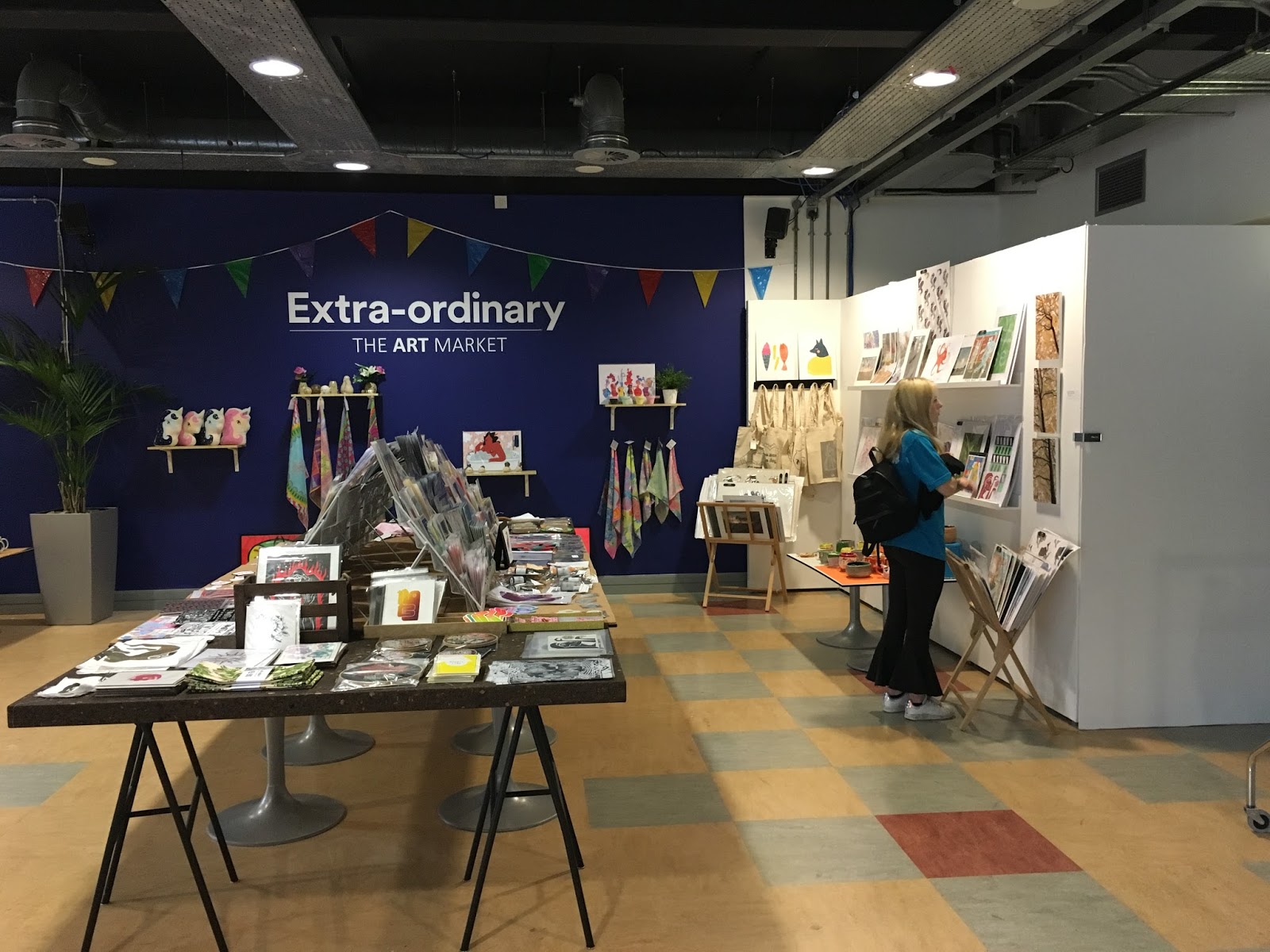
As I mentioned a couple of weeks ago (see this week 70 blogpost) ), the College holds an Art Market as part of the end of year show and I had decided to submit some work. It was quite exciting preparing for this. I took the best 5 prints of the gentrified office building (now titled 'Gentrification'), plus I decided to take the prints I did for the Manchester Metropolitan University (MMU) PGR conference back in February (see this week 58 blogpost) . I wrapped them in cellophane and they looked pretty professional. I decided to price the work for that particular market, especially as the College were not taking a percentage.
 
Prints packed and ready to go to the Art Market
 
Friday was the opening night of the show and of the Art Market. As mention below, I met Michelle beforehand and the Art Market was in full swing by the time we got there and met some of my fellow students. I was thrilled when the sister of one of my classmates bought a 'Gentrification' print plus one of the MMU prints. It made all that time in the print room seem worthwhile. 

On Saturday morning it was my turn to do a stint on the till at the Art Market and I was joined in this task by a student I didn't know but who was very pleasant and easy to work with. I'd not been there long when my lovely tutor, Sharon, appeared. She also bought a print of 'Gentrification' and I was secretly very pleased although I pretended to be tut at her! It was really interesting to see what people were buying - a real mix of stuff, it wasn't the case that one particular genre or medium was flying off the shelves. 
 
View of the Art Market - my prints are the green ones above where the girl is standing
 
I had a quick look when I went in for my tutorial today (more on this below) and could only find one 'Gentrification' and two of the MMU prints left – looking quite exciting!

Printing

After dropping off the prints at the Art Market on Thursday, I went back into the Print Room, and I was in there on Friday too. I’ve been doing some further work on the Burley drypoint (see this week 69 blogpost ). I worked further into the plate, to try to get some lighter and darker marks. Then I tried it drypoint with a painted monoprint on top. I experimented with mixing the coloured ink (cobalt blue) with a transparent ink extender to give a lighter background. This worked OK, as did variable inking of the background. However, most of my efforts at the painted monoprint were rather too indefinite, and the drypoint seemed to come too far to the foreground in the print.  On Friday I tried the transparent ink again, this time with a very high proportion of it, but it got quite sticky and difficult to work with. It did give slightly better results than the previous day, but I’m not sure if these are really two separate prints that I'm trying to put together. I don’t know where, if anywhere, this is going to go next. A possibility might be another drypoint plate as the foreground, or perhaps trying a different colour foreground or mixing some transparent ink into the black so the two layers might “equalise”.


Experimenting with inking the Burley drypoint

I also took the first prints of the aquatint of Royal Park that I was working on a couple of weeks ago (see this week 70 blogpost). There were supposed to be three tones within the print – it had been bitten three times after applying the aquatint solution - but it seems that all the tones had rather collapsed into one. After discussing with Mike, I put another liquid ground onto the plate and worked back into it to try to get some darker contrast into it. However, the result now looks rather too dark – I haven’t been able to get a satisfactory print and basically the plate looks over-worked. I was disappointed with myself but I can learn from this. Really I need to do a test strip beforehand for the aquatint and possibly print it at each stage, although the thought of all that stopping out fills me with dread.

 
The aquatint before I worked into it again - should've left it there!

Catching up 

As I mentioned above, I met Michelle beforehand to catch up with what's happening in her practice. As always it was a good conversation and we discussed opportunities. She had previously encouraged me to submit some of the work based on our dérive for the group show at Left Bank on the theme of 'Movement'. I showed her some of the work I’ve mentioned above and we talked about whether these would be suitable and how I could develop them.

Another catch up was with my tutor, Sharon, at my tutorial on 12th June. As ever, there was lots of food for thought. A large part of the discussion was around what I will submit, as the deadline is now only two months away. There was also a lot of discussion around the idea of the Royal Park aquatint as a journey. Further ideas were around embossing the paper on the Burley monoprint instead of having two layers of print. Much to do!

Tuesday, 30 May 2017

MA Week 70 - Professional Development, Printing and Conference paper


Reflection on the past week, 30th May 2017

I broke up from work for about 10 days on Wednesday 24th May – this was partly to do with my working days, with bank holidays, plus a couple of days off for the “Troubling Time” conference. My intention was to focus as much as I could on my practice in all its different aspects. I started even before I broke up – on Tuesday I sketched one of the photos from the mini-derive, which was made all the easier by my sketching the subject directly the previous day (see this week 69 blogpost) and etched it into a plate prepared with hard ground. I didn’t put too much detail into it as I didn’t want to waste time if it didn’t work – I was still wondering about my technique after the soft ground issues of the last couple of weeks. I zipped into the print room to etch it on Wednesday dinnertime and it seemed to etch OK, which was a relief.

Professional Development
I was straight back into college after work on Wednesday for an event about “Exhibiting your work”, led by Bryony Bond, the Creative Director of The Tetley in Leeds. Bryony gave a 10-point plan to holding a good exhibition. It was good to have the information presented in this way, and pleasing to realise that I probably would have thought of most of it anyway eventually, after years of working in business and organising events. As always, though, there were a few really good points to think about. One was Bryony’s assertion that you shouldn’t be afraid to invite big names from the local art scene (or indeed, the art scene further afield). Curators always want to see new, interesting art. Another was to go to every opening you can, get yourself known, and make as many connections as possible. Also – put on shows yourself and make them events, with artists’ talks and the like.

Another professional development event followed on Thursday morning, “The Art of Communicating”, an event by the Cultural Institute at the University of Leeds. This was led by Kerry Harker, the founder of the Tetley, now a freelance curator. I found Kerry’s style both engaging and accessible. As with the previous evening, I’d already discovered quite a lot of what Kerry talked about in dribs and drabs, but it was good to hear it presented consistently and with a strong message. And again, as with the previous evening, there were a few really important points. A particularly good one was to own, drive and manage your own practice and not compare it to the practice of others. As Kerry pointed out, you might wish you had another’s practice, but you don’t. So take your own practice seriously and move it forward.
There were also two other speakers who had graduated fairly recently and who talked about setting up collectives and starting to make art happen in the city. They gave some tips for getting funding and an insight into difficulties they’d faced. I’d already heard of some of the work of both of them and it was interesting to hear their side of things and also that they spoke honestly.

As always, I have quite detailed handwritten notes from both these events, and blogging about them makes me realise I should go back and undertake some of the actions that I promised myself I’d do immediately.

Printing
The thankless task of stopping out
After the morning’s event, I was straight over into the Print Room to start working into my latest etching. After taking a few prints, Mike helped me to spray a mixture on it that would allow it to aquatint, and I set to work with the endless task of stopping it out and biting it, which is still in progress.

I also had another go with the soft ground conundrum. I stripped back one of the plates that hadn’t worked last week and applied another soft ground, then drew onto it through greaseproof paper. I etched it for much less time than previously and I actually got something out of it – by no means perfect, but enough to give me more to go on.

Small steps forward, or going round in circles?
The plate hadn’t bitten deeply enough to give a proper print, but it did yield a couple of clues. There was a lot of foul bite on the surface, which I took to be where I had rested the circle stencil and my ruler onto the paper on top of the plate. The ground was also starting to come off in one corner of the plate, akin to what had happened the last couple of weeks. When I looked more closely, I realised this was where I’d handled it (even though I’d been really careful). So I concluded that the ground is much more fragile than I’d realised. Again, more experimentation needed, but a step forward.

Today, along with the endless stopping out, I’ve been pulling prints of the gentrified office building to put in the “Art Market” at the end of year show towards the end of next week. The idea is to do a variable edition of 10 and put 5 into the market.

Troubling Time Paper
The other main activity has been firming up the paper for the “Troubling Time” conference in Manchester, which is slowly taking shape. I was really struggling with getting it together earlier today and I knew that I needed to go for a walk, so I took half an hour and walked mindfully. This helped free up my thoughts considerably. I’ve always found a half-hour walk from work at lunchtime really beneficial for, quite literally, clearing my thoughts. I’d never realised it was so integral to my wellbeing, despite a lot of my art practice being walking-based.
Bank holiday weekend work!
Also for the conference, I have used some of my old monoprints to make postcard-sized business cards to hand out to other participants, particularly those who will (hopefully) create the visual work with me in my session. The cards look quite good cut up and in a pile on the table!


Tuesday, 23 May 2017

MA Week 69 - Pressing on with printmaking and Frances Morris talk


Reflection on the past week, 23rd May 2017

Pressing on with printmaking and Frances Morris talk

Developing the drypoint

I’ve developed my drypoint following the circles I etched with the dividers last week. As well as the dividers, I'd bought a circle stencil which proved ideal for drawing the circular shapes both on paper and ultimately on the plate. I sketched out a series of shapes from the mini-dérive, working to relate the shapes to each other and to balance the sketch with a variety of shapes and sizes. I also experimented with textures and shading, and was quite pleased with the result. I then flip-photocopied it and drypoint etched it into Perspex.  As always I found curved shapes difficult to draw - seems the trick is to move the plate rather than the needle.  The idea of this is to form an underneath layer of a two or three layer drypoint of the walk. It gave a reasonable result but I will probably work further into it to try to get a bit more variation in depth, following on from last week’s results. I printed it in blue (process cyan) as I wanted to take one of the colours of the walk, namely that of the railings outside the former Burley Library.
 
The shapes of the overlooked urban environment


Yesterday I went out at lunchtime and did a couple of very quick sketches which might act as a “top layer” to this plate. I’d drawn outdoors previously but taken quite a bit of time over each sketch. These were done quickly, and I was amazed at the amount of visual information you can get down within 5 minutes.
 

Houses; visual note
 
More soft ground troubles.

Following on from last week's experiment, I tried again with pressing plant materials into a soft ground. Last week I used an old plate that I'd acquired and stripped back. This week I used a similar plate plus a brand new one. I sanded them both back equally and cleaned them to within an inch of their life following my hunch of last week. However... still no joy. The ground still came away. So it isn't the plate, given I’d used an old and a new one, and it can’t be the cleaning either. It must be something to do with the preparation and/or the etching. More investigations needed.
 

“Troubling Time” conference paper

I've started to write the paper for the "Troubling Time" conference in Manchester on 1st June. I am going to introduce my research and my practice, then invite the participants to produce a visual work which "troubles time". This is based on the organisers' encouragement of contributions which “engage practically with their duration, with the aim of fostering methodological diversity”. I don’t know if people will engage with it, and it’s already pushing me out of my comfort zone, but that’s probably a good thing.

On a related note, I've just heard that the walking event scheduled for 1st June has been postponed for a couple of reasons. This is a shame but it does mean that I will be able to attend the whole day at the conference which will be good.

Frances Morris talk

Finally I went to an excellent talk by Frances Morris, director of Tate Modern, last night. She is a very engaging, interesting speaker and I learnt a lot about "behind the scenes at museums" from her Talk. I've summarised the points most salient to my own practice in this blogpage.


Monday, 8 May 2017

MA Week 67 - Two weeks for the price of one


Reflection on the past fortnight, 8th May 2017
 
I’ve just realised that I’ve lost count of the weeks somewhere, and that I was going to end up having 81 weeks in an 80 week course, so I’ve combined the past two weeks. I’ve done quite a lot, too.
 
Sketching and etching
I did a final sketch of St Paul’s (see also this week 65 blogpost) which still wasn’t brilliant, but allowed me a further chance to play with perspective. I don’t know why I found it so difficult; possibly it was because I was trying to alter the perspective from the photo I was using. Next day I transposed it to one of the little copper plates and worked on this for a couple of days. It still wasn’t a brilliant drawing, but the etching worked and I got some prints out of it. I used the needle with the slanted edge (I think it’s called an echoppe) which worked well when making curved shapes. I also used a roulette wheel to give some texture to the blossoms and leaves and I was surprised by how deeply it bit. It took so deeply in relation to the etched lines that I didn’t think they had bitten. I imagine I probably dug too far in with the wheel.

One result of this was that the blossoms were obscured. I thought about drypointing them in, but Mike suggested regrounding, re-etching and re-biting the plate. This seemed like a good way to learn about multiple grounding. I used liquid hard ground again and the resulting re-work certainly gave more definition. However there was a lot of “foul bite”, with dots here and there. I then realised I’d not cleaned the plate before re-grounding, so presumably there were dots of grease that resisted the ground. Possibly not ideal, but a lesson learnt. Also the dots gave some texture, so possibly a slightly happy accident.
 
Springtime St Paul's
 
I had intended to grind this off the plate and do a completely different design, but I’d learnt so much from this little plate that I’ve kept it, for now at least.
 
On Saturday and Sunday I attended the “Etching Weekend” at the West Yorkshire Print workshop in Mirfield. It was excellent. I worked with two images; a photo of Assisi I’d taken on holiday a few years ago, which I knew would work up into different areas of tone, and an image of some tulips from my mini-dérive with Michelle.  
On the Saturday we prepared and etched a hard ground plate, for which I used the Siena image. I’d already practised a lot of this technique but I learnt a lot of hints and tips. We also prepared a soft ground plate. It was really interesting to see the nuances of different workshops. 
On Sunday we started with the soft ground plate, into which I pressed some plant materials that were just growing outside the window. I then traced the photo of some tulips into the ground. I was surprised how dark and crayony the marks bit; the soft ground is very fragile compared to the liquid hard ground I’ve been using in college.
 
Assisi aquatint
 
The next stage was aquatint, and I decided to aquatint both plates. Our technician, Kate, applied the actual rosin powder but I would like to learn how to do this. I’d worked out the tones I wanted for the Assisi print and it was a bit tedious applying the stop out varnish to achieve this, not really knowing what the outcome would be. I was very pleased with the result considering it is a first effort. It printed rather too dark but Kate showed us how to adjust the transparency of the ink to allow lighter-toned printing.
 
Sepia tint tulips
The plant material images and the heavy drawing marks of the tulips don’t necessarily belong on the same plate, but they don’t look too bad together and this serves as a really good test/ideas plate for future soft ground use. Kate helped me to print it in colour. I would have liked to have picked her brains further on that point, but time didn’t permit. All in all an excellent weekend.
 
 A moan retracted
 
I mentioned in this week 63 blogpost that I’d submitted a conference abstract and heard nothing. It transpires that an email must have got lost somewhere in the ether as it had been accepted! This caused a panic as the conference had been extended to two days and my panel clashed with the walking event with Zoë and Lynne. Fortunately the organisers were mighty accommodating and have moved my panel to the morning so I can do both events. So that’s a paper to write added into the plan then!
 
Otherwise…
 
I was away over the weekend, which was great, so other than that I’m desperately trying to catch up with my creative journal. It’s good reflecting back with the benefit of hindsight but I really wish it was a bit more up-to-date!