Showing posts with label art. Show all posts

Monday, 17 July 2017

MA Week 77 – “Movement” Group Summer show at Left Bank Leeds


 “Movement” Group Summer show at Left Bank Leeds, 12th - 15th July 2017

The highlight of this week was the "Movement" group Summer show at Left Bank Leeds. The opening night, on Wednesday 12th July, was buzzing and it was really lovely to be supported by a number of classmates and other friends who attended during the evening. The show was also open Thursday - Saturday inclusive, 10 am - 4pm, and in total there were over 300 attendees. This is the only annual group show at Left Bank, and it is a prestigious one within the Leeds art scene. Although the gallery space is fairly local to me, the show itself was national and included established artists such as Ian Kirkpatrick (now Leeds-based, work in many national collections), Michelle Harrison (Manchester-based painter, illustrator, has exhibited internationally, artwork on the flyer) and Jelena Lunge (York-based illustrator, has exhibited internationally, work exhibited next to mine). For me, this was my first major step in establishing myself in the Leeds art scene.

 
"Royal/Library" series of prints exhibited at Left Bank Leeds, 12.07.2017

The venue is a former church which is used as a multi-disciplinary arts venue, and this interesting space lent itself well to this kind of show. My prints, "Royal/Library" - series of 4,  were displayed in an alcove, which gave the work its own space and allowed it to “breathe”. This led to an interesting interplay with work in the neighbouring alcoves. There were 4 alcoves on "my" side, which alternated works in colour with works in black and white, and this gave a nice rhythm to the exhibited works. There was also a rhythm to the frame colours - my frames were white, whereas others had gone for black or a mixture. My prints were hung in a series of 4, rather than a quadrant - all the series were hung this way - and they were hung from a batten with string. This hanging technique was used in all the alcoves and gave a consistency and narrative to the works. The rhythm was also reflected across the building, to the works on the opposite wall, which were hung similarly. My own prints, mainly orange and red, were contrasted in the opposite alcove by some lovely illustrations based on the sea, mainly in blue, black and white. As well as the alcove space, the main body of the former church had been divided up using display cabinets. These formed a kind of "zones" within the space and also led to a natural circulation of people.

 
Opening night - visitors viewing my prints (alcove behind settee)

The exhibition was curated by Courtney Spencer, a director at Left Bank, and it was interesting to see how Courtney had ordered my prints. I would have done it slightly differently, and this is one of the joys of having someone else display your work - the other person sees something else in it. The exhibited works covered various genres: paintings, mixed media, sculptures, videos, textiles and even performance pieces - I think mine were the only prints which is gratifying. There was a great deal to take in given the variety of the work, and I am still processing a lot of it in my head. Rather than try to document it all here, I think some of the influences will intuitively work through into my future practice. However, I will mention a couple of particular favourites: “Bookworm”, a tubular sculpture made from books by Sarah Binless, whom I met , and those sea illustrations by Sarah Louise Hawkins.  The curation was excellent and it was great to make contact with Courtney.
Left Bank Leeds, exterior view

Left Bank is a wonderful space and I went back on the Saturday with Michelle, who originally suggested I apply for the show. It was good to see the show when it was a little quieter and there was more space and time to take it in. I can feel the space luring me back and I would like to volunteer there, perhaps to do some invigilation, when the MA is over.

Having work in the show felt unbelievable, a real achievement, and it takes my work to the next level. It was exciting for me to see it to see it displayed alongside other artists' work, forming a dialogue, and this led to an emerging sense of myself forming a dialogue with other artists. The show was over all too quickly but I will definitely apply next year.


Monday, 12 June 2017

MA Week 72 – selling work at the Art Market and looking ahead to hand in


Reflection on the past week, 12th June 2017

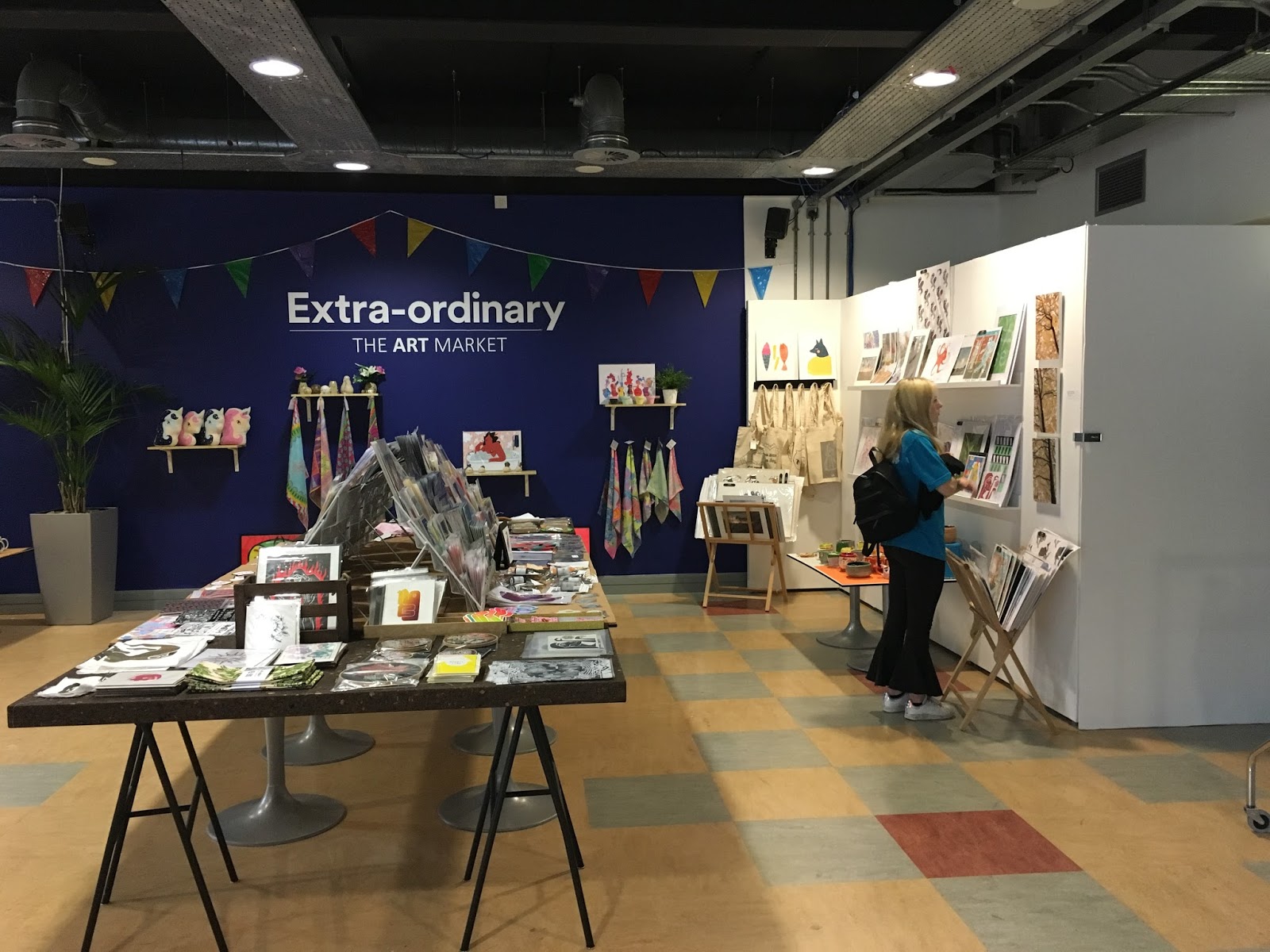
 The Art Market

As I mentioned a couple of weeks ago (see this week 70 blogpost) ), the College holds an Art Market as part of the end of year show and I had decided to submit some work. It was quite exciting preparing for this. I took the best 5 prints of the gentrified office building (now titled 'Gentrification'), plus I decided to take the prints I did for the Manchester Metropolitan University (MMU) PGR conference back in February (see this week 58 blogpost) . I wrapped them in cellophane and they looked pretty professional. I decided to price the work for that particular market, especially as the College were not taking a percentage.
 
Prints packed and ready to go to the Art Market
 
Friday was the opening night of the show and of the Art Market. As mention below, I met Michelle beforehand and the Art Market was in full swing by the time we got there and met some of my fellow students. I was thrilled when the sister of one of my classmates bought a 'Gentrification' print plus one of the MMU prints. It made all that time in the print room seem worthwhile. 

On Saturday morning it was my turn to do a stint on the till at the Art Market and I was joined in this task by a student I didn't know but who was very pleasant and easy to work with. I'd not been there long when my lovely tutor, Sharon, appeared. She also bought a print of 'Gentrification' and I was secretly very pleased although I pretended to be tut at her! It was really interesting to see what people were buying - a real mix of stuff, it wasn't the case that one particular genre or medium was flying off the shelves. 
 
View of the Art Market - my prints are the green ones above where the girl is standing
 
I had a quick look when I went in for my tutorial today (more on this below) and could only find one 'Gentrification' and two of the MMU prints left – looking quite exciting!

Printing

After dropping off the prints at the Art Market on Thursday, I went back into the Print Room, and I was in there on Friday too. I’ve been doing some further work on the Burley drypoint (see this week 69 blogpost ). I worked further into the plate, to try to get some lighter and darker marks. Then I tried it drypoint with a painted monoprint on top. I experimented with mixing the coloured ink (cobalt blue) with a transparent ink extender to give a lighter background. This worked OK, as did variable inking of the background. However, most of my efforts at the painted monoprint were rather too indefinite, and the drypoint seemed to come too far to the foreground in the print.  On Friday I tried the transparent ink again, this time with a very high proportion of it, but it got quite sticky and difficult to work with. It did give slightly better results than the previous day, but I’m not sure if these are really two separate prints that I'm trying to put together. I don’t know where, if anywhere, this is going to go next. A possibility might be another drypoint plate as the foreground, or perhaps trying a different colour foreground or mixing some transparent ink into the black so the two layers might “equalise”.


Experimenting with inking the Burley drypoint

I also took the first prints of the aquatint of Royal Park that I was working on a couple of weeks ago (see this week 70 blogpost). There were supposed to be three tones within the print – it had been bitten three times after applying the aquatint solution - but it seems that all the tones had rather collapsed into one. After discussing with Mike, I put another liquid ground onto the plate and worked back into it to try to get some darker contrast into it. However, the result now looks rather too dark – I haven’t been able to get a satisfactory print and basically the plate looks over-worked. I was disappointed with myself but I can learn from this. Really I need to do a test strip beforehand for the aquatint and possibly print it at each stage, although the thought of all that stopping out fills me with dread.

 
The aquatint before I worked into it again - should've left it there!

Catching up 

As I mentioned above, I met Michelle beforehand to catch up with what's happening in her practice. As always it was a good conversation and we discussed opportunities. She had previously encouraged me to submit some of the work based on our dérive for the group show at Left Bank on the theme of 'Movement'. I showed her some of the work I’ve mentioned above and we talked about whether these would be suitable and how I could develop them.

Another catch up was with my tutor, Sharon, at my tutorial on 12th June. As ever, there was lots of food for thought. A large part of the discussion was around what I will submit, as the deadline is now only two months away. There was also a lot of discussion around the idea of the Royal Park aquatint as a journey. Further ideas were around embossing the paper on the Burley monoprint instead of having two layers of print. Much to do!

Wednesday, 2 March 2016

MA Week 20 - Heritage Show + Tell Presentation


Heritage Show + Tell Presentation - 1st March 2016 

Well, how DID I get here?
My submission for the University of Leeds's "Heritage Show + Tell" was accepted and I was pleased to be able to present my research and practice to their audience. The Heritage Show + Tell exists to showcase aspects of heritage in Yorkshire, particularly research, learning and outreach. The idea is that you talk for three minutes with three slides. There are 5 or 6 speakers and afterwards everyone mingles and chats over wine and twiglets (yes, really). 

I spoke on the theme "How did I get here? Using heritage for creative practice". I explained the three strands of research by creative practice: 
  • Research through practice - producing visual outcomes. I mentioned my twin narratives of identity and industry and showed visual pieces relating to these. 
  • Research into practice - articulating the theory that underpins your practice. Here I mentioned Harrison's theory that heritage is based on people, places and objects, and how I have these three things: myself, my foremothers and forefathers; my place in Leeds and Yorkshire; and my manufactured industrial objects. Therefore my practice is underpinned by a theoretical perspective of heritage.  
  • Research for practice - I showed images of my generative wandering to Armley and talked through these. I went past my birthplace, "found" a mill which brought into play textile heritage, saw used and derelict factories, photographed the Armley gasometer and spent time considering the railway which brought power and prosperity to Leeds.
Third slide

On my third slide, I showed some of my responses to the wandering and invited people to chat to me afterwards.
 
I said most of what I wanted to say, but was hit by a technical hitch partway through the second slide. The animation of my 5 images started ok and 3 appeared, but the other 2 didn't. A bit of clicking backwards  and forwards brought up the full 5 images, but a similar problem beset the final slide. This threw me although I tried not to let it show. I essence I had broken my cardinal rule; never present without first running through the slides on the kit you're going to present on. I just hadn't been able to do that.  The Show + Tell was talking place in a new venue and the organisers were having problems even getting the presentations onto the kit. It was a "smart screen" so the control was through the "projector screen" on which the presentation was running, so there wasn't even a PC to get to, to take the animation off. A lesson learned - don't put animation into slides unless you know the venue you'll be presenting at!

The audience for this particular evening was a bit different to previous audiences. There were not so many students - there are often a lot of MA students from the University of Leeds - and more members of the public. I had a good chat afterwards with Elaine Evans, another of the presenters, who teaches Fashion at the University of Leeds. We were talking about the longevity of clothes from the 1960s and 1970s and the throwaway culture of today. I also talked to another lady from Leeds City Council who likes trains and architecture and she showed me some fab pictures of Budapest bus station that she'd taken recently - brutalism and yellow buses! She also said she thought my image would weave up into a nice teatowel. That gave us all a laugh.

This was a good experience for me. It moved me away from my work persona and placed me as an art student. Another presenter kindly videoed me on my phone and I have reflected on the event. It was a first step back on the way to public speaking and as such I think it was positive. I can learn not to put animation into my slides (which is something I always do, to try to keep audience interest). I would like to be able to present a poster or short paper next, so I need to keep any eye out for opportunities to do this. I really enjoy the Show + Tell. It's always a really interesting and entertaining night and I was glad to give something back to it.

Tuesday, 9 February 2016

MA Week 16 - Heritage as a critical perspective (1)


I have been wrestling for a while now with this idea of my critical perspective, and to try to make some sense I got a couple of likely-sounding books from the library, then left them in my bag while I got on with exciting stuff like printing and painting. I’ve had a recall for one and so last night I sat down to skim read it with a view to copying the most important bits. In the end I read the first two chapters, not in their entirety, but closely enough to make me realise this is an important book for me. 

The book is “Heritage : Critical Approaches” by Rodney Harrison and it has given words to some of the things I’ve been doing creatively. To find this academic validation of what I’m doing has been a joy, a relief and a boost to my creative confidence.  Below is a synopsis of what I consider to be the most pertinent points of what I’ve read, and a discussion including how I think it speaks to my practice follows here. Whilst I hope to read more of the book over the coming weeks, I think Harrison’s introduction to his approach in the first two chapters gives me a grounding that that stands for itself. 

Synopsis of pertinent points from "Heritage : Critical Approaches",
Chapters 1 & 2

Heritage, argues Harrison, has proliferated as a result of “the process of globalisation, deindustrialisation and the rise of the experience economy”, but it remains a “broad and slippery” term that can cover buildings, monuments, memorials, songs, festivals, languages and so on (pp4,5). He sees it not as object-based, but rather as “dialogical” – heritage emerges from the relationship between people, objects, places and practice. It therefore involved in the production of local, regional and national identity (p8). Harrison’s view does not distinguish between “natural” and “cultural” heritage, but he does distinguish between “official” heritage – e.g. the archaeological significance of Stonehenge – and “unofficial” heritage – e.g. the use of Stonehenge for festivals by neo-pagans (p15). The “unofficial” is really used to describe people’s attachment to a place, for whatever reason that might arise. Heritage refers to set of attitudes and relationships with the past – relationships that need to be formed and maintained (p14). However, it is not primarily about the past – it is created in the present by sifting the past and using it as a perspective to view the present and to inform the future (p4).

So why the surge of interest in heritage?  Culture and traditions only seem to become “heritage” when they are at risk. Heritage has not traditionally concerned itself with the “everyday” unless it is at risk of loss, when it becomes more remarkable. (p 18). Harrison suggests the surge is down to modernity, which he defines as a kind of social order that looks to the future and is concerned with novelty, progress, and speed, and which takes a linear view of time (so we are always moving away from the past). The speed of change means there is always a threat to the present. If Harrison’s idea of “risk” is correct (and it seems reasonable to me), then the past is always at risk and starts to become heritage; the speed of progress leads to obsolescence and nostalgia (p23-25). So heritage concerns itself with a loss of or threat to objects, places and practices that hold a collective value.  Further, modernity is inherently disordered due to the rate of change and so heritage seeks to impose a structure or classification on items, such as is done in museums. We structure and restructure the past. 

Harrison also introduces various further ideas. The two most relevant to me are:

“Agency”, where he believes that “collectives” of humans and non-humans interact to make heritage. Humans use non-humans to do their will; humans invent objects to do their will (Agency is evidently not seen as an act of individual will). Different agencies can mix, merge and interact in many different ways (p 33/36) 

Similarly, “Symmetrical archaeology” is concerned with the entanglement of humans and things. It suggests the past is actively created by archaeologists. Harrison expands this to include all other disciplines involved in heritage studies, to purport that heritage is a product of not only the human imagination, but the entanglement of humans and objects, pasts and presents.(p 37/38).

Sunday, 6 December 2015

MA Week 9 - Artist Research : Stuart Whipps


Stuart Whipps, "The Kipper and the Corpse" (2015), installed at BAS8, Leeds Art Gallery
 
Stuart Whipps has come onto my radar via his piece in the British Art Show 8 (BAS8), “The Kipper and the Corpse” (Leeds Art Gallery (2), 2015). It is the carcass of a mini built by British Leyland in 1979, the year Margaret Thatcher came to power and the year Whipps was born. Whipps’s work explores the “slippery relationship between memory and truth” (Leeds Art Gallery (1), 2015) and as such I feel it relates to some of the work I’ve done on de-industrialisation – pulling from my own memories. I had quite a strong emotional reaction to this piece; it reminded me of what my family went through with the de-industrialisation of Leeds. There was a sense of emptiness, starting into the shell of the car… where had it travelled to? What had gone on inside it? Who owned it? A stark monument to the Thatcherite chapter of our collective history. Whipps intends to restore the Mini with the help of ex-Longbridge employees as BAS8 tours over the next year.

The piece is the third part of a series of works which investigate the demise of the Longbridge motor works in Birmingham. For the first part, Whipps photographed the plant between 2005 and 2008, and also travelled to Nanjing in China to photograph the motor company that had bought the property rights from MG Rover. (Colin & Yee, 2015, p 120)/

The second chapter was exhibited at the “East International” exhibition in Norwich in 2009. This included photographs of the recently closed plant and archival documents including “text pieces that use the cumulative word counts for all of Margaret Thatcher’s Speeches, Interviews and Other Statements between her election in May 79, and the sacking of Derrick (Red Robbo) Robinson at British Leyland in November 1979. They are presented by the categorisation method utilized by the Margaret Thatcher archive”. (Whipps. S.,(1) n.d.). Herbert (2009, p329) also comments on the inclusion of a script from an episode of Fawlty Towers, mentioning striking car workers– the name of the episode gives its name to the current piece.  Herbert considers the 2009 piece underlines and opposes the Thatcherite line of de-industrialisation’s inevitability and affirms the move to a post-industrial economy.

All three chapters in this series seem to resonate directly with me. One of the first pieces of practice I undertook concerned the de-industrialisation of the UK and the rise of China as a superpower. The piece I produced commented on the loss of industry in Yorkshire in particular, and the vigorous and bullying rise of Chinese imported goods. The saddest thing to see on the Mini carcass was the British Leyland works plate next to the museum exhibit number. British industry now only exists as some memory in the Museum space.
 
How are the mighty fallen
 
Another piece of work by Whipps which deals with archive and memory is “Birth Sprse in Peckham. Latham was a Zimbabwean-born British experimental artist who was concerned with processes, and the recording of sequences of events and patterns of knowledge (Stiles, n.d.).  Whipps investigated Latham’s archive and interpreted it as a fragmented display, including an animation of text from books in Latham’s collection, which he made during the exhibition itself (Street, 2013). Whipps deliberately disturbed Latham’s archive by collapsing together the various events and their representations. (Whipps. S.,(2) n.d.).

In all these pieces of work, Whipps is taking archival material –photographs, documents or a car – and re-interpreting it. He builds upon the memory, but he also re-works it, and so by implication distorts it. He gives his own viewpoint; it’s not his own lived experience, he is giving his version of someone else’s history. He is often creating randomness from order, as with Latham’s archive and the archival documents in the East International exhibition. He also makes works in progress ; the restoration of the Mini, the animation of Latham’s books. Here I believe he is creating new experience – something existing, viewed differently – and thereby new memories.


Tuesday, 24 November 2015

MA Week 7 - facts and figures


Some relevant facts and figures

 
Bob & Roberta Smith discussing the value of the arts to the economy
at Creative Networks Event, Leeds College of Art, May 2015

As part of my research for my “Professional Context” presentation, I’ve been looking at what the “Creative industries” actually comprise and how much they give to the economy.

Origins of the term “Creative Industries”

The term “Creative Industries” actually comes from the government of Tony Blair. This government identified these industries as important to the economy, and brought 13 sectors together under the umbrella of “Creative Industries”. Digital technologies were seen as a particularly important facet. The approach combined “new labour” modernisation with some “old labour” cities. Blair wanted to find a concept in which the UK could still be identified as a world leader in the UK’s post-industrial age. However, some of the traditional Labour-held cities had already moved culture to a central part of their economy once traditional industries had declined. Sheffield and Manchester are examples of this (interestingly, Leeds isn’t mentioned – but here we moved to a financial sector economy). The concept of Creative Industries was exported to other countries and is seen as a successful marketing exercise for the UK. (Flew, 2012, pp9-15)


USA

I chose to look at the USA because their cultural capital is so large. America boomed post-war and their culture now permeates the whole of Western culture, and possibly (probably?) world culture. Think of American movies, music, fashion, food. Yet in spite of this they have no national creative industries policy. Some funding is available via the National Endowment for the Arts but the sector is strongly reliant upon private philanthropy. Another factor is the strength and power of the commercial entertainment sector (Flew, 2012, p 40). However, the NEA, established by congress in 1956, does partner with the state and federal agencies and the philanthropic sector to support and promote access to arts and culture for all Americans (National Endowment for the Arts (1), n.d.). It awards grants to organisations which meet its aims up to the value of tens of thousands of dollars (National Endowment for the Arts (2), n.d.).

Despite no national creative industries policy, Flew (2012, pp 40-41) identifies the expansion of cultural activity in some American cities as the idea of arts and entertainment quarters aimed at attracting creative practitioners to live and work in the city. Flew quotes a text by Florida which influenced urban policy and cultural planning to take up the idea of “creativity strategies”. This meant that city planners began to actively seek to promote the “three T’s” of technology, talent and tolerance to cause creative practitioners to work, live and contribute to the economy of their city. Seattle, Austin and Boston are amongst examples quoted of cities with strong, dynamic creative economies.

The US does have an organisation that lobbies on behalf of the arts, “Americans for the Arts”. Their aim is to lead and to bring together organisations and individuals who promte and support the arts such that all and any Americans can access culture and the arts. Any individual can join and their website is full of information about how to lobby for the good of the Arts.

The US definition of creative industries does not include the commercial entertainment sector (Flew, 2012, p 39). However, the industry is still healthy. According the the NEA,
(National Endowment for the Arts (3), n.d.), in 2014 the creative industries sector was worth $698bn (£459bn), equivalent to 4.3% GDP.
 

Italy

Italy is clearly another country whose culture has had a profound effect on the world. Think Italian couture, Roman Catholic church, Roman monuments, Renaissance artists.

Traditionally there has been public funding for heritage, music, theatre and the like, initially provided centrally, but more recently provided less centrally and more via the regions and local authorities (Compendium, 2015, (1) & (2)). However, with the pressure on public finances, the state has increasingly turned to the private sector for help. This has resulted in sponsorship of renovations by private companies. For example, the luxury leather goods manufacturer Tod’s has given £20m for the restoration of the Colosseum. This gives them the right to have their logo on the tickets for a period of time, and to associate the Colosseum with their branding. This engagement with the private sector has yielded funding for a variety of projects (Fendi are sponsoring the Trevi Fountain restoration, for example), but also friction as there is a view that Italy is simply selling its massive cultural heritage to the highest bidder. A further complication is the active solicitation of foreign sponsorship, e.g. “a preliminary agreement with Saudi Arabia to fund the restoration of the Mausoleum of Augustus” (Faiola,2014).

The Italian creative industries sector figures for 2011 show it adding €95bn to the economy, about 6% of GDP (Forum D’Avignon and Tera Consultants (2014); Italian National Institute of Statistics (2012)), but I don’t have a further breakdown of this. However, it seems healthy in its own right.
 

UK

The UK has also given its culture to the world: the British Empire, Beatlemania, Britpop….

Centralised funding comes from the Department for Culture, Media and Sports via Arts Council England (for England, at least). ACE’s mission is “Great Art and Culture for everyone” (Arts Council England (1), n.d.); they support organisations that facilitate public access to arts and culture of different genres – music, art, theatre, museums etc. The latest funding round shows a significant cut : for 2012-15, ACE distributed £1.4bn of public money and £1bn of National Lottery money. For 2015-18, the figures are £1.1bn of public money and £700m National Lottery (Arts Council England (2), n.d.).

To quote Dr. Ben Walmsley of the University of Leeds, “Art fundraising is in an exciting state of flux. Are we ready for change?” (Walmsley, 2015). Whether we are ready or not seems irrelevant as change is what is happening.  Walmsley goes on to say that arts organisations need to “stop appearing to be needy” and to become embedded in their communities. In other words, they need to get business savvy PDQ. In fact, ACE has inaugurated the “Arts Fundraising and Philanthropy” programme to “transform funding” (Arts Fundraising and Philanthropy (n.d.)) and to “develop an enterprising culture in which income generation is placed at the heart of an arts organisation’s business model and ethos” (ibid).

All this said, the UK creative industries sector is still doing well, generating £76.9bn of value equivalent to 5%GDP. I was quite surprised to find out that 46% of this is from software and games – a sector that didn’t really exist 30 or 40 years ago - and only about 7% from music, arts and culture – which is where I would position myself. (The Creative Industries (n.d.))


Leeds

Leeds has given some culture to the world – textiles, Hepworth, Moore, the Kaiser Chiefs (??) – and is bidding to become Cultural Capital of Europe in 2023. But the funding situation reflects that of ACE. In 2012-15 Leeds City Council had a funding pot of around £3m per year for the arts. By 2017-18 that will have been cut to around £2.5m per year (Yorkshire Evening Post, 2014). Most of the funding is distributed to arts organisations (Leeds City Council (n.d.)), to allow citizens to access the arts and culture. However, through further investigation I realised they also fund “Leeds Inspired”, which I’d hitherto only known by its website, and they do small grants of £100 - £1000 to individuals to support artistic activities, such as exhibitions. However, you do have to have a track record of delivery. (Leeds Inspired (n.d.))
 

Discussion

This has been quite a time-consuming but interesting investigation. There is a welcome theme of organisations that support the arts in all the places above, showing that even in these times of financial constraint, at least some importance is still attached to the arts. I do think, though, that the situation in Italy – turning to the private sector – is going to be reflected across the piece. The Arts Fundraising and Philanthropy initiative is, I suppose, a necessary evil in England, to ensure that the arts can remain vibrant across the country. I think we will see more and more of this as the Conservative government squeeze public services further. As the “creative industries” was a Labour invention, it will be interesting to see if the Conservatives actively decide to undermine these sectors.
 
The creative industries seem to be holding their own, even growing in the UK. This, again, is welcome news as it implies the sectors are maturing and established. I was a little concerned to see how much the UK sector relies on the Software sector. I’m not sure if the proverbial man on the street would quote software as part of the creative sector. I wonder if its inclusion in the figures obscures the fact that the “traditional” arts sectors are perhaps not doing as well as they might.

Anyway, on the basis that I am unlikely to be applying for funding abroad any time soon, it was interesting to find out about the Leeds Inspired small grant scheme and it does give me a glimmer of hope. I used to write and critique business cases in a previous life so that “transferable skill” may well come in useful again. I think my next steps need to be to continue my networking strategy, to step it up in fact, and to start to get some creative work done. Then I can see where I fit into the  Leeds scene. Aligning myself with one of the established organisations here, say perhaps volunteering for East Street Arts or similar, would seem to be my best bet to get experience which could help me get funding. I need to develop these ideas into more concrete plans as I progress with the course.


Wednesday, 28 October 2015

MA week 3 - researching research methods


Research Methods – initial investigations

I was fortunate enough to find a book entitled “Research Methods in Education (Cohen et al) which introduces different methods in bite-size, digestible chapters. A quick browse through yielded two methods which I think are currently relevant: Grounded Theory and Action Research.

Action Research is described thus “ the combination of action and research render that action a form of disciplined, rigorous enquiry, in which a personal attempt is made to understand, improve and reform practice” This method involves problem-posing as well as problem-solving –so there has to be some definition of the problem beforehand.  (Cohen et al, 2011, pp 345-346). Approaches can vary from “scientific” to self-reflective enquiry; however, “The goal of action research is improvement” (ibid, p358).
 
Action (acrylic test piece, 2013)
Research
 
I understand this as follows: if I pose myself an investigative question – such as “how do acrylic media behave?”,  then I can undertake an action regarding this – paint a test piece – and then write a reflective summary – the research. My reflection then feeds what I do next, which may be further tests, or the question may be sufficiently answered that the practical experience gained can be used in a resolved piece.

Grounded Theory states that the theory emerges from the data, rather than vice versa. It holds that patterns and theories are implicit in the data, waiting to be discovered. The theory is emergent rather than pre-defined and tested. In rigorous use of grounded theory, data is coded and presently central themes (or codes) emerge. Presently a core variable or category emerges, which is one to which most categories are related. When using grounded theory, you have to be able to tolerate uncertainty and avoid premature conclusions (ibid, pp 598-603).

As I’ve been examining my practice ahead of giving my presentation on my theoretical context, I have effectively been using a version of this. If I consider that my pieces of work are my data, I have been informally reviewing them to group them together. I have identified three “meta-narratives” (heritage, identity and process theory) and these could effectively be classed as the “core categories” derived from the “data”.


Cohen, L., Manion, L.,& Morrison, K. (2011) Research Methods in Education. Abingdon, Routledge.

MA Week 3 - The curse of academic reading


Reflection on taught session, Friday 16th October 2015

Understanding and critically analysing academic papers


The afternoon was heavy going. We had been asked to read and annotate a paper by Peter Dallow regarding practice-based research in the creative arts. I’d dutifully done this and had nearly lost the will to live part way through. This is not a criticism aimed solely at Mr Dallow, should he ever read this. Rather it is a reaction to the fact that I find academic papers – particularly social science-type papers- very verbose. I am used to brief business documents and academic papers seem to repeat the same things again and again, although I acknowledge that that may be highlighting nuances beyond my grasp.

The nub of Dallow’s paper appears to me to be that practice-based research – as opposed to practice – has to have an element of considered, written introspection and reflection in order to demonstrate the originality of the way in which the artist has engaged with their materials and produced an outcome. To be honest, it made me ask the question, “why do we have to write in response to art?” Why can’t we produce another piece of art, or a song? Why can’t we, for example, make a series of images that show development of thought/technique prompted by the article? However, the article contained an interesting quote (which cites Frayling, (1993, p5)) that “creative work is ‘as much about autobiography and personal development’ as it is” (Dallow, 2003, p60).

Some fellow students and I analysed one quote from the article regarding the differences between practice and practice-based research (Dallow, 2003, p53). We concluded that supplying a product to a client constitutes practice. Even if you have to learn something new along the way – for example, a new software package – this is not really research, more a means to an end of getting a tool for the job. This, though, raised the question of whether something might be known to others in the world, but might be ground-breaking for you personally. Also, you might do something within your comfort zone, but that might push others’ boundaries. In that case it could be classed as practice-based research (in our opinion).

I told my classmates that the article had got me quite mad with its excessive verbiage, so they suggested I should cut it up and put it together in a different way so it made totally random verbiage.  This then led us to all get a bit edgy about how we felt about cutting up books… earlier that day I’d been pondering the idea of the tension between archive (keeping stuff) and declutter(being able to move in your own house), and now another tension. Here’s me thinking creatives are not academics, then none of us were totally comfortable with the desecration of a book. We need to push our boundaries big-style.

Some general conclusions from the session: 
        
·         Practice-based research should be innovative, risk-taking, and push you out of your comfort zone.
·         Practice-based research must disseminate information/processes as well as producing a finished product (this is repeatedly stressed as important)
·         The audience and context are part of the research, not just the end product
·         Practice-based research is cyclical and reveals something new to you, possibly about yourself


MA Week 3 - Heritage, Memory and all sorts of interesting stuff


Reflection on taught session, Friday 16th October 2015

Creative Practitioner Presentation

Today it was Sharon’s turn to take the first session. I found more in common with her practice than with Annabeth’s from last week. Sharon is a milliner, which I’ll never be, but she is very interested in textiles, and with that, the “heritage” or “memory” aspect. Sharon also has a background which encompasses subjects other than art, and she described how she had sometimes felt “on the outside”, which I’ve felt a few times already during this course (but am working to overcome).

Sharon introduced the idea of using archives and museum resources to investigate narratives from the past. She illustrated that different views (lives) can give rise to different narratives, e.g. millworker vs millowner. This highlighted to me the difference between my narrative of de-industrialisation and Simon Fujiwara’s narrative for his “Aspire” piece produced this year (on display outside the new University library). According to the information board in the University Art Gallery, he views the de-industrialisation as a positive move, moving Leeds away from its dirty past into the “new, post-globalised urbanism”.

Sharon also indicated the importance of considering how your practice relates to that of any given institution – or indeed, how you make it relate – and how that could give rise to opportunities for collaboration. She presented information about students going into a mill, and how eventually students and millworkers began to educate and inform each other. The collaboration helped both groups. Again I need to let this play over in my mind. If I am producing pieces that relate to heritage, is there some opportunity here?

We viewed a film about the pioneering art educator, Tom Hudson, who went to Brazil where he tried to help people express themselves through art when they were suffering from the repression of the political situation there in the 1970s. The film was made by his estranged son using archive material from the NAEA – so once again an illustration of different narratives.

I hadn’t thought of accessing archives (e.g. Yorkshire Archive Service perhaps?) as part of my project, as I feel my own lived experience keeps providing me with enough source material to keep me going, but now I need to let the question of expanding my practice into enquiring into others’ lives play over in my mind. This also raised the ongoing issue of the narrative of your own memory. If you create works from your own past, whether from objects or simply from your own memories, does this start to create another narrative as you re-examine your memories? I think it probably does, and on top of that there is going to be plenty of potential for other narratives if people view and react/respond to your work.

Finally we examined some museum artefacts that had come from the Whitworth Museum in Manchester. They had come without any documentation as to their provenance. We examined some babies’ bonnets and a beautiful embroidered scarf and tried to identify any clues about where/why/for whom they might have been made. The idea of different narratives was underlined when I said I thought the exotic church, birds and houses on the scarf might indicate it was (from? a representation of?) Mexico, and my classmate thought it was from Turkey. We are, I suppose, constantly reimagining our past, and probably our present too. We assign new perspectives to old objects. We look at ads from the 1970s and think they are ridiculously outdated in their portrayal of women. We watch old 1970s comedies and can’t believe how politically incorrect they are. But life wasn’t bad then. Did we just take ourselves less seriously? Perhaps a little of that, although I know I have a feminist streak from growing up at that time and the dominance of the male world-view.

The more I write here, the more interested I am in all this about memory and reimagining and narratives. I think it already appears in my practice and probably will do so more strongly in future (if I ever stop writing and do something creative).

Tuesday, 27 October 2015

MA Week 2 - Notes on notes....


One of the things I need to get my head round PDQ is how to make notes on lectures, notes on books and papers I’m reading, and how to keep a Research Methods Journal. 

I am a maker of copious written notes. I already have multiple notebooks on the go for this MA course, which makes me feel mighty happy as I love notebooks. I love the blank pages, the joy of the lovely paper, the ability to write in them in my small, black writing, the physical action of writing. It helps me think. There are lots of arrows and bullet points and exclamations. I think in words and my thoughts transfer seamlessly to the paper. It’s a technique honed via many a lecture and meeting over the past whatever number of years. 


Writing notes in the taught sessions is fine, and I can review them at leisure and make connections and conclusions. Mind maps and ruminations about the presentations I need to do are also good in the notebook. However, I have been struggling a little with notes from textbooks. With the need to be able to quote and to give page numbers, I wondered about going straight into a word processor. The recommended text by Blaxter et al (2010, p. 121) suggests doing this. I gave it a go but it took far more time than handwriting (above)! Using the computer seemed to make me go into overdrive with detailed quotes, rather than my usual annotated scribbles. I also found, perversely, that I remembered less of what I’d read – presumably because I hadn’t physically written it. So, I’ve now reverted to my hand-written notes and hand-written quotes. I’ve introduced a new tactic of writing a short summary, a few sentences, at the end of each piece of reading. This seems to be working well for now.


I’ve decided I have to give blogging a try for the Research Methods Journal…. so here we are. This seems to be the best way to deal with being able to keep up the journal whilst having to have it “handed in” at the same time. It also makes it easier to insert images, rather than having to print them and physically cut and paste.
 
There are pros and cons though. I seem to associate using the computer with work- business- rather than anything for pleasure. On the other hand I can edit my past entries if I so desire, rewrite history, in a way that would be obvious in a written notebook. This could be useful in a positive way if I want to add something new to a previous post on a particular topic.

Let’s see how it goes.
 

Tuesday, 20 October 2015

MA Week 2 - Research Methods are not quite as scary as I'd thought


Reflection on taught session, Friday 9th October 2015

Research Methods introduction

 
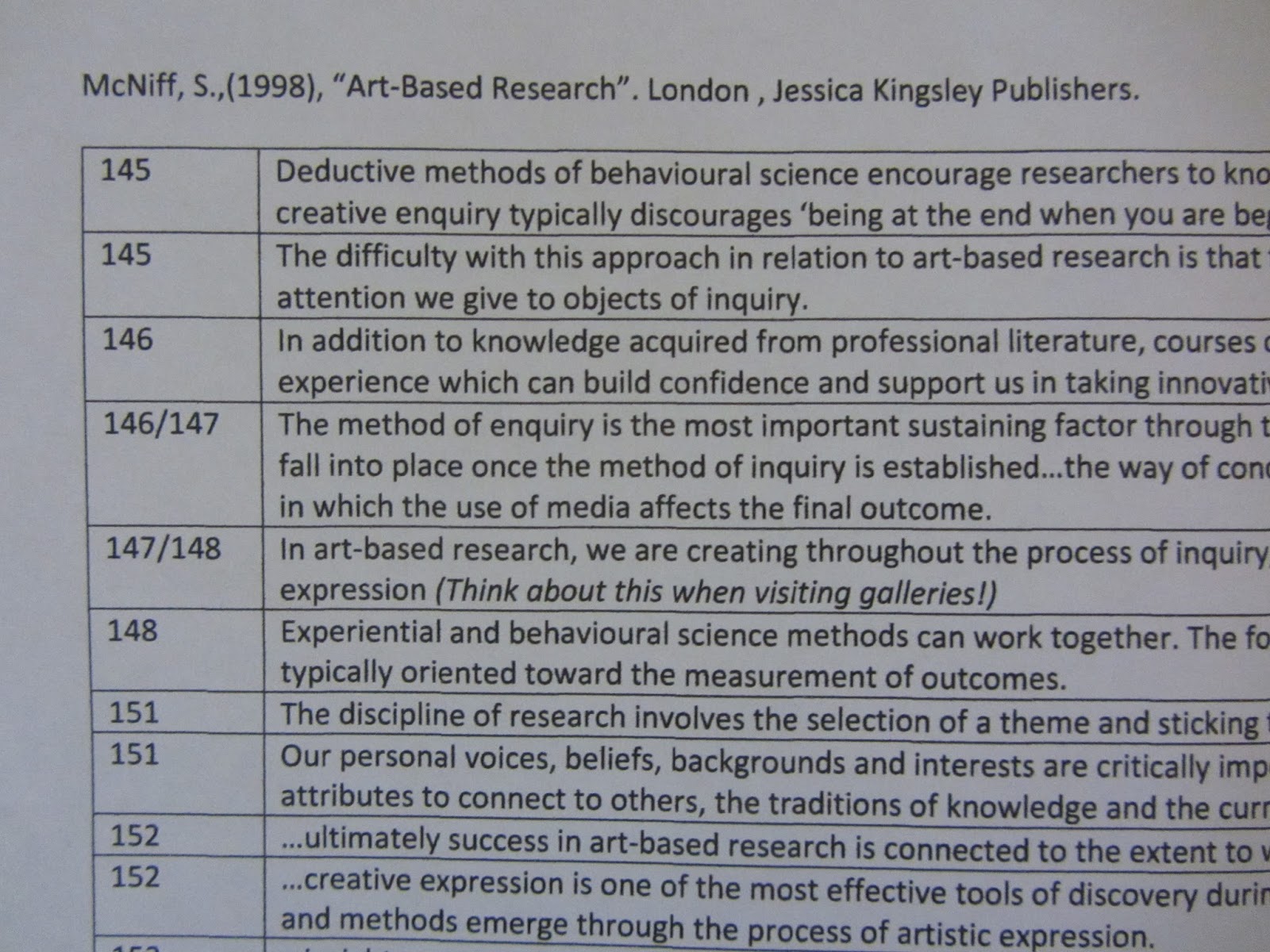
In the afternoon we had an introduction to Research Methods with Sam . I was relieved to find that I was undertaking some of the methods already, but didn’t know they had defined names.  Research concerns itself with discovering something in a systematic way, and crucially, disseminating the new knowledge. The steps can be defined as: identify problem, observation, enquiry, experimentation, reflection, solving, making the solution public. So obviously one way I could make the “solution” public would be by exhibiting my artwork. This ties in with my thoughts on “where I fit in”, as mentioned above. Arts-based research is considered to be a different approach to either traditional social science qualitative and quantitative methods, and can be divided  into: Research into arts practice –history, theory; Research through arts practice – studio projects plus supporting documentation; Research for arts practice – media experimentation etc. Rather than gathering data, the primary research activity can be something such as drawing or producing technical diagrams.

Having pondered on my notes from Sam’s session, I can see that I am doing a lot of research into practice at the moment. To a certain extent I find this limiting and frustrating, but the research through and for practice will definitely follow next year once these first two modules are delivered. I also concluded that my practice has elements of narrative enquiry – not least into myself. By using my own story and image, I avoid a lot of ethical issues (and this is why I do use my own image). I undertake lots of action research, or experimentation – which tied in with Annabeth’s idea of “playing” from the morning session. I usually produce drawings or images of one sort or another as my primary research. I have tended to work “bottom-up” or in an inductive manner, building up small pieces of visual information, but I am now using these pieces of work to find my “frameworks”, or “meta-narratives” (“top down” approach). So far I am thinking of my meta-narratives as: socialism/anti-Thatcherism, feminism, repeatable forms/patterns/processes…. but watch this space!


MA Week 2 - Playing as learning


Reflection on taught session, Friday 9th October 2015

Creative Practitioner Presentation

 
Annabeth took the first session today and talked about her practice. It’s very different to mine – she is an animator – but there was still lots to take out of it. One important thing I took out of this was Annabeth’s desire to learn through play, or experimentation. It made me realise that it’s OK to investigate for its own sake, as long as you have the time, because you never know when you will need to apply that knowledge. Another important point was the idea of working with others. Annabeth had worked with a traditional Indian dancer to produce a “digital cloth” with moving images, which the dancer choreographed. She had also developed a virtual field trip for geologists, working with geologists at the University of Leeds.  These were very strong ways of demonstrating the importance of developing a community of practice. Annabeth also listed her networks and links. A third important point was taking time to evaluate and reflect. Finally Annabeth touched on a discussion of “craft” vs. “commerce” as drivers. Discuss!!
 
I felt very comfortable with Annabeth’s idea of playing and the way it can lead to mastery. I also identified with her point about evaluating, reflecting, and feeding that back into your work. I’ve done a lot of this in my practice and felt very comfortable with the idea of trying to continually improve. Posing a problem to yourself, coming up with potential solutions, working them through, reflecting, choosing how to go forward – I think this is one of the most important ways you can grow as an artist.

However...who is my community of practice? At the moment probably my fellow students and students from previous courses. I am also trying to develop my networks and contacts by attending events, seeing what’s out there, and where I (might!) fit into the Leeds Art Scene. This is something I’m very aware I need to work on. I’ve identified some events between now and Christmas and they are part of my plan to deliver the two modules that need to be completed by December.


Monday, 19 October 2015

MA week 1 - Starting out


Reflection on first taught session, Friday 2nd October 2015
Show & Tell followed by group discussion


Memory Cubes: an investigation into Therapy, 2013

The first part of the session was a “Show & Tell” and I was in a group with Pamela (painter), Sally (surface pattern designer) and Larissa (musician/performer). I took my “Memory Cubes” and I went first. The others in the group understood what I’d been trying to achieve (depicting what we keep inside and what we show to the world). However, I controlled the demonstration and in retrospect I wish I’d just given the others the cubes to explore! Why do I need to protect them? They have been finished to a quality so that they can be handled. I need to think about other people touching, as well as viewing, my work. Sally referred to the cubes as “bricks”. I hadn’t even thought of that link to my current investigation as housebricks are a different shape. Thanks for the link, Sally! I think it shows that certain themes come out again and again in different ways. I need to remember this and use it to help me identify new threads to my work.

Despite having very different practices, we found some common threads. One was “control”. My work dealt with controlling what you show to the world and what you keep inside – a form of control. Sally was using different printing techniques to demonstrate chaos and control. Pamela made very symmetrical and geometric paintings which were very controlled in their execution. Both Sally and Pamela has used repeat patterns in different ways. We also had some colour palettes in common. Pamela uses a lot of red, black and white, as I do. Larissa had also used black, white, red and pink paint to cover her body in her music video. Sally, on the other hand, had used blues, greens and earth tones.

Something we all used was layering. Pamela uses egg tempera and acrylic media and uses many layers. Sally had layered screen prints on a garment and also used photoshop layers in digital printing. Larissa’s sound was very layered and she uses her voice as another sound layer, rather than trying to enunciate her lyrics distinctly. And of course I love my layering for the complexity it brings to my work. I found identifying these common threads really helpful as I felt it helped validate my work as genuinely creative.
 
Each small group fed back their thoughts into a plenary with the whole group. This revealed some interesting points. One was around “who is the audience”. Quite a few students felt that their professional and personal practices (“free practice”) were different. There was also a feeling that we are trying to please some amorphous mass of people out there by doing pieces that “they” will want – but do “they”?

Curiosity was identified as important. Experimentation, playing and discovery were also identified as important but thought also needs to be given to resolving and “finishing”, not just playing.

Thinking about changes to your process or the medium you work in can change your practice and the message you are giving. However, change of any kind may be forced upon you, may be evolutionary (“natural development”) or may come through choice. Biographical work will naturally change with time because you as a person change. Ethical considerations are also important. Do you need to reveal all your work to everyone? (this question is, of course, of particular interest to me).

An important point that arose for me today was “what is my practice”? I struggled to answer succinctly when Sally asked me. But I have to accept I have now left Access level behind and I need a clear answer. I like the use of the word “biographical” because that is what my practice is –autobiographical, really, quite often. It is, at the moment at least, also collage-based, although not in the sense of using found images like Richard Hamilton or Kurt Schwitters – it uses images I create. So for now I will describe my practice as a biographical, collage-based practice. This brings into play the question of “who is the audience”? I keep thinking that I want to produce lovely watercolours or drawings or prints – but this is not what I pursue! I need to consider and resolve this as I move on with the course.