Showing posts with label reflective practice. Show all posts

Monday, 31 July 2017

MA Week 79 – The End is Nigh


Reflection on the past week, 31st July 2017

Printmaking

I spent Thursday in the print room – sad to think it will be one of my final sessions in there. I printed the final stage of the Royal Park aquatint. It needed a little bit more definition in the foreground, just to pull the foreground forward a bit more, so I drypointed some more vegetation into it, on the basis that both the plate and my patience were wearing thin after the repeated etchings. I also brasso’ed the sky and it printed quite nicely. The drypoint gave a much lighter, fuzzier mark than the etching and this has set me off with the idea of a drypoint into metal, but that will be post-MA.
 
Aquatint plate - final state

I don’t think I mentioned that I had been trying out different papers – I tried Fabriano Unica white, Canaletto, which is a creamy colour and Somerset velvet white. I think I got the best prints on the Somerset paper, but all the papers worked well, and I would use them all again. In particular, the Canaletto is fine for everyday work. Having made detailed notes on soaking times etc, the trick with the Somerset seems to be to give it a really good blotting. There is much more at play here, such as press pressure and the type of blankets, on the press, but there’s little point in further experimentation as I’ll be leaving this print facility soon. I am hoping to move my printing practice to Leeds Print Workshop from September. At this point I will experiment to try to get a stable process as hopefully I will be there for a while.

I produced three prints of the plate at each stage and on each paper, and currently I am flattening them in batches under boards at home – I need my floor space back

As I mentioned last week, I will submit these prints a series, a metaphor for the MA journey. However, the journey doesn’t end there, so at some point I will need to do something that demonstrates this. I would like to somehow creatively destroy the plate but I don’t think I will get time to do it this side of the MA deadline.
 

Scarborough!

On Thursday I also tried brasso on the little Scarborough plate and printed that, too – the polishing seemed to help. I’ve also heard that my prints of this were accepted at Woodend Gallery in Scarborough for their Summer postcard show. So a trip to Scarborough is on the cards post MA, as if an excuse were needed!
 

Writing up

Most of the time since my last blogpost has been spent writing up. I’ve finally finished the deep reflection on the “Troubling Time” conference and I comb-bound it today. This should form a great resource for ideas and new research possibilities post-MA.

A different kind of map; how my practice has worked out this year
 
For my creative journal, I identified 10 themes, all interrelated, with a view to writing a holistic reflection on each theme. I’m finding it really interesting to look back over the whole module. I’m identifying lots of new possibilities and am generating lists of future ideas. Some of these were already in my mind; others have appeared as I’ve been writing. Again, this should form a resource for to kick-start what comes post-MA, whatever that may be. It’s also raising the question of how I will write things up once course is over. I think it will probably be in a workshop notebook plus annotated examples of print experiments taped into sketchbooks. It seems important to keep notes of processes to act as a reference.

I have to say that the writing up seems endless. I’ve written up 6 themes, with extensive reflection, but Etching is the next theme – wish me luck! As so often, I am reminded of my panel at Troubling Time. Bob discussed the idea of artists in their bunkers, and Jo discussed the idea of slow periods followed by periods of frantic activity. The current phase is definitely in the latter category.


Monday, 10 April 2017

MA Week 64 - Catching up and Manchester


Reflection on the past week, 10th April 2017

 
I’ve been doing quite a bit of catching up this week restarting my long overdue creative journal. I’ve done a little bit more sketching with a view to etching. I was intending to do more on last week’s collage ideas at the weekend but decided to enjoy the sunny weather instead – it might be the only two days we get!

One thing I have managed to do is to catch up with the blogposts about the Manchester Met postgraduate conference in February. The links are here:

It’s been good to reflect back on this experience now I am feeling a little better. There are still a couple of posts to catch up from the end of February and I’ll get onto these as soon as possible.
 
Saul Hay Gallery
I paid a very enjoyable visit to the Saul Hay Gallery in Manchester. This is a compact gallery tucked away by the canal and railway in Castlefield. It’s not been open long but seems to be doing well, which is good news. It’s also a really friendly place and I had a good chat with the owner, Catherine. The reason for my visit was to see some work by Mandy Payne and Josie Jenkins in the “New Topographies” exhibition. I’d not seen either Mandy’s or Josie’s work for real before so this was a good opportunity on my way to meet an old friend for lunch.
 

Interior view of the gallery
 
There was a good deal of art depicting the urban within the exhibition. I keep finding that more and more people use the urban as inspiration and this gives me the will to go on with my practice. Josie is showing works from her “Scrap” series- oil paintings of a car scrapyard. It was these pieces that originally attracted me to her work. The colours are bright and the yard is depicted on a Summer day, causing a tension between the mood and subject matter of the painting, yet at the same time rejoicing in the juxtaposition of the colours. The compositions are quite tightly cropped, almost voyeuristic, which adds to the sense of tension. Josie also has a couple of pieces made from reclaimed materials . I wasn’t aware of this aspect of her practice before and found it interesting –the pieces are physically layered and this brings complexity. They are layers of landscapes within what appear to be old wooden speaker cases.

 
The white-bordered print is Mandy's work and the paintings to the left of it are Josie's Scrap series

Mandy’s pieces included a lithograph and two pieces collaged onto small tiles of her trademark concrete. I particularly liked the almost-abstract “Stripped Bare”, a lithograph and blockprint collaged onto concrete . Her work is so meticulous and detailed. All aspects – the subject matter, the limited colour palette, the substrate – conjure up the urban. I am still hoping to see one of Mandy’s aerosol on concrete pieces for real.

Inspiration, then, and also the aspiration to one day have pieces in a gallery like Saul Hay.

It was also quite interesting to “find” this part of Manchester – Castlefield – as I am no real fan of the city. However, I really liked this area, which is evidently one of the oldest areas, near the meeting point of the Bridgewater and Rochdale canals. It made me wonder if I could wander there. How would that feel? Not being in Leeds? Am I ready for that? I’m not sure.


Tuesday, 8 November 2016

MA Week 46 - Mini Mabgate psychogeography, the End of Year show, and more reading


Reflection on the past week, 8th November 2016

 
Still nothing visual to share, but I have been doing something a bit more interesting this week.

A mini wander
On Friday afternoon I finally got to visit the End of Year show of the graduating cohort. I had an unexpected mini-urban-wandering around the area too. The first thing was that I managed to get some images of the semi-demolished British Gas offices off Regent Street. Some definite fodder for visual work there –nice rectangular shapes coupled with the bleakness and strangeness of the still-standing skeleton. I couldn’t get near the building (and wasn’t for leaping over the 10 foot fences) but I could get the camera lens through a gap. I’m thinking of possibly some charcoal sketches but no doubt it will end up in a print at some point.

 
Dereliction. No doubt to be followed by gentrification.

Wandering up then towards the studio on Mabgate, I was a bit circumspect as it’s not the most salubrious part of Leeds. My eye was taken by an unexpected iron bridge over a beck. The most unusual thing was that there was a building over it, and the beck flows in a culvert underneath. I felt into conversation with an interested and interesting man who works out of that building. He told me it was in constant danger of collapse into the beck! He also told me that the area wasn’t very good, with drug addicts around on a night, but that it is being gentrified. “The town is coming this way”, he said, referring to the new Victoria Gate over the other side of the urban motorway flyover. He pointed out a building that will soon be converted to apartments. Whether or not this is true, I’ve not checked, but there seems no reason to disbelieve him. So gentrification makes its way out West. It was interesting, therefore, to find this Guardian article a couple of days later. If what the bloke said is true, there is at least something correct in what is otherwise an error-laden article.
 
Building, beck and bridge shadow
 

I also found a disused foundry, Hope Foundry, which now evidently houses a music charity. Such a fascinating building, but I didn’t have time to loiter. The City of Mabgate pub, with its sage green faience tiles, is now closed, but later a colleague told me she used to go to lock-ins there. The tiles reminded me of the ones on the Albion pub in Armley. I guess they are from the same time. So many stories, so little time… and yet all brought to the surface by the same psychogeographical approach of connecting with the environment and its people.

 
The City of Mabgate, as was

The End of Year show
I had to press on to the exhibition itself as I was already running behind for the day. I was disappointed that I couldn’t make the opening night, but in a way it was probably better for me to be able to see the artwork without dozens of people around. I thought it had been curated really well, with a kind of band of colour running left to right across the middle of the room. My erstwhile fellow students, John and Lorna, were invigilating that day and we talked about how a lot of their work was monochrome, as was ours in the work in progress exhibition in June.

MA Creative Practice Show 2016, Studio 24, Mabgate
 
It was fascinating to see how their work had developed. I remembered Lorna talking about pieces of paper discarded from archives, and she had worked up a piece based on stitch, discarded paper clips, wood and metal. It formed an installation in its own right and spoke clearly of the past, memory, the unwanted, the discarded – all repurposed and given shape, form and importance again as an art piece.  John’s work involved a lot of layering and printing into acrylic medium, which is much closer to my own practice than Lorna, but which also refers to memory and representation. I was particularly interested in some transfer prints of very abstract, mainly black photographs onto found paper, board and plaster. There was a lovely layering, a sense of decay and temporality. It has started to form ideas in my head of not only testing out paper when I get printing again, but other substrates.
 
The exhibition showed the work of 11 artists and it seemed to hang together harmoniously despite very different styles and subject matter. Some of the pieces were colourful and based around graphics; others more muted and based around memory and experience. The venue suited the pieces better than I’d expected. It’s one of the old buildings in Mabgate that has been partly boarded out to form an exhibition and event space. So there are plenty of areas of bare, peeling wall, and part-hidden floor tiles, alongside the white gallery space and the tiny, homely cafĂ© bar in the corner. It was a real palimpsest of a place, wearing both its history and its current use concurrently and very well indeed.  I don’t know what will happen with our end of year show – there are rumours that it will be in the college – but this place was different, something away from the endlessly white walls. It did open a new perspective on the idea of the exhibition space contributing to the exhibition (which it did in this case – I suppose the wrong choice would subtract from the exhibition).

Quite bizarrely, one of my Access tutors then turned up, and it turns out he runs the place with two other people! It was great to catch up with him and to hear how they are making a success of the place. He reassured me that the area wasn’t too bad and that you had to hang out there to catch its… rhythm? Atmosphere? I’m not sure which word I’m looking for. Again there was that idea of the connection with place, becoming part of place, which keeps cropping up again and again as I read about psychogeography.

I was reluctant to leave as I’d really enjoyed this little window into another world, seeing friends’ final pieces, and meeting up with old acquaintances again. But the dissertation waits for no man (or woman), and I discuss this week’s progress (or otherwise) below.

Dissertation progress
I had a really useful and insightful tutorial on Thursday, in which Sharon pointed out some holes I knew were there and some I didn’t! It was really useful to get another viewpoint on it and she kindly took the time to comment in some detail. Basically it is going along the right lines, but there are some places where I have edited too much out of it, particularly about nostalgia, identity and Northernness. Sharon also gave me a couple of references, one of which I’ve looked at, and which should be useful.

To get back into the idea of nostalgia, I read a paper called “The Dilemmas of Radical Nostalgia in British Psychogeography” by Alastair Bonnett (2009). It seeks to compare and contrast “the use of the past to critique industrial modernity”  and the “suppression of nostalgia” (p45). I’ve discussed this in more detail here. There is some useful information, and some useful quotes, in here. There is more reading to do, especially around Northernness and around the everyday. I feel that I need to read selectively – I know now where the gaps are, and I need to fill them – but I find it difficult as everything is so interesting and new.

I think a large part of the problem I’m finding is that I am pulling elements of theory from so many different places. Heritage theory and identity theory are only the start points, and psychogeography is so big and so interesting. On top of this is this idea of everyday theory, then there’s the use of and attachment to place, and memory/re-memory. Within 8000 words I can barely scratch the surface.

One other thing that came out of the tutorial was a discussion about influential and relevant artists for me whom I had discovered via Twitter rather than the white walls of the gallery. Sharon suggested that this may be another manifestation of needing to tell a narrative in a different way, with social media almost acting as another means of distributing information vs the “official” of the gallery. It is probably too early to judge whether social media will ever be mainstream enough to be able to cite in an academic paper, but there is no doubt that it is an important source of information and inspiration for me. I do have a concern, though, that it is experience at arms’ length; seeing images on a smartphone can never get near to seeing the complexity of a piece of work in real life. It was really good to be able to get out and visit the End of Year show as it seems an age since I’ve visited a real life gallery, so perhaps that is a strand of research I will be able to pick up on once the dissertation is finished.

Monday, 10 October 2016

MA Week 42 - Dissertation underway


Nothing visual to show this week. I didn’t get into the Print Room as I was away Friday/Saturday. However, I have made a start proper on my dissertation. I had a really good tutorial with my very patient tutor, Sharon, on Wednesday, which confirmed I’m on the right tracks with the structure. Since then I’ve spent time putting some flesh on the bones, so to speak. I’ve read a bit about psychogeography but there’s still more to do. I’ve been reading The Situationist International : A User Guide by Simon Ford (2005) , in which he describes Guy Debord – who is the founder of the Situationists International Group and the father of psychogeography – as seeing the psychogeographical walk as a drift, called the dĂ©rive.  See this Week 42 blog post for a summary of this. This contrasts with Tina Richardson’s viewpoint which she expresses in one of the chapters of the eminently readable book she’s edited, Walking inside out : Contemporary British Psychogeography (2015), in which she sees the psychogeographical walk as being more purposeful than just a stroll. So more reading and thinking to do. However it does seem Debord’s original idea allows for random and chance encounters, so this does help with my ideas of walking along and being open to whatever you might come across.
 
I also had the pleasure of meeting up with some members of staff from Leeds Beckett University on the same day, to talk about taking part in their “Being Human” event. There were four of us in total, from different backgrounds: English, History, Cultural Studies, and me! The plan for the day is to take groups of attendees on a short walk in the city centre, then invite them to reflect on what they’ve seen and experienced through creative writing and some sort of visual response (which is where I come in – it will probably be through collaging pre-cut shapes). We walked the short route and we all saw different things and could give different comments and insights from our various backgrounds. It was a very short burst of interdisciplinary collaboration and it was quite fascinating. I’m really hoping that I can get to the day and that it will be equally interesting.

This week, I’ve met one of my Twitter friends, Jane, in the flesh. That was great, to sit and natter away over lunch about our respective art practices. For the rest of the week it’s dissertation and hopefully the Print Room on Thursday.


Monday, 23 May 2016

MA Week 28 - Pylon Abstracts and Salford Symposium


Reflection on the past week – 23rd May 2016
 

Some interesting experiences and work this week. I haven’t been back into the print room, unfortunately, because I was ill on my afternoon off. Shame as I had written a list of things to try out. However, I have been making some progress with some little acrylic pieces. 

I pursued the idea of working up the repurposed pylon monoprint from my Week 26 post into four pieces. As time is of the essence, I decided to work straight into acrylics rather than work with pastels or cut paper as I might normally do when planning and developing  a piece. I wanted to see how the colours and paint would work.
 
Pylon 1 : spot the constructivist influence
This is one of the results at the first sketch stage. There are two or three layers of paint and I’ve used some masking tape too. It’s fairly faithful to the original monoprint but it’s clear that there is too much going on at the top left and not so much at the bottom right. I’m therefore working on a second sketch which is looking much more balanced and which I hope will be OK to reproduce on board for the End of Year show.  

It’s interesting how the marks translate, or not. The “grubby” marks of the monoprint, which give a nice industrial feel, don’t work so well in the acrylic. The inclusion of marks of different thicknesses in the acrylic version gives the work energy and movement. Not that they lack in the original; I have just had to think differently about how to represent them and how to rework the lines of the original to get the piece more balanced.

 
Crit in transit
The original four sketches were the subject of a three-phase crit at the end of last week! I put a couple of them onto whatsapp and there were suggestions they would work up as linocuts – I’m not overly experienced in linocutting but I might give that a go later on in the year. Then I had a crit with two classmates on our way to Salford (of which more later), now known as the “crit in transit”. This revealed some ideas of day and night, of lights beaming out of the darkness, and a very challenging question of whether this represents what’s going on in my head (who knows?). Later, when I finally got to Salford, another two classmates kindly had a look. There were further suggestions of taking the pieces back into print, perhaps by monoprinting from or into them, of further layering, and also the question of trying to get them up off the page more. They do look 2D, but perhaps that’s how they’re supposed to look. I’m not going to be able to try all these things before the end of year show, but I am definitely up for trying a bit more layering and I’ll do that when I go back to working on them tomorrow. 

The Salford jaunt was interesting. We met with MA students from Manchester Metropolitan University and the University of Salford in a place called Atelier Artworks, an old light bulb factory. It was a strange space; industrial, dirty, under-used, disused almost, yet alive with the studios of a number of artists. Because of being ill I hadn’t really had much chance to prepare, so my responses were very much that – immediate.

 
Salford Piece 1
 
 
I concentrated on shapes and colour and produced two compressed charcoal and pastel pieces. On both the bottom layer was a rubbing of the metal stairs. There was a lot of improvement that I could immediately see; if I’d thought a bit more about it beforehand, I would have positioned my various images on piece 1 differently. As it was they overlapped too much. A lesson to learn. Don’t get overwhelmed by the situation and jump straight in. On piece 2 I think the red is a bit too intense. I liked the colour of the two doors, bright red and bright emerald green (these were their colours in real life), but I wish I’d left it as a black pencil drawing on the red rubbing.

Salford Piece 2

On the other hand, producing these as immediate responses means there is a lot to develop – there are no filtered or refined ideas in there. The shapes and colours can be used in different ways in future pieces. I really wish I’d taken more photographs and made more rubbings of the stairs to use now I’ve got back. Another lesson to learn. Part of the immediate response also means that these pieces bear the imprint of the site; not only the stair-rubbings, but the fact that I sat on the uneven, cracked concrete floor to do them. This means the lines are not straight because the floor was so uneven; something that I couldn’t filter out as I actually did the work.  I am beginning to understand, and to like, a little bit more about responding to place through these experiences (the Armley walk, the pylon photos, the Salford Symposium). 

We had a crit in groups of three and one of the comments on piece 2 was that it was like looking through a window when there was a dangerous chemical incident going on. It made me see the piece in a different way and I liked it a bit more then. I think the first stage in developing something from this would be to take the stair pattern from piece 1 and work with it; this was the first thing that captured my attention as walked up to the space where we’d be working. 

There wasn’t nearly as much time as I would have liked to interact with the students from other institutions. I think most of the others probably felt the same as I did – slightly nervous, happier to stick with our own classmates. It would have been nice to have had an ice-breaker to get to know people and perhaps more time to view each other’s work. Having had the experience, I wish I could go back and do it again and get more out of it.


Friday, 13 May 2016

MA Week 27 - pylons and printing


Reflection on the past few days – 13th May 2016
 

The week unexpectedly turned out really positive. I managed to get into the print room for an hour after work on Tuesday and pulled the first prints from the pylon plate. OK, it’s not the best drypoint ever, but it is certainly the best one I’ve done and the marks really worked for me. The blackness is good quality. I felt really happy when I peeled the first print off the plate. It’s visually communicating what I want to communicate. It’s also the first one I’ve done with the new etching needles and it was great to get off to such a good start with them.
 
Pylon print one

Today (Friday) I went back into the print room and worked into the plate a little bit more, to add a bit more detail. I then decided to try printing it in red. This linked back to the writing in red ink that I did last weekend, and this question of whether the red marks might be really black marks but in a different colour. I experimented a bit with double-printing, too. My conclusion is that the black works better. The red seems too light for the fairly light weight of the lines. The red isn’t really saying what’s inside me, either. So back to black, for now at least.
Pylon : red
Pylon : double print, red and black
 

Then I had a really insightful tutorial with my personal tutor, Sharon. I had become quite aware that my subject matter seemed to be hopping around a bit (buildings, cranes, pylons…) and wasn’t sure why this was, nor whether this necessitated further theoretical perpectives. After discussion I concluded that I am inspired by the industrial landscape (as opposed to the natural landscape) and these items are all part of that landscape. We also discussed the fact that I’ve taken photos of factories, pylons etc whilst on a journey, in those cases a car journey, but that this is not all that different to the Armley generative wandering. It is a response to interesting things whilst on the move. 

This may bring in theories of place. I’d looked briefly at phenomenology during the week and wondered if this might be the theory I needed – exploring lived experience?? But the discussion turned to the fact that we are shoehorning visual practice into theories used for other subjects, other areas of enquiry. I suggested we need theories of our own as creative practitioners. Quite what my theory would be, I’m not sure, but it would be something about black mark-making.

Sharon also challenged me to think about working with other people’s histories. Could I do this? I don’t know. What if their marks weren’t black? Should I be thinking about written and/or oral histories? Diaries? Soooo very much to think about.  

Sharon also encouraged me to continue to write reflections, whether on post-its or whatever, so that I don’t lose the sense of the moment and place and time of creating whatever I’m doing. So I’ve come home and started immediate blogging!
 

The advent of the pylons - time, place, lunch!
I took some photos of pylons on another car journey. This car was being driven by an old school friend, Fran, and contained another old school friend, Clare, in the back. Fran is a musician, amongst other talents, and we’d been discussing the creative process whilst en route to Clare’s house. I was telling her about drawing industrial infrastructure and that I fancied creating some work about pylons. So she encouraged me to photograph any pylons I saw. There was a monster one at the motorway junction for Clare’s place and this is the one featured above. Our destination was lunch with another old school friend, Moira. By the time we met up with Moira the other two had also become pylon spotters and were pointing out particularly picturesque pylons on the return journey. A creative by product of a lovely lunchtime!  


Monday, 9 May 2016

MA Week 26 - reflection on the last two weeks


Reflection on the last two weeks – 9th May 2016

May has definitely felt better than April, and I am getting back into gear with both practice and critical thinking. It would be nice to say I’ve made good progress, but that’s probably overstating it… however, I have made progress.

Over the past couple of weeks I got back into the print room and did some more monoprinting. This time I used the arm rest as Lyndon had advised. I found it difficult to get a continuous line as the arm rest got in the way. I wonder if I should try a smaller piece of paper (A5?). However, the results were much better without me inadvertently rubbing my hand over the paper as I moved the pencil. I continued with the pylon theme, though I completely failed to blot the paper enough the first time round, but this still gave an interesting effect. I also had a go with some grey paper that had just arrived and this gave a nice “industrial” feel. I also had a “doodle” to see what effect I could get from rolling the pencil or deliberately rubbing the paper with my fingers.

 
Pylon monprint on grey paper

I reached a point where I decided to have a think about how to work into the prints. I had a bit of a creative block about this but eventually decided to try a bit of red acrylic and to think about the shapes within the pylons. This worked OK but seemed to go much better when I tried some looser, more fluid marks over the paper which had become textured from being inked by rolling the pencil. I think I will ink some papers this way simply as a background for working upon. Some of the shapes also looked a bit “Chinese”, which wasn’t totally unexpected as the abundance of items made in China is part of my theme of the decay of British Industry.
 
Monoprint/acrylic experiments
In the same delivery as the grey paper, I received some drawing nibs and decided to have a go with these. A couple of people (my tutor and a couple of classmates) had mentioned that my notebook could be an artwork as the writing is small and even. I had been resisting writing about my work on all fronts as part of challenging myself to priortise the visual, so using it in artwork seemed untenable. Anyway I decided to do a piece of free writing about writing onto one monoprint. It really loosened my mind. It occurred to me that I will freely admit that I think in words – so why don’t I make the words work for me, rather than allow myself to be dominated by them? By writing, visual creativity somehow opened up. This may well have been in part because I was using a new writing/drawing instrument, and also because I was writing in red ink rather than my beloved black. But it was at least in part because the free writing turned into critical thinking about whether the writing was subverting the artwork, or vice versa. From now on I will write as I did in the last two terms, but just not as much. Then I can see more about what I’m doing and why and where it’s going next, but not get overwhelmed.

Writing about writing
 I still wasn’t sure what to do about the monoprints so I cut up one of the grey ones and put it back together fairly randomly, then looked for new connections and marks I could make. The lines are rather thin, and the larger square seemed to fall neatly into four quadrants, but I could immediately see that I could work this up into perhaps some small acrylic pieces.  I hope I can get onto producing them this month, then they could go into the WIP show on 10th June.
 
Re-purposed pylons

Also in my delivery of art treats were some etching needles, and I have etched a pylon into an A5 drypoint plastic, but alas I didn’t get time to print it. So that can be part of next week’s creative practice.  Progress and a way forward… didn’t seem possible in April!


Friday, 29 April 2016

MA Week 25 - reflection on April


Reflection on April – 29th April 2016

April turned out to be a pretty rubbish month all round, to be honest. Some very difficult personal circumstances consumed most of my energy and wherewithal so I got little done on my MA studies. 

One thing I did try was to use post-its to record reflections within the sketchbook I’d started. This worked to a certain extent. I deliberately didn’t want that book filling with writing and this seemed like a reasonable way to capture my thoughts at the time, without reams of writing. I will probably continue using this technique although not all the time.

Answers on a post-it
 
I moved seamlessly on from working on pictures of cranes to images of pylons. There is a similarity of structure between the two somehow, with the criss-cross struts. I tried drawing a little pylon-based scene as a basis for a drypoint but it was very poor and I got really disheartened with myself. Mentioning this to my lovely classmates, a few of them said they’d also had non-productive Aprils, which perked me up a bit. I decided to break the cycle of not being able to draw by trying some drawn monoprinting. 

My first attempts were not brilliant but they were a damn sight better than the pencil drawings I’d done earlier in the week. The best one is shown here, although there is an issue in the paper taking up the ink where I’ve moved my hand over the surface as I made the marks on the back. Lyndon advised me to use an arm rest to try to eradicate this “smudging”. This is based on a picture I took of some industrial installation or other next to the M1 in Rotherham on a journey down South (disclaimer: I wasn’t driving).

 
Mucky monoprint

The monoprinting allows looser marks than I seem to be able to make with a pencil and this loosening of the marks seemed to help to loosen the general creative tension a little bit.

Sunday, 13 March 2016

MA Week 20 - reflection on term 2


I've learnt a lot this term. I've carried on with my investigations into heritage and identity. I set myself some objectives in mid-January - here's how I got on: 

Learn more about printmaking
I undertook a lot of action research here.  I experimented with lino cutting, solar plate printing and drypoint etching. The solar plate printing was a totally new technique for me and I got reasonable results . See my Week 15 post. I now have this as a technique in my "toolkit" for future use. The Lino printing didn't yield such good results but this may have been due to the inks I was using. By far my favourite was the drypoint etching. I produced a plate based on my "generative wandering" (see below) and the combination of subject matter and technique really gelled with me. I  like the quality and blackness of lines I can achieve. See my Week 20 post.

Learn more about Laser cutting
Again a good deal of action research. I've used the laser cutter throughout the module. I have concentrated on cutting images of my own face (in keeping with pursuing my investigations into identity) and have developed a much deeper understanding of how to prepare the image and what the laser can and can't do. This is another very versatile technique for my "toolkit". See for example my Taking Stock post. 
 
Generate as many ideas as possible
Use of the laser cutter and print facility, along with the insights gained in the generative wandering,  have generated myriad ideas. I have been able to develop some of them, but I've noted all of them in my creative journal. So they can form a repository for starting points for the next module. 

Do something a bit scary re personal development
I rose to the three-minute-presentation challenge of the University of Leeds's "Heritage Show + Tell" (see https://heritageshowtell.wordpress.com ). I talked about my approach to research by creative practice. See my Week 20 post with more details of how it went. 

Dr.  Tina Richardson, psychogeographer, has offered me the opportunity to write about my generative  wandering in a guest blog post on her website, http://particulations.blogspot.co.uk, so I will definitely be taking her up on that.

Research artists
I wrote a reflection on the exhibition catalogue for "Cloth & Memory" (see my Week 18 post) which encompassed five artists. I haven't undertaken any other formal artist research, but I have begun to follow more artists on Twitter (and some have begun to follow me, which is gratifying). Whilst this is not formal research, it's a really good way to get instant inspiration each day as other people tweet their work in progress or pictures of road markings or brutalist buildings or beautiful landscapes. Me on Twitter : @1962AB. 

Draw for 15 minutes a day at least 3 times a week
I had intended to draw with a pencil in a book but in fact I only did a little of that. I found myself drawing lines with the laser cutter and with etching tools. Overall it probably amounted to 45 minutes a week and more... Honestly!

Do the blog slog every Monday
Through setting this objective I learnt to write more concise blog posts. It didn't always happen on a Monday, but unless there was anything particular to say - like when I read Harrison's book (see my Week 16 post) - this worked much better. I found the blog worked as a kind of overall journal of what I was doing, and allowed me to document and reflect on progress, whereas the creative journal has allowed a much deeper reflection on individual visual outcomes.  

Time management
I have had my usual plans (3 versions) and had to do a lot of juggling about when I went down with flu in mid-February. These has helped me prioritise creative pieces to take forward and ideas that can be documented and "parked" for possible future use.  

 
Overall progress
I continued to work under my "heritage" and "identity" theoretical perspectives and this worked well. Throughout, I have kept a reflective perspective on the work I'm producing and - equally importantly - how I'm progressing and what I'm learning. I've documented mistakes and experiments and solutions, and also when I've chosen to pause an investigation because it is not yielding the results I'm looking for. The latter is important in making judgements about how to progress, both creatively and from the project management viewpoint.

Undoubtedly the breakthrough during this module was reading Harrison's fine book, "Hertiage : Critical Approaches", and undertaking the generative wandering to Armley, both of which happened in the same week. I had been trying to find some underpinning theory whilst remaining true to my beliefs that I was working on identity and heritage narratives arising from my own lived experience. Harrison's book vindicated my approach.  

The combination of the two gave me confidence in applying a theoretical perspective and a research method (the wandering) directly to my work and I went on to produce four acrylics-based pieces which responded directly to the colours and shapes I encountered. I also used laser cutting to help prepare the corrugated cardboard in two of the pieces as an experiment in depicting myself as an integral part of my work and as my identity in the heritage of Leeds. Within these pieces, I worked quite freely, in an unfettered and almost automatic way. This was quite a departure for me as I would usually do a good deal of testing even for a small piece. I enjoyed this freedom and need to allow that to continue.  

There is more to explore from the wandering, such as temporality, decay, boundaries and so on. I am hoping these themes will continue into the next module. At this point, I feel my theoretical perspectives and techniques are really starting to come together. My confidence in my practice - and in myself - is growing as I take these steps in my professional development. I am feeling much more comfortable with my theoretical perspectives of heritage and identity. I still enjoy the mixed media approach to practice and I imagine I will continue to pursue this in the next module. Overall I think it has been a successful term and it should stand me in good stead for the next module, which embeds a closer relationship between theory and practice.


Monday, 22 February 2016

MA Week 18 - Reflection on the past 10 days


A mixed bag of fortunes recently.
 
Week commencing 9th February was really productive, with the breakthrough reading about heritage as a critical perspective and with the generative wandering. I then went on to finish off the acrylic piece I’d been doing the week before (see this Week 16 post), and also started another acrylic piece on paper which was a visual response to the generative wandering. 
 
Armley, WIP, February 2012
 
I had also managed to get some advice from IT about how to prepare images for the laser cutter (as mentioned in this post under “Laser cutting”) and I had made a different template of my face. I tested this and decided to simplify it even further. The IT guys and the laser technician both thought that I was probably aiming at something too ornate with all the detail in the hair and eyes. 

Then week commencing 15th February was a disaster. I had Monday afternoon off and used it to prepare the simplified image mentioned above. Then I came home to do some blogging and found my poor partner down with flu. So arty time lost on Monday and Tuesday as I packed him off to get some rest and tried to look after him. On Tuesday I then cut the simplified image from 9mm MDF and it burnt. This wasn’t entirely unexpected but it was still a blow as I’d hoped to build up a stack of these cut images as part of an ongoing idea of being able to “look down” into the image and see what’s inside. I’ll ask further advice, but I think I might be at the point where I have to pause the laser investigations. I’m not getting the results I’d hoped and there are deadlines looming! I have learnt lots about laser cutting notwithstanding.  
Charred remains of grand designs
 
Then even bigger disaster as I went down with the flu myself on Wednesday. So I’ve done next to nothing for a week - I didn't even get to college on Friday. Even my finely honed project management skills (!) can’t pull a week back over three weeks. So I will need a bit of prioritisation and juggling as I move towards the deadline. It’s such a shame after such a breakthrough the previous week, but that’s art, that’s life.

Monday, 8 February 2016

MA Week 16 - Crits


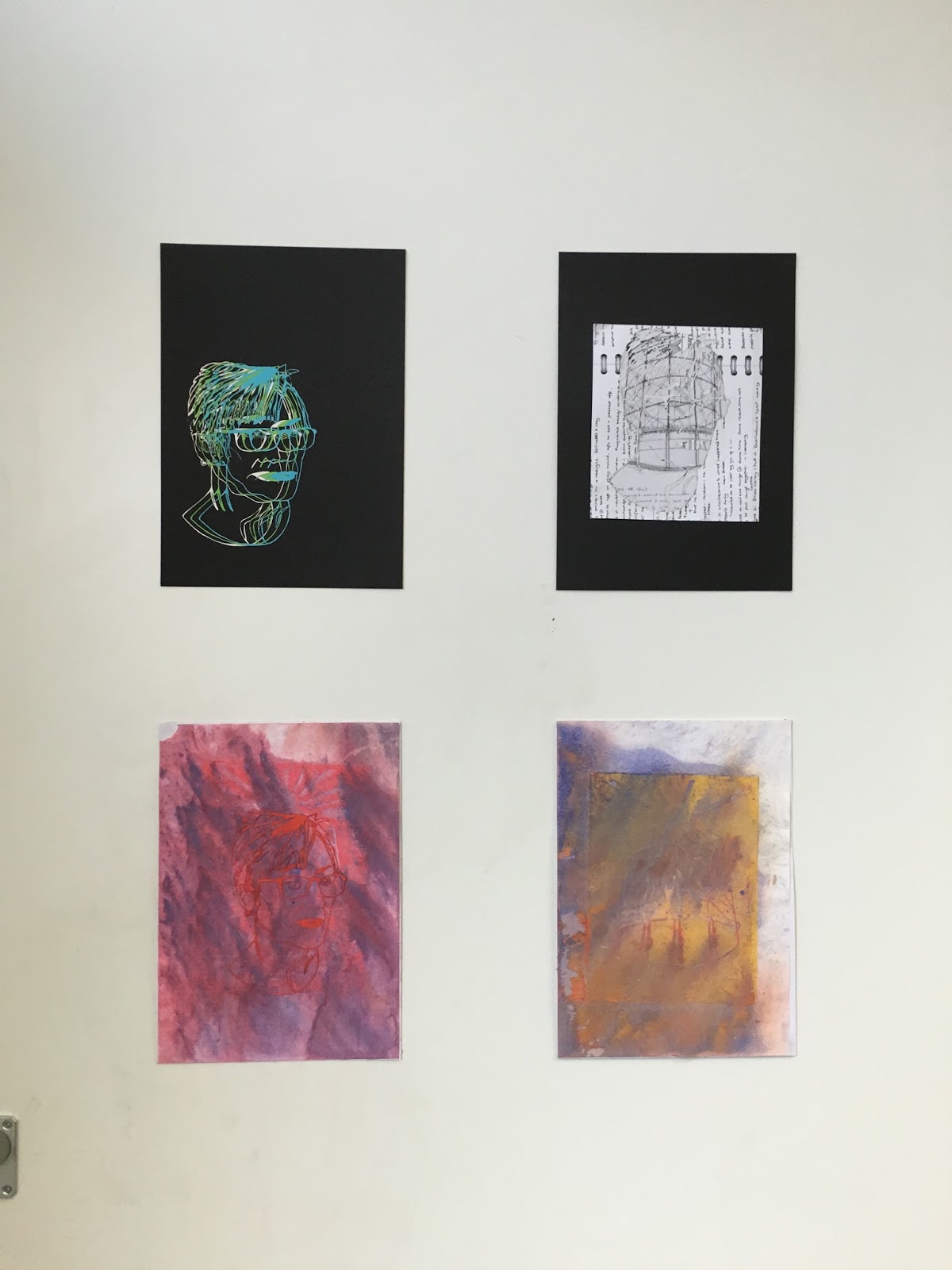
The taught session this week took the form of two crits. You had to take in some work, so I took the decomposed gasometer pictures (explained in this post) and some of the laser cuts of my face. I was nervous about sharing the work as I felt it was still at a very early stage. Each of us displayed our work as you might see it in a gallery.
 
Ready for critiquing!
 
 
Silent crit

We worked in a group of 4. Three participants observed and commented on the work of the other participant, who had to remain silent for about 10 minutes and then was able to respond and discuss for 5 minutes. I had expected it would be very difficult to keep quiet, but it was totally absorbing listening to the others’ comments.  I really enjoyed this exercise and I got lots out of it (and I hope the others in my group did, too).

Comments received:

Images form a series of 4, linked

(Three colour laser cut)

eyes lose detail as overlaid

Carry on with more of the same cut images

Make a circle with more of the same cut images

Carry out a journey in colour by using more of the same cut images in a rainbow of colours

(laser cut with gasometer image)

Selection of words on image appears deliberate

Depicts hidden or contained memory which now exists only inside your head

Self is natural ; gasometer is man-made

Image is very delicate. Try more layers to get depth.

Link between me and gasometer

(Decomposed gasometers)

Japanese sunburst above my image

Curiosity re how the images were produced

Relief; positive and negative

 
Fellow MA students, Sally and Ali, seeing the lighter side!
Socratic crit
 
Again we worked in a group of 4. In this style of crit, the artist can introduce their work and the group can discuss freely. I found this less useful because I was priming the other participants with my viewpoint, rather than letting them form their own opinions. 

Comments received

Try a monoprint of my face to lose some of the crispness and control

The laser cut lines look like wires or a circuit board

Use parts of face rather than whole face - make it more universal.

 
Reflection

Although my classmates are aware of my subject matter, so are hardly neutral judges, I was pleased with the way they picked up on what I was trying to depict, particularly in the silent crit.  It was interesting that there was a thought that the words on the gasometer image were deliberately chosen, as this wasn’t the case. But as they were from my own notebook, they were bound to relate to my interests, so they were not random either.  

The idea of carrying on with different colours for my laser cut image is an interesting one. It could produce an interesting extended effect. However, given the problems I’ve had with sticking down these cutouts, I would have to do this from card. One to consider, definitely.

Monoprinting is another technique to consider. I was actually watching a group doing it in the print room the other day and I liked the “sooty” effect they got around their lines. I’ll try this if I can make time. 

The most striking comment was about the gasometer laser cut depicting hidden or contained memory which now exists only inside my head. This really ties in with my current thinking about repurposing and re-imagining our memories, but it articulated it in very different words. It also resonates with the work I’ve done on the many views of ourselves that we present to the world.