Monday, 19 June 2017

MA Week 73 – Monoprinting with Movement!


Reflection on the past week, 19th June 2017

I spent the earlier part of the week continuing to consider what I could submit for the “Movement” Summer Group Show at Left Bank Leeds, following my conversation with Michelle last week. I felt that the Burley drypoint wasn’t yet developed enough. However, the circles-and-squares soft ground etching from a couple of weeks back  was of interest as there seemed to be a lot of movement just from those few shapes.

Other ideas included doing another etching of Royal Park and printing it at each stage of the aquatint, or doing a long drypoint of the MA journey. However, both of those will take too long at this stage and they are not particularly to do with movement, although both are ideas that I may take forward before the end of the MA. Eventually I decided that I would do something specifically to submit to the Show and that I would use the tried and tested method of monoprint with resists of letters and stylised map which I developed from the dérive withMichelle. To these I added some of the shapes I saw. This approach made sense as the dérive was a physical movement, and coincidentally it terminated very near to Left Bank.

Chute-ing star

Ahead of this, I had a sunny lunchtime walk on Wednesday to the Royal Park pub area again (I am becoming obsessed with this area) and also took some more pictures of another coal chute I came across. As the print room was closed on the Friday, I only had Thursday to do the prints, so rather than try to laser cut the street and other shapes, I hand cut them from thin card on Wednesday evening. I managed to get the letters laser cut on Thursday morning. I chose the letters from “LIBRARY” as the now-defunct Burley Library was one of the most interesting parts of the walk. I then realised that a lot of these letters are duplicated in “Royal”, as in Royal Park, so that confirmed my decision.

 Thursday was a frenzy of monoprinting. I would have liked to have used a blue and a red ink as my two colour choices, but I was unsure whether they’d combine to a vibrant purple or a grotty brown, and I didn’t have time to test this. I chose cadmium deep red and cadmium yellow based on the red and yellow tulips we’d seen at the start of the walk, on the basis they’d mix to a nice orange. In the event they mixed to more of a brown, but this didn’t matter too much as it could indicate the colour of the bricks of the houses around there. The red got a bit too dominant, and I tried thinning it with the transparent ink, but this just made it sticky. I was a little bolder than when I did the previous monoprints and in some I left quite a lot of white areas. I also tried to print the inked shapes onto the prints with some success, but this needs more experimentation.

 
Monoprints with Movement

I got a good number of prints, and hopefully some will be suitable for submission to the Show. I need to review them and pick out the best ones.

Other than that, I’ve started a detailed reflection on the Troubling Time conference, which will hopefully work up into a source document for academic and visual research post-MA.

Monday, 12 June 2017

MA Week 72 – selling work at the Art Market and looking ahead to hand in


Reflection on the past week, 12th June 2017

 The Art Market

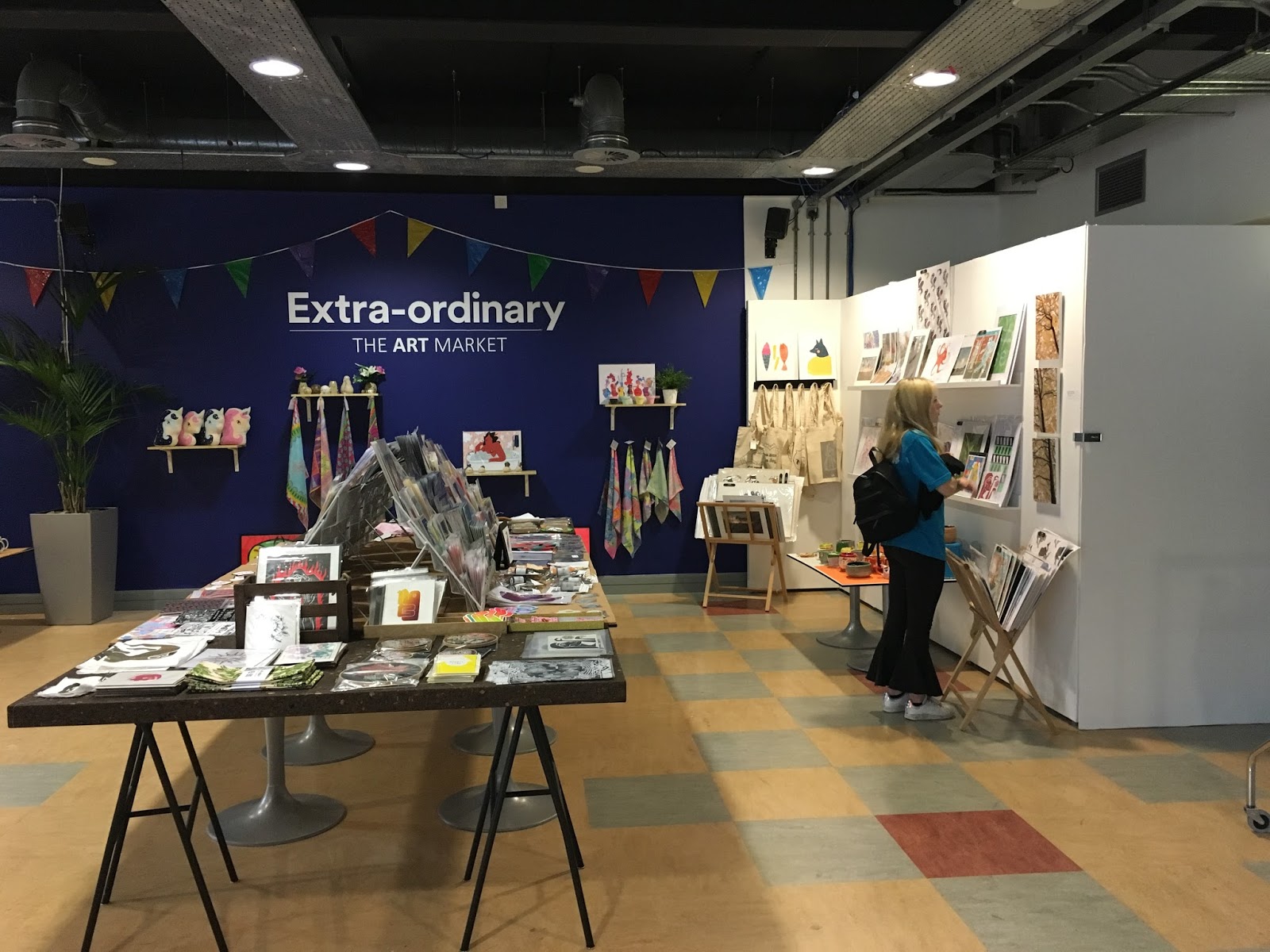
As I mentioned a couple of weeks ago (see this week 70 blogpost) ), the College holds an Art Market as part of the end of year show and I had decided to submit some work. It was quite exciting preparing for this. I took the best 5 prints of the gentrified office building (now titled 'Gentrification'), plus I decided to take the prints I did for the Manchester Metropolitan University (MMU) PGR conference back in February (see this week 58 blogpost) . I wrapped them in cellophane and they looked pretty professional. I decided to price the work for that particular market, especially as the College were not taking a percentage.
 
Prints packed and ready to go to the Art Market
 
Friday was the opening night of the show and of the Art Market. As mention below, I met Michelle beforehand and the Art Market was in full swing by the time we got there and met some of my fellow students. I was thrilled when the sister of one of my classmates bought a 'Gentrification' print plus one of the MMU prints. It made all that time in the print room seem worthwhile. 

On Saturday morning it was my turn to do a stint on the till at the Art Market and I was joined in this task by a student I didn't know but who was very pleasant and easy to work with. I'd not been there long when my lovely tutor, Sharon, appeared. She also bought a print of 'Gentrification' and I was secretly very pleased although I pretended to be tut at her! It was really interesting to see what people were buying - a real mix of stuff, it wasn't the case that one particular genre or medium was flying off the shelves. 
 
View of the Art Market - my prints are the green ones above where the girl is standing
 
I had a quick look when I went in for my tutorial today (more on this below) and could only find one 'Gentrification' and two of the MMU prints left – looking quite exciting!

Printing

After dropping off the prints at the Art Market on Thursday, I went back into the Print Room, and I was in there on Friday too. I’ve been doing some further work on the Burley drypoint (see this week 69 blogpost ). I worked further into the plate, to try to get some lighter and darker marks. Then I tried it drypoint with a painted monoprint on top. I experimented with mixing the coloured ink (cobalt blue) with a transparent ink extender to give a lighter background. This worked OK, as did variable inking of the background. However, most of my efforts at the painted monoprint were rather too indefinite, and the drypoint seemed to come too far to the foreground in the print.  On Friday I tried the transparent ink again, this time with a very high proportion of it, but it got quite sticky and difficult to work with. It did give slightly better results than the previous day, but I’m not sure if these are really two separate prints that I'm trying to put together. I don’t know where, if anywhere, this is going to go next. A possibility might be another drypoint plate as the foreground, or perhaps trying a different colour foreground or mixing some transparent ink into the black so the two layers might “equalise”.


Experimenting with inking the Burley drypoint

I also took the first prints of the aquatint of Royal Park that I was working on a couple of weeks ago (see this week 70 blogpost). There were supposed to be three tones within the print – it had been bitten three times after applying the aquatint solution - but it seems that all the tones had rather collapsed into one. After discussing with Mike, I put another liquid ground onto the plate and worked back into it to try to get some darker contrast into it. However, the result now looks rather too dark – I haven’t been able to get a satisfactory print and basically the plate looks over-worked. I was disappointed with myself but I can learn from this. Really I need to do a test strip beforehand for the aquatint and possibly print it at each stage, although the thought of all that stopping out fills me with dread.

 
The aquatint before I worked into it again - should've left it there!

Catching up 

As I mentioned above, I met Michelle beforehand to catch up with what's happening in her practice. As always it was a good conversation and we discussed opportunities. She had previously encouraged me to submit some of the work based on our dérive for the group show at Left Bank on the theme of 'Movement'. I showed her some of the work I’ve mentioned above and we talked about whether these would be suitable and how I could develop them.

Another catch up was with my tutor, Sharon, at my tutorial on 12th June. As ever, there was lots of food for thought. A large part of the discussion was around what I will submit, as the deadline is now only two months away. There was also a lot of discussion around the idea of the Royal Park aquatint as a journey. Further ideas were around embossing the paper on the Burley monoprint instead of having two layers of print. Much to do!

Monday, 5 June 2017

MA Week 71 - Troubling Time


Reflection on the past week, 5th June 2017

 
Preparation

Wednesday was spent finalising the paper for the "Troubling Time" conference on Thursday, 1st June. I reused some of the slides from the "Grim up North" paper last September, and took my dissertation as my academic source material. The ideas was to do a talk of about 5 minutes then ask the participants to produce a visual work, based on the organisers' encouragement of contributions which “engage practically with their duration, with the aim of fostering methodological diversity”. In the end the talk lasted 7 minutes, and I felt that 10 minutes would be a reasonable amount of time to be able to produce the artwork and that this would work within my 20-minute slot.
 

The day itself

The conference itself was a fantastic day and I am writing a very deep reflection on it to hand in as part of my final submission. The speakers included PGR students and lecturers, many of whom are practising artists. They introduced me to concepts of temporality that I hadn't realised existed. In particular, there was discussion of capitalist notions of time; the regimented working day, driven by society. Contrasted with this were notions of doing less to achieve more, awareness of differing temporal rhythms, and the joy of the dérive. The reflection I’m producing will form a rich source of research material for me to develop once the MA is finished.

 
My Panel

My own panel, “Walking and Space”, was shared with two particularly excellent speakers, Bob Dickinson and Jo Lee. Bob is a PGR at Manchester Metropolitan University as well as being an established art writer and former BBC radio journalist. Jo is a Senior Lecturer in Graphic Design at Sheffield Hallam University. Bob's talk, “ART BUNKERS”, started by describing artworks being displayed in an underground bunker in Konjic (in Bosnia-Herzegovina) and ranged through many concepts of “bunkers”, including the way that artists bunker themselves in studios in old mills and the like in the more run-down parts of town. These then become gentrified and the artists have to move out. This made me think, somehow, of me bunkering myself away in the print room, forgetting to drink water or eat my lunch, completely focused on the artistic task in hand.

 Jo's talk, “Essaying time: photography, artistic knowledge and meaning in movement”, covered concepts of how artists work - very slow periods followed by bursts of intense activity - plus the idea of going backwards to move forwards, constantly repurposing and seeing anew. She showed a mesmerising slide show of triptychs of her photographs of the now-defunct Spode porcelain works. So many surfaces, marks that were just crying out to be made, a palimpsest of life. Interesting concepts around surfaces, what’s underneath, does it need to be revealed.

Jo had helped calm my pre-talk nerves and in the end things went well. After explaining my practice and my methods of layering and the way I use colours, I invited the participants to produce a piece of visual work that said something about that day. I'd taken along a selection of pens and pencils, some blank paper, an old road atlas - a nod to psychogeography - and pairs of scissors. I'd done a couple of quick sketches in the train in the way over and used this as an example - but none were needed. I'd been prepared for people to ask for further clarification, to do nothing, or even to argue - but none of this happened. Everyone got on with the task in calm, studious silence.

The responses were incredibly varied and complex and in all honesty I am still processing this in my little brain. The responses included a participant from Argentina who used portions of the sea from the road map to depict her first crossing of the Atlantic; a stitching together of various pieces of the road atlas index with a challenge to estimate how long it would take to travel from each place to the next; a clock with no hands; a compartmentalised version of the journey that I'd undertaken that morning, from Leeds to Manchester. I stuck them all in a sheet of A1 paper I'd brought along, rather hurriedly, so aesthetically it wasn't overly pleasing, but time was pressing on.

 
The artwork on display at the conference

The session overran wildly (well, about 5 minutes) but nobody seemed too worried about this. As I mentioned in my week 70 blogpost, I'd made some postcard sized business cards which I offered to participants by way of thank you. These went down really well and were very much taken in the spirit in which they were offered. 

 After the session quite a few participants came up to chat to me. Some were studying, or had studied at Leeds and had enjoyed the images of the city that I'd used. My Argentinian friend commented that she'd never seen this done in a conference before and was really pleased to be able to contribute to the collaboration.

 My initial reaction was to take the collaborative artwork and submit it as part of my MA submission, but I quickly realised I couldn't do this, as it didn't belong to me. It belonged to everyone who had contributed and to that point in space and in time. So with the help of a couple of the others I pinned it up on the wall.
 

Networking

One of the really enjoyable things about the day was the number of international participants. Over lunch I chatted with an Albanian and two German participants, one of whom is a professor in Tokyo.  There were also participants from Universities in Greece, Canada, Hungary and Poland. This international flavour made for very broad view and was quite a contrast with the "Grim up North" paper, which was more localised by the nature of its subject matter. This in turn made me realise how flexible and malleable my practice is, and how the visual arts cover such a wide range of source materials in every piece they produce. This breadth of practice is such a key strength of the visual arts.
 

With Bob at the drinks reception
The day ended with a drinks reception. It was a lovely Summer afternoon and we drank prosecco in a nearby bar. I chatted at some length with Bob, who was a very interesting and equally knowledgeable conversationalist. It rounded off one of the most interesting days I've had during the MA.
 

The next day

The conference itself was actually two days, but I'd only booked for one. I wished I'd booked both. However, it would have been too much of a rush to get back to Manchester for 9am the next morning, plus I needed to get back into the print room to prepare for the art market as I mentioned in last week’s blogpost. I'd connected with a few of my fellow participants on Twitter and one of the first tweets of the day was an image of our collaborative work welcoming the participants to day 2. The excellent conference organisers, Mao Hui Deng and Sophie Stringfellow, also tweeted a picture of themselves in front of the work as a wrap-up to the conference at its close that evening. It seemed the work had become a kind of talisman for the conference, some kind of visual representation of the narrative of the two days. I felt humbled and gratified.

I was very tired that next day but I was aware that the previous day's discussions had left me with a different view of time. So rather than rushing, I decided to relax and enjoy the printing. This was one of those serendipitous moments when theory and practice combine in increased creativity. I'd inked this plate umpteen times before, but the inking suddenly went quite futurist and dynamic, with no input from me at all. I'm not sure how this happened but it was intuitively connected with the previous day's activity.
 
The conference will stay with me for a long time. A real highpoint of the MA.


Tuesday, 30 May 2017

MA Week 70 - Professional Development, Printing and Conference paper


Reflection on the past week, 30th May 2017

I broke up from work for about 10 days on Wednesday 24th May – this was partly to do with my working days, with bank holidays, plus a couple of days off for the “Troubling Time” conference. My intention was to focus as much as I could on my practice in all its different aspects. I started even before I broke up – on Tuesday I sketched one of the photos from the mini-derive, which was made all the easier by my sketching the subject directly the previous day (see this week 69 blogpost) and etched it into a plate prepared with hard ground. I didn’t put too much detail into it as I didn’t want to waste time if it didn’t work – I was still wondering about my technique after the soft ground issues of the last couple of weeks. I zipped into the print room to etch it on Wednesday dinnertime and it seemed to etch OK, which was a relief.

Professional Development
I was straight back into college after work on Wednesday for an event about “Exhibiting your work”, led by Bryony Bond, the Creative Director of The Tetley in Leeds. Bryony gave a 10-point plan to holding a good exhibition. It was good to have the information presented in this way, and pleasing to realise that I probably would have thought of most of it anyway eventually, after years of working in business and organising events. As always, though, there were a few really good points to think about. One was Bryony’s assertion that you shouldn’t be afraid to invite big names from the local art scene (or indeed, the art scene further afield). Curators always want to see new, interesting art. Another was to go to every opening you can, get yourself known, and make as many connections as possible. Also – put on shows yourself and make them events, with artists’ talks and the like.

Another professional development event followed on Thursday morning, “The Art of Communicating”, an event by the Cultural Institute at the University of Leeds. This was led by Kerry Harker, the founder of the Tetley, now a freelance curator. I found Kerry’s style both engaging and accessible. As with the previous evening, I’d already discovered quite a lot of what Kerry talked about in dribs and drabs, but it was good to hear it presented consistently and with a strong message. And again, as with the previous evening, there were a few really important points. A particularly good one was to own, drive and manage your own practice and not compare it to the practice of others. As Kerry pointed out, you might wish you had another’s practice, but you don’t. So take your own practice seriously and move it forward.
There were also two other speakers who had graduated fairly recently and who talked about setting up collectives and starting to make art happen in the city. They gave some tips for getting funding and an insight into difficulties they’d faced. I’d already heard of some of the work of both of them and it was interesting to hear their side of things and also that they spoke honestly.

As always, I have quite detailed handwritten notes from both these events, and blogging about them makes me realise I should go back and undertake some of the actions that I promised myself I’d do immediately.

Printing
The thankless task of stopping out
After the morning’s event, I was straight over into the Print Room to start working into my latest etching. After taking a few prints, Mike helped me to spray a mixture on it that would allow it to aquatint, and I set to work with the endless task of stopping it out and biting it, which is still in progress.

I also had another go with the soft ground conundrum. I stripped back one of the plates that hadn’t worked last week and applied another soft ground, then drew onto it through greaseproof paper. I etched it for much less time than previously and I actually got something out of it – by no means perfect, but enough to give me more to go on.

Small steps forward, or going round in circles?
The plate hadn’t bitten deeply enough to give a proper print, but it did yield a couple of clues. There was a lot of foul bite on the surface, which I took to be where I had rested the circle stencil and my ruler onto the paper on top of the plate. The ground was also starting to come off in one corner of the plate, akin to what had happened the last couple of weeks. When I looked more closely, I realised this was where I’d handled it (even though I’d been really careful). So I concluded that the ground is much more fragile than I’d realised. Again, more experimentation needed, but a step forward.

Today, along with the endless stopping out, I’ve been pulling prints of the gentrified office building to put in the “Art Market” at the end of year show towards the end of next week. The idea is to do a variable edition of 10 and put 5 into the market.

Troubling Time Paper
The other main activity has been firming up the paper for the “Troubling Time” conference in Manchester, which is slowly taking shape. I was really struggling with getting it together earlier today and I knew that I needed to go for a walk, so I took half an hour and walked mindfully. This helped free up my thoughts considerably. I’ve always found a half-hour walk from work at lunchtime really beneficial for, quite literally, clearing my thoughts. I’d never realised it was so integral to my wellbeing, despite a lot of my art practice being walking-based.
Bank holiday weekend work!
Also for the conference, I have used some of my old monoprints to make postcard-sized business cards to hand out to other participants, particularly those who will (hopefully) create the visual work with me in my session. The cards look quite good cut up and in a pile on the table!


Tuesday, 23 May 2017

MA Week 69 - Pressing on with printmaking and Frances Morris talk


Reflection on the past week, 23rd May 2017

Pressing on with printmaking and Frances Morris talk

Developing the drypoint

I’ve developed my drypoint following the circles I etched with the dividers last week. As well as the dividers, I'd bought a circle stencil which proved ideal for drawing the circular shapes both on paper and ultimately on the plate. I sketched out a series of shapes from the mini-dérive, working to relate the shapes to each other and to balance the sketch with a variety of shapes and sizes. I also experimented with textures and shading, and was quite pleased with the result. I then flip-photocopied it and drypoint etched it into Perspex.  As always I found curved shapes difficult to draw - seems the trick is to move the plate rather than the needle.  The idea of this is to form an underneath layer of a two or three layer drypoint of the walk. It gave a reasonable result but I will probably work further into it to try to get a bit more variation in depth, following on from last week’s results. I printed it in blue (process cyan) as I wanted to take one of the colours of the walk, namely that of the railings outside the former Burley Library.
 
The shapes of the overlooked urban environment


Yesterday I went out at lunchtime and did a couple of very quick sketches which might act as a “top layer” to this plate. I’d drawn outdoors previously but taken quite a bit of time over each sketch. These were done quickly, and I was amazed at the amount of visual information you can get down within 5 minutes.
 

Houses; visual note
 
More soft ground troubles.

Following on from last week's experiment, I tried again with pressing plant materials into a soft ground. Last week I used an old plate that I'd acquired and stripped back. This week I used a similar plate plus a brand new one. I sanded them both back equally and cleaned them to within an inch of their life following my hunch of last week. However... still no joy. The ground still came away. So it isn't the plate, given I’d used an old and a new one, and it can’t be the cleaning either. It must be something to do with the preparation and/or the etching. More investigations needed.
 

“Troubling Time” conference paper

I've started to write the paper for the "Troubling Time" conference in Manchester on 1st June. I am going to introduce my research and my practice, then invite the participants to produce a visual work which "troubles time". This is based on the organisers' encouragement of contributions which “engage practically with their duration, with the aim of fostering methodological diversity”. I don’t know if people will engage with it, and it’s already pushing me out of my comfort zone, but that’s probably a good thing.

On a related note, I've just heard that the walking event scheduled for 1st June has been postponed for a couple of reasons. This is a shame but it does mean that I will be able to attend the whole day at the conference which will be good.

Frances Morris talk

Finally I went to an excellent talk by Frances Morris, director of Tate Modern, last night. She is a very engaging, interesting speaker and I learnt a lot about "behind the scenes at museums" from her Talk. I've summarised the points most salient to my own practice in this blogpage.


Monday, 15 May 2017

MA Week 68 - Successful exhibit and failed experiment


Reflection on the past week, 15th May 2017

Etching experiments

It’s now May and I need to start to focus on the final project and the hand-in, 3 months away but fast approaching. After enjoying etching so much, I’ve decided to concentrate on intaglio printing to produce my final pieces (so no surprise there, then).

I’ve finally started to work up some of the ideas after the April mini-dérive. I’ve been sketching abstracts of shapes from the walk, and I’m still playing with how they might work together. I’ve also been trialling how best to drypoint circles, as previously pondered. I’ve done a test plate which has given interesting results. I bought a pair of dividers but I think they are a bit light weight for this task. However, the rather faint mark they made gives depth to the plate as it contrasts with some of the deeper marks, so perhaps there is something to pursue there. I’ll continue to work on this.

 
Playing about with circles and acetates

A disappointment was a failure with grounding a plate. I’d applied soft ground to a previously-used copper plate, which I’d re-prepared according to what I’d learnt so far. I wanted to press it onto the grates I photographed to try to get some surface texture. I tried this but it didn’t work – I think the two surfaces were too flat, and Mick (the Print Room manager) said this was probably the case. By this stage I was already unconvinced by the ground, but tried making some further marks into it and biting it. When I came to rinse it, the ground rinsed off. As far as I can tell, it hadn’t adhered to the plate properly. I can only think I didn’t clean the plate enough before I applied the ground, but I’d spent quite a lot of time soaping and re-soaping it. Back to the drawing board with that one, but at least this setback is early on in the proceedings and I can rethink the idea.
 

Exhibition exposure

I forgot to mention a couple of weeks back that I had had a piece accepted for the “Framework” exhibition at the Old Red Bus Station bar in Leeds. The exhibition is to raise money for Leeds Women’s Aid and the organisers (coincidentally also students at Leeds College of Art) wanted pieces that would be suitable for viewing by children. As that rules out a lot of my current rather darker work, I submitted a painting of some lilies that I did a couple of years ago and was delighted to get it accepted. Even better, I met up again with Michelle before the opening last Thursday and we talked more about developing our work together. There were a few other familiar faces from the MA course too and it was a really lovely occasion.
My piece is the flowery one at the top. Honestly.
 
Academic thoughts

I also met up with Zoë again to chat more about how the walking event will work on 1st June. As always it was an interesting and insightful discussion. It set me thinking in much more detail about how it is going to work. I think the paper I’m giving in the morning in Manchester will have some overlap with it, as I’ve been working on the basics of that, too. More thinking to do on both those topics.
 
Looking at this blogpost – I have actually done quite a lot over the past week! It didn’t feel like it at the time. That’s the value of reflective practice, I guess.

Monday, 8 May 2017

MA Week 67 - Two weeks for the price of one


Reflection on the past fortnight, 8th May 2017
 
I’ve just realised that I’ve lost count of the weeks somewhere, and that I was going to end up having 81 weeks in an 80 week course, so I’ve combined the past two weeks. I’ve done quite a lot, too.
 
Sketching and etching
I did a final sketch of St Paul’s (see also this week 65 blogpost) which still wasn’t brilliant, but allowed me a further chance to play with perspective. I don’t know why I found it so difficult; possibly it was because I was trying to alter the perspective from the photo I was using. Next day I transposed it to one of the little copper plates and worked on this for a couple of days. It still wasn’t a brilliant drawing, but the etching worked and I got some prints out of it. I used the needle with the slanted edge (I think it’s called an echoppe) which worked well when making curved shapes. I also used a roulette wheel to give some texture to the blossoms and leaves and I was surprised by how deeply it bit. It took so deeply in relation to the etched lines that I didn’t think they had bitten. I imagine I probably dug too far in with the wheel.

One result of this was that the blossoms were obscured. I thought about drypointing them in, but Mike suggested regrounding, re-etching and re-biting the plate. This seemed like a good way to learn about multiple grounding. I used liquid hard ground again and the resulting re-work certainly gave more definition. However there was a lot of “foul bite”, with dots here and there. I then realised I’d not cleaned the plate before re-grounding, so presumably there were dots of grease that resisted the ground. Possibly not ideal, but a lesson learnt. Also the dots gave some texture, so possibly a slightly happy accident.
 
Springtime St Paul's
 
I had intended to grind this off the plate and do a completely different design, but I’d learnt so much from this little plate that I’ve kept it, for now at least.
 
On Saturday and Sunday I attended the “Etching Weekend” at the West Yorkshire Print workshop in Mirfield. It was excellent. I worked with two images; a photo of Assisi I’d taken on holiday a few years ago, which I knew would work up into different areas of tone, and an image of some tulips from my mini-dérive with Michelle.  
On the Saturday we prepared and etched a hard ground plate, for which I used the Siena image. I’d already practised a lot of this technique but I learnt a lot of hints and tips. We also prepared a soft ground plate. It was really interesting to see the nuances of different workshops. 
On Sunday we started with the soft ground plate, into which I pressed some plant materials that were just growing outside the window. I then traced the photo of some tulips into the ground. I was surprised how dark and crayony the marks bit; the soft ground is very fragile compared to the liquid hard ground I’ve been using in college.
 
Assisi aquatint
 
The next stage was aquatint, and I decided to aquatint both plates. Our technician, Kate, applied the actual rosin powder but I would like to learn how to do this. I’d worked out the tones I wanted for the Assisi print and it was a bit tedious applying the stop out varnish to achieve this, not really knowing what the outcome would be. I was very pleased with the result considering it is a first effort. It printed rather too dark but Kate showed us how to adjust the transparency of the ink to allow lighter-toned printing.
 
Sepia tint tulips
The plant material images and the heavy drawing marks of the tulips don’t necessarily belong on the same plate, but they don’t look too bad together and this serves as a really good test/ideas plate for future soft ground use. Kate helped me to print it in colour. I would have liked to have picked her brains further on that point, but time didn’t permit. All in all an excellent weekend.
 
 A moan retracted
 
I mentioned in this week 63 blogpost that I’d submitted a conference abstract and heard nothing. It transpires that an email must have got lost somewhere in the ether as it had been accepted! This caused a panic as the conference had been extended to two days and my panel clashed with the walking event with Zoë and Lynne. Fortunately the organisers were mighty accommodating and have moved my panel to the morning so I can do both events. So that’s a paper to write added into the plan then!
 
Otherwise…
 
I was away over the weekend, which was great, so other than that I’m desperately trying to catch up with my creative journal. It’s good reflecting back with the benefit of hindsight but I really wish it was a bit more up-to-date!