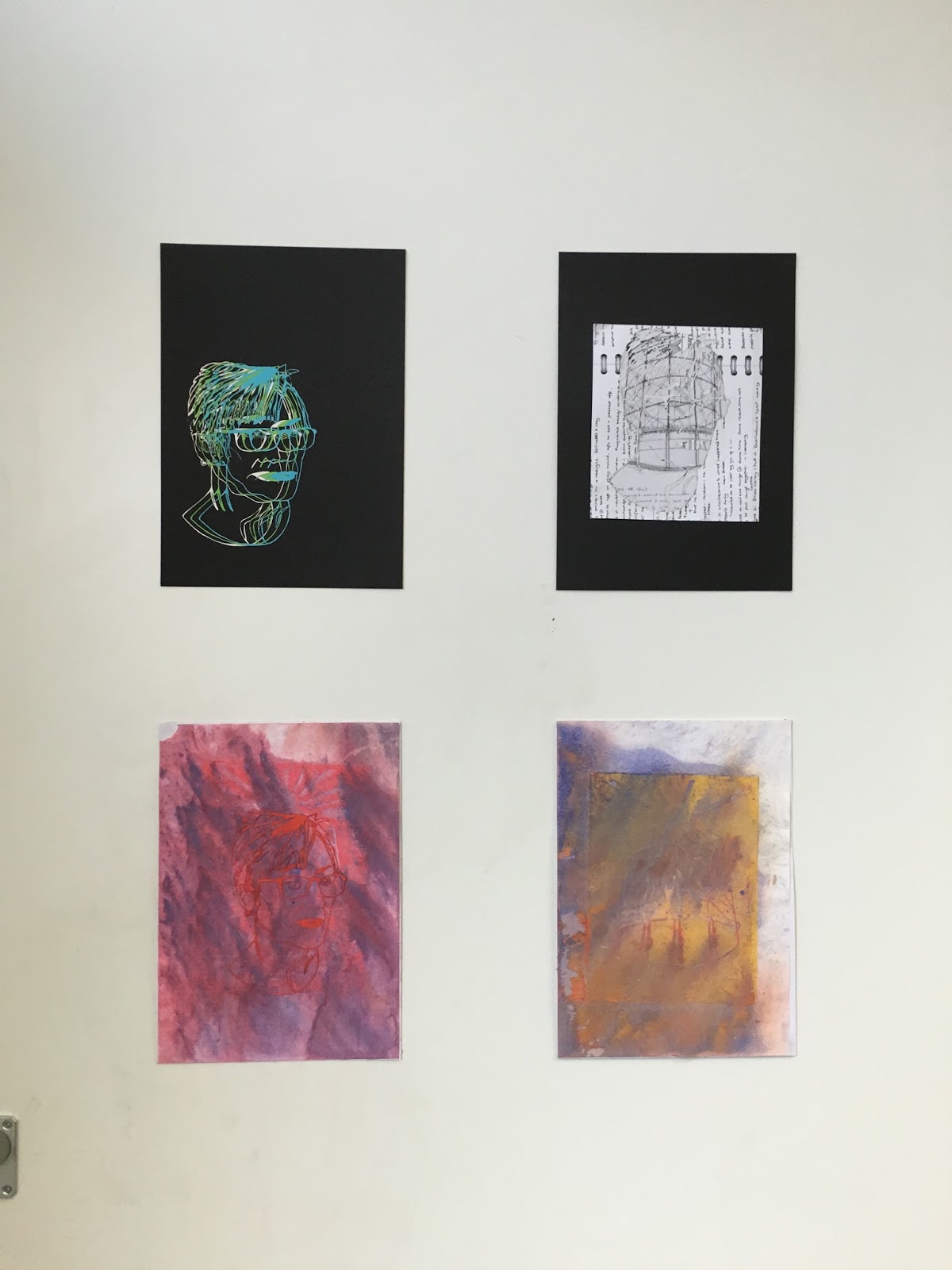
Reflection
on the past week, 27th March 2017
Printing and processes
Following on from
last week’s blogpost, I updated my overall plan but decided I needed more
tactical, day by day plans, to allow me to focus and get something done. I
decided that I should work around being able to get into the Print Room on
Friday. I wanted to restart etching but felt unsure about how to do so.
It’s amazing what
a bit of thinking time can do. A few strands came together, somehow. A couple
of weeks back I had a discussion with one of my fellow students about how my
health difficulties impact on my ability to produce work. I seem to have
intense phases of activity followed by days or weeks of inability to do
anything, even blog. She said, “that’s your practice. Work with it”. This quite
obvious piece of information came as both a revelation and a relief. Within
creative practice there always seems to be a driver to do work on a grand
scale. Realising that smaller pieces of work can also be valid suddenly opened
up new ways of working.
Allied with this,
I’d been reading and pondering upon a newspaper that I’d received at the MMU
conference. The illustrated paper is by Howard Read, whom I’d met and talked
with briefly, and it describes his visual and academic research into the gentrification
of Elephant and Castle in London. The subject material was of obvious interest
to me. Alongside considerations of the removal of social housing and the
creeping gentrification, Howard had discussed in detail the purpose of
sketching and drawing. Again, a real insight: not all drawings have to be
finalised. Indeed many drawings should not be finalised as they are a
contribution to a future, finalised piece. A sketch can be just that – a visual
note, so to speak.
 |
| Original photo.... |
These two strands
manifested themselves in a realisation that I didn’t need to rush anything; I
could work on a smaller scale with a more robust process. I therefore got an A5
sketchbook and did a (reversed) sketch of one of the Mabgate photos. It isn’t
perfect, but it is allowed to be like that. I also moved some things around in
the composition to suit my purpose. I let myself enjoy the sketching rather
than pressurising myself and it worked so much better. The following evening, I
found the little copper plates that hadn’t worked in the Summer, and found I’d
re-ground them. I freehand-etched the same image into one of them.
 |
| Etching based on photo |
I hadn’t been in
the print room for so long that I felt slightly nervous returning. By happy
coincidence, Mike (the technician) had been doing some etching so had
up-to-date experience of how long to bite the plates. I bit it for 29 minutes,
inked it, printed it and… it worked! 7 x 4.5cm of wonderful scratchy black
marks. I spent the rest of the session working with different papers (Canaletto
and Zerkel) and different levels of polishing, to get used to using the copper.
The plate’s previous biting (from the Summer) has left it pitted and this gives
an interesting undertone, so this is possibly something to do more deliberately
as I move on. I also sanded and inked another of the little plates from the
Summer ready for the next piece.
Crit
The same day, five
of us got together for a crit. I’d brought in the paintings I did for the MMU
conference plus the Mabgate office print (see this week 51 blogpost) , but by this time I’d printed the
little plate and had become quite immersed in that. Ignoring this, my
classmates gave me plenty of input!
 |
| Details of "tiles" from work for MMU conference |
Again, as at the
conference, there was interest in the “tiles”. There was a suggestion to
introduce colour into the tiles, or to try strips. They suggested using
photocopies and copies onto acetate to help composition. Another wake-up call
around process. I know this – so why haven’t I been doing it? It’s been the
time pressure that I’ve put myself under, of course. There was a feeling that
the map elements might be too literal an interpretation of the journey, and it
was suggested I consider cropping some of the work – effectively using a little
square viewfinder to find points of interest. This tied in with ideas I’d had
to do a few smaller pieces – paintings, prints, drawings, photos –based on the
Mabgate photographs. A really interesting idea was to take a “slice” of work –
why does everything have to be square, or rectangular.
I particularly
like the idea of basing something on the “tiles” but using colour and using
strips so this is a probable area for experimentation.
London
The next day, the
same five of us went to London. I’ve written reflections about the galleries we visited in this London Galleries page.
However, there is something more to relate. We were all feeling pretty tired at
about 4.30pm outside our last gallery, the Drawing Room, and after some
discussion set off to walk to Elephant & Castle tube station to get the
tube back to King’s Cross. We hadn’t go far when by chance we saw a bus going
to King’s Cross so we boarded. This meant a top-deck view of Elephant & Castle,
including the very development that Howard Read had been recording. I’ve never
been to Elephant & Castle before in my life. It was such a heavy
coincidence that it intuitively confirmed to me that my approach of the past
week was the correct direction at this point.
 |
| Visiting galleries is thirsty work |