Showing posts with label research methods. Show all posts

Tuesday, 1 November 2016

MA Week 45 - an emerging structure for the dissertation


Reflection on the past two weeks, 1st November 2016

Nothing visual to share from these past two weeks, unfortunately. A combination of a couple of days away then picking up one of these bugs that’s going round meant I didn’t get into the print room. I did, however, join the new Leeds Print Workshop and had my induction and that made me want to get printing again. There are also lots of interesting buildings around there so I have earmarked that area for a bit of a wander as soon as I have time, whenever that might be. 

Most of my “spare” time has been spent on structuring and editing my dissertation. As I mentioned in my week 43 blogpost, I’d realised that the structure wasn’t correct. I’d written it as a kind of series of analyses of different theories and techniques – heritage theory, identity theory, psychogeography – then I was struggling with relating this to my own practice. I’ve now moved things around such that the theories form a backdrop to the Armley urban wandering I undertook back in February, and that wandering and its outcomes are the body of the essay. I then move on to describe that the theoretical perspectives and the wanderings form a methodology. Possibly methodology is a bit too grand a term, but it’s a working method that works for me. 

I’ve been quite surprised at exactly how much work it’s taken me to do this restructuring. I’m used to writing business reports and to putting together an argument. However, having to reference and evidence everything in an academic essay is much more time consuming than I’m used to. Writing the dissertation as an introduction, three chapters and a conclusion is odd too. The chapters are only two or three pages long so they are not really called “chapters” in my head. Siloing the information is proving problematic too. I can only think that it’s one of these things that would be easier the next time you did it. 

Anyway, I now have the first draft that actually has some proper flesh on the bones, so to speak, and though it’s woolly in places, it does have the basic flow of what I want to say. It’s about 5000 words and the target is 6000-8000 so it is well on its way. I’ve got to the point where I’m so close to it that I need a couple of days away from it as I can’t tell whether a paragraph is rubbish and needs deleting or whether it is crucial to the argument. I have a tutorial with Sharon on Thursday 3rd November so hopefully that will give me a bit of clarity.
 
I am aware that I am still relying heavily on a small number of books and I discussed this with Karen, the academic writing tutor. She advised me that you don’t necessarily need to “compare and contrast” but you do need more than one author’s supporting ideas within the essay. She told me to envisage it like being in the room with your “favourite” authors for a day. After that you would want to hear some other voices and ideas. I liked this viewpoint. Whilst I was doing the restructuring, I deliberately didn’t read any further texts as I wanted to concentrate solely on the structure. The next tasks will be to start reading again, and possibly to think of other forms of research, although time remains of the essence.


Monday, 27 June 2016

MA Week 33 - Holbeck urban wandering : End of Days


Holbeck Urban Wandering – 23rd June 2016

An urban wandering to find some more Northern shapes, inspired by the view from the train leaving Leeds.


Transcript: 

23.06.2016, en plein air, Granary Wharf 

I didn’t do the wander I’d anticipated. In the end the bus I got only went to the Bus Station, not City Square, so I got off there & wandered via Call Lane. I returned to my old haunt of the path by the canal near Brasserie Blanc. It was great to be doing an art project while the skirts and suits were in their offices. Then I walked down Water Lane to Tower Works. Very gentrified now; offices and open spaces, but a very peaceful and welcoming space. I ate my sandwich and sketched the shape of the towers, nearby offices and Bridgewater Place. You can get out onto the canal there, too, which I never knew. Lots of railway signal gantries as that’s where the main line to London leaves the city. I’d intended to go look at Temple Works but I walked by the canal a little way instead, and photographed the reflections. I was thinking about this idea of how much of an actor you are in an artwork? How much of an actor are you in a generative wandering? If you let yourself deviate from your intended path, have you lost control or gained the point of wandering? You can always go somewhere else another day. Wandering heightens your sense of place and your perception of shape. I thought it would be difficult to wander somewhere I didn’t know, but you just have to open yourself to the experience.

-------------------------------------------------------------------------------------------------------------

Tower Works
I’d taken a rubbing of a door at Tower Works and wrote the above transcribed text onto that, although it was really a bit dark to write into. It was written at the end of my wander, sitting on a bit of grass, surrounded by bars with office workers eating and drinking al fresco. By chance I had wandered into the world of others at their lunchtime. I felt a bit like I was moving amongst them as an interloper, a ghost. I hadn’t realised how many offices there were nearby, and there were many workers taking the chance to walk in the warm sunshine – it was about 22 degrees – and to have a cheeky drink with their colleagues. I began to wonder about their stories. There was a group of six women who strode out as I sat sketching, chatting twenty to the dozen. They were on the way back when I strolled further up the towpath, and I guessed they did this most days, come rain or shine.  What did all these office dwellers do? Who was in with the in crowd and who was out? Did they even notice me sitting sketching and writing? Were they all as cheesed off with their jobs and daily grind as I was when I worked in Finance in the city centre?

 
Leeds Minster, 23.06.2016

It was a gorgeous sunny day, a day when it’s really good to be alive. Oh how different life felt the next morning. I took over a hundred photos, including Leeds Minster in use as a Polling Station. Without intending to, I had recorded the quotidian in image, sketch and text on the day of the EU Referendum.

In some ways I can hardly bear to look back on the photos as they seem to represent the last day that things were (vaguely) sane, but at the same time they present compelling evidence to support my ever-growing belief that each day is gently laying down the heritage of the future. That day certainly did.


Wednesday, 15 June 2016

MA Week 31 - an afternoon well spent


An afternoon well spent - 15th June 2016 

I took the afternoon off and went to the Tall Tales : Crooked Yarns research forum at College. I’ve discussed this in detail here. It really was a thought-provoking afternoon and a validation of the way I’m conducting my research. 

Prior to the forum, I met a former classmate who has sadly suspended her studies. It was great to catch up with her and our conversation yielded a couple of significant points that I want to document.

Sometimes it takes a conversation to make you realise the blindingly obvious. Both of us are mature students, and in my own case I don’t have a first degree in an Art subject. We acknowledged between us that returning to studying art later in life meant we are not in a position to compete with the young graduates in their early 20s. However, we do bring life experience and the experience of our own respective careers. Is there a way that this can be acknowledged within the educational field? How do we make this experience count? In my case, the latter is probably answered by putting to use my transferable skills – project management, presentation skills – and I acknowledged to myself that these skills, which I take for granted and barely notice, are helping me to progress with the course. 

Following on from that, we talked about motivations. We both love being artist/makers and both of us have had health issues. We articulated the joy of doing something creative simply because you can and you are still breathing! Harking back to one of the comments I made in my week 27 post - in and amongst all the methodologies and perspectives from which we try to hang our work, shouldn’t there be one which describes working for the sheer thrill of creativity?


Friday, 8 April 2016

MA Week 22 : Practice Based Research


Practice Based Research – 8th April 2016

This session from Karen was based around four clips from Canterbury Christ Church University’sCentre for Practice-Based Research in the ArtsPertinent points from the four clips: 
Goran Stefanovski
  • He writes for the theatre so need to consider his audience from the outset.
  • Ideas come from who we are – “sparks from crossed wires” – the idea gets you, not the other way round.
  • Quality control – a battle with the material and oneself to get to the end. An exercise in perseverance.
  • He is showing, performing and acting ideas, not describing them; the practice of theory.
I particularly liked the assertion that you have to wait for the idea. This has happened to me several times during the course. It is frustrating but I have learnt to accept these times and treat them almost as a short break. 
Bryan Hawkins
  • He makes sculptures, paintings and photographs.
  • He finds two difficult things – starting and finishing.
  • He has worked on his own personal experience, then on others’ experience, the history and place. He also said that the idea comes to find him.
  • He suggests going to a place repeatedly and letting it “seep into you”; he did this with WW2 pill boxes, drawing, painting, photographing in an almost spiritual way.
I identified with this very much, particularly the repeated visiting of a place. The place then becomes yours. I think you can then produce something more fundamentally representative of the place. Hawkins’s work is figurative but mine often becomes more abstract.  
Anthea Kennedy and Ian Wiblin
  • These people are film-makers.
  • They had responded to place in their work. They let work take shape without scripts.
  • Memory is one of their themes and they deal with its presentation and re-presentation.
Their film dipped about all over the place and I paid little attention. It was left to others in the class to point out that memory is not linear and this is the point they were making. I am such a philistine when it comes to film.
Rebecca Pattinson
  • She uses analogue photography in the digital age.
  • She believes that film has a tangible relationship with reality that digital doesn’t have, and that film makes it less possible to manipulate an image compared to digital.
I could understand her perspective although I don’t know if I share it. Both this artist and the previous one used silence in their clips. I didn’t even notice! My classmate Ali, who used to be a radio producer, pointed this out. 
Two things struck me from this session. The first was how I tuned out the latter two clips as they were not talking about anything that interested me directly. How often do I miss out on inspiration by not being engaged? Am I creating a “bubble” of my own by only tuning in when it suits me? The second was that the session was directly relevant and easily accessible, unlike some of the previous research methods sessions. It almost felt like this session should have taken place much earlier in the course. It offered clarity on what practice-based research is because it gave real examples from real artists.
 

Monday, 15 February 2016

MA Week 17 - Generative wandering : in search of the North


Generative Wandering as a research method– in search of the North 

I’ve been working with some existing images of trees for a while, just because they are nice images, but really they are not saying what’s inside, which is more gritty and less pretty than trees (though I do love trees. I think they are wildly underrated). Challenged by my tutor, I said I would go out and take some photos to generate some more visual source material, so she told me I should submit them if I did. Bluff called, I decided I would walk to Armley, a district of the city that borders the city centre, where I knew I would find railways to photograph if nothing else. 
 
Armley from Woodhouse

I walked from college in Woodhouse to Armley and it was 1 ½ hours mightily well spent. What started off as a targeted wandering to find images that match my childhood view of Northernness became slightly personal and introspective. I stopped for a moment as I passed the street where I was born. I feel nothing for the street yet I am repeatedly drawn to this part of Leeds.  
Trouble at t' Mill
 
Cobbled streets, graffiti, all kinds of architecture; Victorian villas, Georgian façade, high rise flats and a nice bit of brutalism, all with the backdrop of the skyscrapers of the city centre. A massively unexpected find was the canal towpath and a re-purposed mill, right next to the Inner Ring Road flyover. To be honest I was circumspect about being on the towpath as, yes, there were joggers and workers, but also a couple of people near whom I didn’t want to loiter. I clutched my bag tightly. Shame. But a mill? What could be more Northern?? 

Electrifying
Moving on I climbed up next to the railway. There was a bridge with fairly open sides so I couldn’t cross it (I have some kind of open bridge phobia – if I can see the road below I panic). That was a pity. However I could walk up Armley Road and photograph the railway in the cutting, near the Adult Store (yes!).  
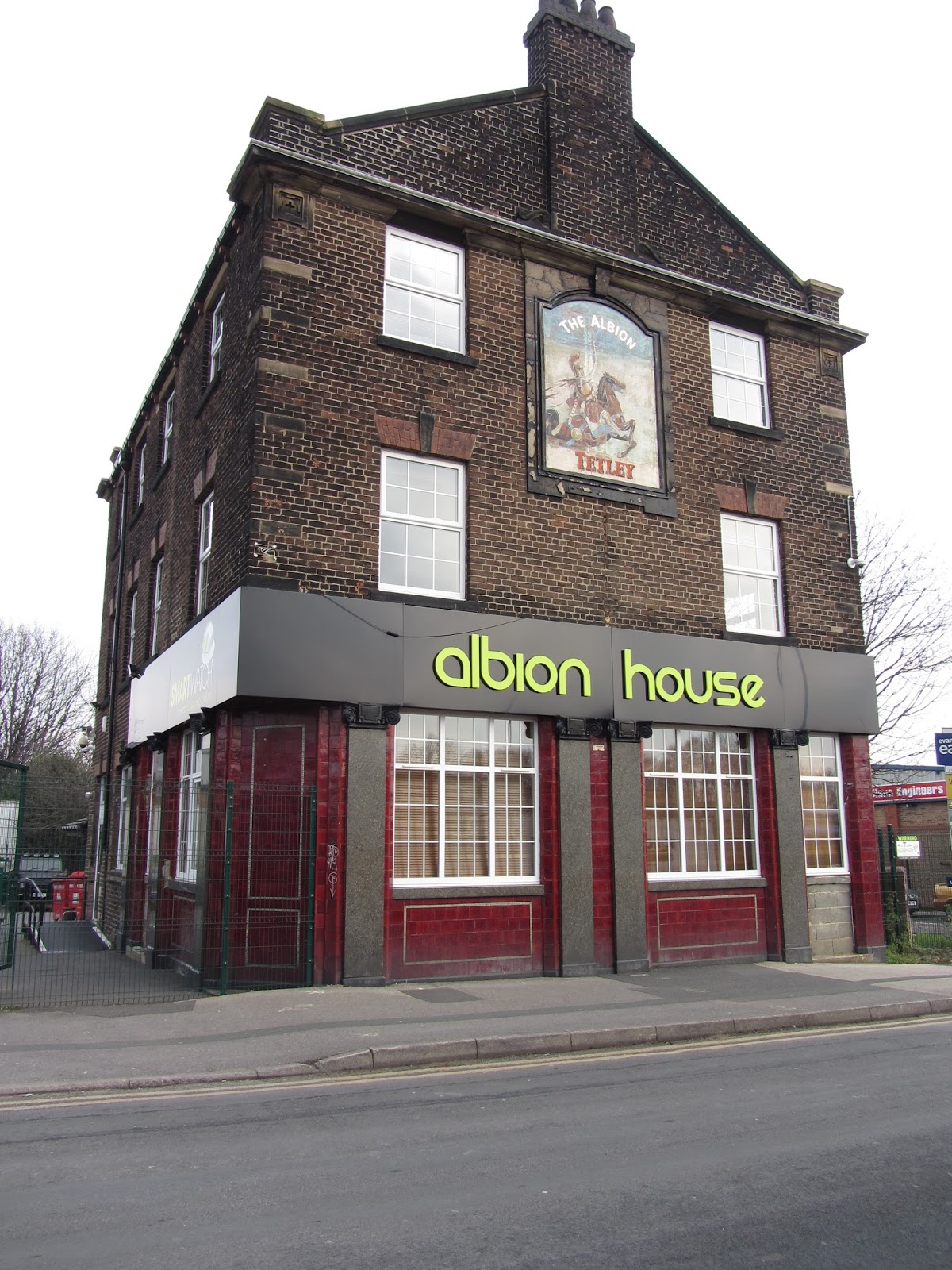
Daughters of Albion
 
There is a light industrial estate there, Albion Park. The Albion itself is now an office for a security firm but its red glazed tiles and ornate picture of a warrior give away its origins. My Dad’s workmates used to make the first purchases from their wage packets in there on a Friday. The Engineering Shop where he worked is long gone, although I don’t know when it was pulled down – he was finished in the early 80s after 30-odd years with the same firm. A poignant moment, to walk where he had, in a place that was his but not mine.  

There were some factories, though, nice and Northern, one still in use and another looking rather derelict. Walking back down Armley Road (clutching bag again as I spied a couple of Diamond White drinkers), I took a bridge-free detour to cross the inner ring road.  This yielded some more gritty buildings to photograph and also the opportunity to get right next to the railway and a good view of a signal gantry with lovely geometric shapes. Then my final destination (and I braved my bridge phobia – just!). The gasometer next to the gyratory. It’s painted pale blue and the rust is just the right shade of complimentary orange to offset it perfectly. 
Paradise by the Gasboard Light

So… did I find my view of Northerness? Yes, there were glimpses. I suppose any part of the country has gasometers (Leeds evidently has five) and electrified railways and adult stores. But the mill is definitely Northern, and the factories gave me a feeling of industry and purpose and dirt and making. I found more memories, too, not that I was looking for them.  

Overall, though, the whole experience of wandering in a part of Leeds that I’ve not explored before (although I’ve driven on those roads many times) was exhilarating in a way I didn’t expect. It was a kind of industry of my own, this search for industry. I “made” some photographs and generated lots of further ideas for making from the visual material, and also from the experience (the lived experience, I guess) of being in those places. There really was a feeling of research about it, somehow; researching visually by looking, and researching by choosing where to walk and thereby forming links between those places. Researching by half-thought out imagined narratives for the builders and decorators in their name-bearing white vans on the gyratory on their way home/to the pub/ to the take-away on a Friday afternoon. Researching by letting myself try to understand this place, what goes on there, what used to go on there. I was weary but buzzing by the time I eventually got home.


Tuesday, 9 February 2016

MA Week 16 - Heritage as a critical perspective (2)


Discussion:  relevance of heritage as a critical approach to my practice, and further points arising

If Harrison is correct, heritage is not only concerned with railway engines and buildings and statues of Queen Victoria. It is concerned with our relationships with “things”, and more importantly, our attitude to those “things” – the ones we love and keep, and the ones we reject. It’s also concerned with our relationship with other people. He doesn’t overtly say this, but we may or may not know those other people; we have a heritage that is uniquely our own, in my opinion, but it is contingent upon and intersecting with the heritage of may others. 

Therefore it follows to me that the desire to produce images of industrial “things” – the gasometer, handtools, railway engines and so on that appear in my work – is a product of my familiarity with, and affection for these things. These familiarities and affections fuel my identity and my identity (values, background, attitude) fuels them. The desire to produce and manipulate images of myself is another way of looking at my identity, but also its make-up – i.e. my heritage. This is supported by Harrison’s assertion that heritage is involved in the production of identity. These two hitherto disparate parts of my practice (heritage and identity) have become two sides of the same coin via Harrison’s words.   

When discussing modernity, Harrison suggests it “can be understood as not simply a set of ideas and philosophies, but also a quality of lived experience” (his emphasis, p 24). This is the only time in my reading so far that I have come across this. There seems to be a missing point here. If part of heritage is predicated on the relationship between places, people and objects (p14), then isn’t “unofficial heritage” – if not the official variant- by definition being laid down by our everyday lived experience? We are constantly forming and re-forming our familiarities and affections with “things” so I believe that we are, to some extent at least, the authors of our own heritage, and that of contingent people and groups of people. This would also support Harrison’s notion of the role of heritage in the production of local, regional and national identity. I believe that my practice comes from my lived experience (therefore, heritage and identity) and that I am communicating this visually rather than by written means.  

If modernity is concerned with a desire to get away from the past, there must be an equal and opposite reaction (to paraphrase Newton) to yearn for the past. As you (well, I) get older, I find the pace of change slightly more difficult to deal with. There is also the effect of the throwaway society and of globalisation. Why is nothing made in England any more? Answer: because it can be imported more cheaply from countries where there is still industry. And so I develop nostalgia for the past. But if we create heritage by viewing the past from the present, then by definition I think there is re-purposing at work. Perhaps not necessarily deliberate, but exaggerations and rose tinted specs do creep in. We long for the simplicity and comfort of childhood and perhaps of the values of society at that time – at least those that we consider to be more noble than the equivalent values of today’s society. 

Another question that came to mind whilst reading Harrison is this : if we are makers/artists, aren’t we interested in what’s gone before? How do we build on it (literally/metaphorically)? We research for practice (we look at what others have done) and by practice (we trial our own versions of their techniques). Things (tools, brushes, techniques) from yesteryear that we still have and use in our practices; are they really part of our heritage or really part of our present and future? There is an indivisibility of the human and the non-human, whether that is the natural environment or the created object. 

Harrison also touches on de-industrialisation, which is a recurring theme in my work. I have a personal belief that it is part of the human condition to make things to use. Therefore, if we are makers/artists, we have an inextricable link with industry, as industry is “making” on a grander scale. So de-industrialisation breaks or weakens this link, leaving a “loss”. This is where my memories kick in, such as the smell of the hops roasting at Tetley’s when it was a brewery and I was a schoolgirl. But they are now only memories, re-purposed for my practice, just as Tetley’s has been re-purposed as an Arts Centre. I express my memories in the hope of striking a chord with others of a similar heritage. 

If, as Harrison suggests, heritage is concerned with place, and human interaction with place, then perhaps this also explains some of my desire to record my wanderings on the town moor. I was born near there and work near there and study near there. I have quite a lot of photos of wanderings on there. Granted, some of this is because I bought a new camera and it’s a convenient place to experiment. But I began wandering to here in my previous life, when I worked in a stressful job in the city centre. I wanted to escape the city and found the exercise and the green lung of the moor a retreat in my lunchtime. In essence I was shifting back to my roots, but whether this can truly count as heritage under Harrison’s description is a moot point. It is possibly an exploration of my personal history, but it could be argued that it is exploring my heritage and thereby that of other contingent groups. 

Extending this argument, those photos form part of my archive, if indeed I have an archive. I have deliberately got rid of a lot of my physical archive in an attempt to declutter. But I carry an archive, an intangible archive, with me in the form of my memories, as we all do. This forms a part of what I am attempting to express visually. If archives are part of our heritage, then I think I am vindicated in using heritage theory to support my practice. 

My final thought for the moment is this: exploring one’s lived experience is not always an exploration of heritage. It can take a psychological viewpoint of dealing with your past, rationalising, making sense of it. A piece I did after serious illness is a literal archive, as there are documents collaged in. It’s a layered piece, trying to show the complexity of illness.

But perhaps these that are often present in my practice have multiple meanings. The outer layers may mask what’s underneath, not only in the sense of the passage of time, but in the sense of hidden emotions and feelings that are not on view to the wider world.
 
Developing the layering in the work I’m currently doing, which breaks down the surface as well as building it up, perhaps starts to reveal some of what’s inside, which is probably personal history rather than heritage. But if, as I have argued, lived experience contributes to heritage in the broadest sense, then they may ultimately show layers of heritage.

Monday, 1 February 2016

MA Week 15 - the tension between the written and the visual


Reflection on taught session, Friday 29th January 2016
Use of language in art 

The afternoon session was intended to be about an article called “Critical language and visual art : post-structural analysis”, discussing the language used to describe art. But I hadn’t read it and the reason I hadn’t read it was because I knew it would take me a long time to read and digest it (I wasn't alone). I find academic papers in the arts and social sciences difficult to follow. I know I’ll only get better at dealing with them by reading them, but at this point I didn’t have the time to deal with this one, or better said I wanted to prioritise creative work at that point. 

A discussion regarding the use of language around art took place in any case and it raised some interesting points. One view was that the language used needs to be shared and egalitarian; whether spoken or written, it has to be understood by both sides. However this was not necessarily the case in practice, with art critics using their own jargon. There was also a view that art in the middle ages was controlled by social and religious paradigms which meant that there was a set, controlled, view of it and meaning of it. We are now allowed to question things more, so this no longer exists. Other views were that language is powerful and on the other hand, that visceral or spiritual experience does not need to be, and indeed cannot be, communicated by words. A further point was that we are moving to communication by emojis and immediate communication by Vines, so our written communication is slowly being eroded. 

I find a tension in this. I have always written lots. I am a copious maker of notes and I think in words and I write lists and plans. But this course is about creative practice, and a big chance for me to move to a more visual way of communicating, and to improve that same visual communication. It’s a Master’s degree, so there is going to be a need for academic reading and writing, of course. But often I feel the perceived need for communicating in words overshadows the driver, the need, the urge to create artwork. One of my fellow students, who has spent a lot of their professional life dealing with language, also feels the same. The tension spills over into my time management. I’m behind on my blog but I have to sacrifice it for the sake of my creative work (or else I won’t have anything to write about!). How to resolve: keep the blog writing to one evening a week, unless there is something particular to really get into.

MA Week 15 - Academic Posters


Reflection on taught session, Friday 29th January 2016
Academic Posters 

The first part of the day was taken up by looking into academic posters. Annabeth introduced these as a good way to summarise your work in an A2 format. They are often used by new researchers who are starting to develop academic outputs. We organise a poster conference for Arts and Humanities PhD students at the University of Leeds and it’s a good opportunity for them to present their work in a familiar, and hopefully less stressful environment, so I’m already on board with the idea of it being a good way of disseminating your research. 

Some tips from Annabeth: 
  • 500 words maximum
  • Could demonstrate synthesis of research and visual results
  • Could make use of infographics
  • Could take the approach Introduction, background, methodology, results, next steps
  • Make sure you have a hierarchy of information
  • Don’t forget a bibliography
  • Identify conferences which will accept posters. 
Answers on a postcard...
 

We then had a little time to view posters from the college staff and the think about a poster of our own – mine is above. It reflects this ever-refining quest to fully understand my research question. Annabeth also mentioned a poster as part of the outcome for the current module, if desired.

Not much more to say on this, other than it is there as a tool to use if the need arises.

Sunday, 24 January 2016

MA Weeks 13 & 14 - Theoretical Perspectives


Reflection on taught sessions, 15.01.2016 and 22.01.2016

Theoretical perspectives
 

Theoretical perspectives are considered important in art practice in terms of communicating across disciplines and other boundaries. A theoretical perspective is a set of "truths" , according to a quote used from Anderson and Herr. The choice of the word "truths" seems odd to me. Isn't it rather a set of opinions, which hopefully are rigorously explored and argued?  Theoretical perspectives can help us to look at what we're doing (creating, making, writing). Practice can develop knowledge and equally, academic research can develop knowledge. Theoretical perspectives can allow us to analyse and articulate this knowledge. 

Some examples of theoretical perspectives:
  • Feminist
  • Marxist
  • Socially critical
  • Interpretivist
  • Post modernist
  • Post structuralist
  • Deconstructivist 
Some elements of a theory may resonate but others may not. You may need to pick and choose, which is acceptable, but must be justified. 

Theoretical perspectives usually divide into quantitative and qualitative. Quantitative perspectives are positivist and assume one truth. Examples given were science, religion, politics, philosophy. Do each of these have one truth? I don't think they do, or if they do, it is only at a very general level. 

Characteristics of qualitative perspectives include multiple "truths" , discursive, reflexive. They are more concerned with an individual than a group and do not view a situation as static. This type includes theoretical perspectives such as narrative theory and phenomenology. The latter concerns how we experience the world vs what physically makes up the world, and one fellow student gave a good example of this; the scientific universal truth of a glass of water vs the experience of drinking that glass of water. and narrative theory. I could grasp that. 

As researchers and practitioners we do not exist in a vacuum, but rather in a community of some sort, with shared techniques, theories and problems. The shared matters form a paradigm (a framework, a world view, a general set of beliefs) that can guide our research or practice. So as an MA cohort we are a community with different practices but within the paradigm of the MA. I also exist as an artist within a very loose Twitter community of artists with whose work I identify in some way. They are all very different - printmakers, fine artists, ceramicists - but I find something in common with their work and I enjoy seeing their working processes when they are kind enough to share work in progress.  

I am not sure I totally understand the concept of a paradigm and I need to look at this further when (if) I ever get the time. I understand the concept of a framework of beliefs but there seemed to be an implication within this session that the paradigm is prioritised and that any occurrence that tests the paradigm needs to be bent into line so that it fits in with the paradigm. Everyone has beliefs but they change with time and experience. I still have strongly held beliefs that I've held since childhood but they are not now so absolute as life experience has, inevitably, introduced grey areas. 

Some definitions that were offered:

Epistemology is the theory of knowledge and is concerned with validity and scope of knowledge and the distinction between justified belief and opinion. This is of interest to me as in a past life I worked on project business cases and this taught me the rigour of justifying an argument. It's a skill which transfers into academic research although the approach is different. I now find myself justifying my argument with citations of others of the same opinion who've managed to get it published!  

Ontology is concerned with the nature and relations of being. It recognises the sentience of our being and that we give and receive knowledge and understanding to each other. An interesting example that was thrown in here is the beliefs of the Middle Ages (as we perceive them now, note) based on religion. Today's world view is difference; secular or many religions. This didn't receive a lot of discussion and although I can understand it as an example, I'm not sure it is a wholly valid one as the "beliefs of the Middle Ages" seemed to equate to the Western Art canon when the comment was made. 

Interpretivist theory is concerned with the role of the individual within the collective social group. It looks at what drivers are making that person behave in that way. Life stories and narrative histories with a particular viewpoint ("lens") are part of this tradition. Socially critical perspective is similar. It looks at levels of power within society and works to develop social change through changing individual and group consciousness. These both sound interesting although I suppose I am commenting on social change rather than causing it. 

From a very different viewpoint, there was an acknowledgement that art research by practice is often motivated by deeply personal concerns. It's therefore based on "local" (personal) knowledge as well as theorised knowledge. This logic may often be lost when writing up. We need to recognise that art may be bringing new theories and realities. This is important to me because I think the voice of the visual needs to be prioritised and this is best done by creating visual work which is then opened up to others for them to comment if they wish.   

A few points from the discussion in class on 22nd January:  

Does language allow you to pull in the viewer or does it alienate them? Are the artist's intention and the viewer's intention equally valid? A recurring theme is that of language as emotive. All words are loaded with a meaning other than the dictionary definition, depending on the context in which they are used. There was an opinion that art can actually be seen as a non-elitist expression. Someone quoted Billy Childish - site yourself on the fringes, do what you want, what's inside you. In other words, don't worry about writing about it or what others are going to write about it. 

We concern ourselves with "how" and "why" artists have done things. But do we need to know why? Can't we have our own opinion on that? Personally I find it helps if I know something of the context of an artwork. I am big on context, though, in all aspects of my professional life. I think some knowledge of the artist or their situation at that point in time gives you a way into the work. What you find next is up to you. Another classmate gave a good quote:  "your art should speak for itself and your words should only enhance it". I think that is probably a validation of my idea of having a little bit of context.  

Another thought was that successful art should resonate with others. In my opinion most art resonates with at least some others in different ways. No one piece of art is ever going to resonate with everybody! 

Well, after two weeks of talking about theoretical perspectives, I think I am more confused than ever. I definitely have some element of feminist perspective but it is not over-riding and neither is it backed up by extensive reading - it's just from growing up in the 1970s. The introductions to what I would consider the more nebulous theories mentioned above seem to need backing up by more extensive reading, but until I can find some theoretical perspective in which to anchor my work, I don't know if I even need to do that reading- and time, as always, is of the essence. During the discussion someone mentioned nihilism as a theory of having no theories and to be honest this sounds attractive at this point in time. It's associated with atheism, though, which is definitely not me. 

I would have liked more detailed sessions in theoretical perspectives, perhaps with a bit more information about some of the main theories. Feminism and Marxism always seem to be the main ones peddled out, but surely there are theories to do with lived experience? Perhaps I just haven't found them yet, although I have been looking.


Monday, 7 December 2015

MA Week 10 - Ethics


Reflection on taught session, Friday 4th December 2015
Ethics

 
Karen led a discussion on Research Ethics.

As we’d learnt before, one of the defining principles of research is that it disseminates information, so by definition it’s not individual. Images, objects and actions can have consequences too. Ethics is crucially important when it involves human participants. Karen gave an example of a student researching disabled dancers. Who owns the research? What gives the researcher the right to do that research?
 
We also discussed the ideas of the Ukrainian photographer Boris Mikhailov. One of my fellow students had been doing a lot of research into him. His series of partly-stripped homeless people in the former USSR came under discussion. Mikhailov evidently defended it as photographing nudity was forbidden under the Soviet Union – but basically, sex sells, and including partial nudity would ensure the plight of the homeless people was raised. If he paid the participants in cigarettes, which they wanted, was it so wrong? I think they were exploited, but I’m not a homeless person, so how can I judge… what gives me the right to judge?

A group discussion followed. One of the points raised was the desire for us all to put work “out there”, trying to build an audience, weighed against the likelihood that it would be stolen or pirated. For example, music samples and photographs. Also, it’s far too easy for people to be able to make anonymous, negative comments via social media. Another thought was that we could be promoting stereotypes (an example given was “McDonald’s eaters”) in our quest to produce interesting work.  We concluded that you can’t allow for every circumstance. You may also decide to publish some work even if it does offend.

I had been pondering ethics after writing about Stuart Whipps’s work in my week 9 blog post.  Had Whipps considered what emotions the Mini carcass might provoke if seen by workers who’d had their lives turned upside down when the Longbridge motor works closed? If so – what did he think and do about it? Anything? I don’t know, and probably never will. However, this was brought a lot closer to home for me earlier in the day. A fellow student told me they had been upset by an image I had used as it unexpectedly reminded them of a very distressing situation.  Generally I have used my own image in any image manipulation I’ve done, in order to avoid ethical issues. And yet I hadn’t avoided them! We talked about the situation and it was clear there was no way I could have anticipated my classmate’s reaction. But this image wasn’t set out to upset. It may have been intended to shock – there is a difference. When I did my depiction of my breast cancer experience, I didn’t care if it shocked. I just wanted to describe the reality of having this disease in a way that is masked by all the pink fluffy sisterhood approach. Although it might have shocked some people and struck a real chord with others, I’d never set out to upset (to clarify, my classmate’s experience was not to do with breast cancer). So in future I need to think about this; if I might upset one or a few persons, should I hold back on expressing myself? I think probably not, although in that case I have to be prepared for negative comment or criticism. As we said in the group discussion, you can’t allow for every circumstance. But a good learning point for me, and I thank my fellow student for being open enough to approach me about it and talk it through with me.

Tuesday, 24 November 2015

MA Week 8 - Project Managing my MA

Project Managing my MA

Plan - version 1
I’m now on version 3 of my outline plan for the delivery of this term’s two modules. I have a background in management and project management, and a plan seemed to be the best way to get a handle on what I need to do. I went through the learning outcomes and tried to understand what actions I would need to take to achieve each one, then I worked the actions up into a plan and cross-referenced it back to the outcomes. That way I could understand if I was missing any outcomes. It also gave me a set of bite-sized objectives for each week, so I could keep tabs on my progress.
Plan - version 2 - growing day by day!

 
By and large this seems to have worked OK. There are a few lower priority tasks that haven’t got done, but these are just things like writing up a talk I’ve been to, not core tasks. I’ve also had to move some actions to other weeks, but that kind of “juggling” is a normal part of project management. I feel comfortable with that. I have handed in my two presentations the night before the deadline and I got good feedback on the first one (still to deliver the second one) so the plan has obviously hung together well.

There are some things to think about, though, which I decided to note down whilst I’m pulling together work for the final Christmas deadline.
1.       With the benefit of the hindsight of having got part-way through the modules, I’m not completely sure I interpreted the learning outcomes totally correctly, or in the fullest sense, in some cases. This means I have caused potential for some rework or further work. How I could have avoided this is not clear; understanding always develops as you undertake any project. However, from the outset, I have regularly checked back between the outcomes and my objectives and I think I have covered (or will cover) everything that’s needed.
 
2.      I had underestimated the intensity of the course. I knew it would be time-consuming, but I hadn’t realised how intense I would find the Friday sessions in college and the practical work I’ve undertaken. Now that I realise this, I try to allow myself breaks. I had expected to be able to do quite a bit of work on the course at the weekend but instead I am doing more during on weekday evenings, and trying to leave some free time on Saturday and Sunday to take a mental break from it.

3.      I have (I think) over-researched some topics at the expense of others. For example, I seemed to spend a long time researching the creative industries in other countries. Whilst this was very interesting, I think I should have stepped back to reflect on what I was trying to achieve and the level of information I actually needed for my presentation. I need to bear this in mind as I work on my essay in the next couple of weeks, and indeed throughout the course.
All in all I am happy to say that I believe I am on track for the December 11th deadline. I will hand in the three versions of the plans, complete with scribbled notes, to evidence my use of project management techniques.
 
Plan - version 3 - must be nearly Christmas!


Wednesday, 28 October 2015

MA week 3 - researching research methods


Research Methods – initial investigations

I was fortunate enough to find a book entitled “Research Methods in Education (Cohen et al) which introduces different methods in bite-size, digestible chapters. A quick browse through yielded two methods which I think are currently relevant: Grounded Theory and Action Research.

Action Research is described thus “ the combination of action and research render that action a form of disciplined, rigorous enquiry, in which a personal attempt is made to understand, improve and reform practice” This method involves problem-posing as well as problem-solving –so there has to be some definition of the problem beforehand.  (Cohen et al, 2011, pp 345-346). Approaches can vary from “scientific” to self-reflective enquiry; however, “The goal of action research is improvement” (ibid, p358).
 
Action (acrylic test piece, 2013)
Research
 
I understand this as follows: if I pose myself an investigative question – such as “how do acrylic media behave?”,  then I can undertake an action regarding this – paint a test piece – and then write a reflective summary – the research. My reflection then feeds what I do next, which may be further tests, or the question may be sufficiently answered that the practical experience gained can be used in a resolved piece.

Grounded Theory states that the theory emerges from the data, rather than vice versa. It holds that patterns and theories are implicit in the data, waiting to be discovered. The theory is emergent rather than pre-defined and tested. In rigorous use of grounded theory, data is coded and presently central themes (or codes) emerge. Presently a core variable or category emerges, which is one to which most categories are related. When using grounded theory, you have to be able to tolerate uncertainty and avoid premature conclusions (ibid, pp 598-603).

As I’ve been examining my practice ahead of giving my presentation on my theoretical context, I have effectively been using a version of this. If I consider that my pieces of work are my data, I have been informally reviewing them to group them together. I have identified three “meta-narratives” (heritage, identity and process theory) and these could effectively be classed as the “core categories” derived from the “data”.


Cohen, L., Manion, L.,& Morrison, K. (2011) Research Methods in Education. Abingdon, Routledge.

MA Week 3 - The curse of academic reading


Reflection on taught session, Friday 16th October 2015

Understanding and critically analysing academic papers


The afternoon was heavy going. We had been asked to read and annotate a paper by Peter Dallow regarding practice-based research in the creative arts. I’d dutifully done this and had nearly lost the will to live part way through. This is not a criticism aimed solely at Mr Dallow, should he ever read this. Rather it is a reaction to the fact that I find academic papers – particularly social science-type papers- very verbose. I am used to brief business documents and academic papers seem to repeat the same things again and again, although I acknowledge that that may be highlighting nuances beyond my grasp.

The nub of Dallow’s paper appears to me to be that practice-based research – as opposed to practice – has to have an element of considered, written introspection and reflection in order to demonstrate the originality of the way in which the artist has engaged with their materials and produced an outcome. To be honest, it made me ask the question, “why do we have to write in response to art?” Why can’t we produce another piece of art, or a song? Why can’t we, for example, make a series of images that show development of thought/technique prompted by the article? However, the article contained an interesting quote (which cites Frayling, (1993, p5)) that “creative work is ‘as much about autobiography and personal development’ as it is” (Dallow, 2003, p60).

Some fellow students and I analysed one quote from the article regarding the differences between practice and practice-based research (Dallow, 2003, p53). We concluded that supplying a product to a client constitutes practice. Even if you have to learn something new along the way – for example, a new software package – this is not really research, more a means to an end of getting a tool for the job. This, though, raised the question of whether something might be known to others in the world, but might be ground-breaking for you personally. Also, you might do something within your comfort zone, but that might push others’ boundaries. In that case it could be classed as practice-based research (in our opinion).

I told my classmates that the article had got me quite mad with its excessive verbiage, so they suggested I should cut it up and put it together in a different way so it made totally random verbiage.  This then led us to all get a bit edgy about how we felt about cutting up books… earlier that day I’d been pondering the idea of the tension between archive (keeping stuff) and declutter(being able to move in your own house), and now another tension. Here’s me thinking creatives are not academics, then none of us were totally comfortable with the desecration of a book. We need to push our boundaries big-style.

Some general conclusions from the session: 
        
·         Practice-based research should be innovative, risk-taking, and push you out of your comfort zone.
·         Practice-based research must disseminate information/processes as well as producing a finished product (this is repeatedly stressed as important)
·         The audience and context are part of the research, not just the end product
·         Practice-based research is cyclical and reveals something new to you, possibly about yourself


Tuesday, 27 October 2015

MA Week 2 - Notes on notes....


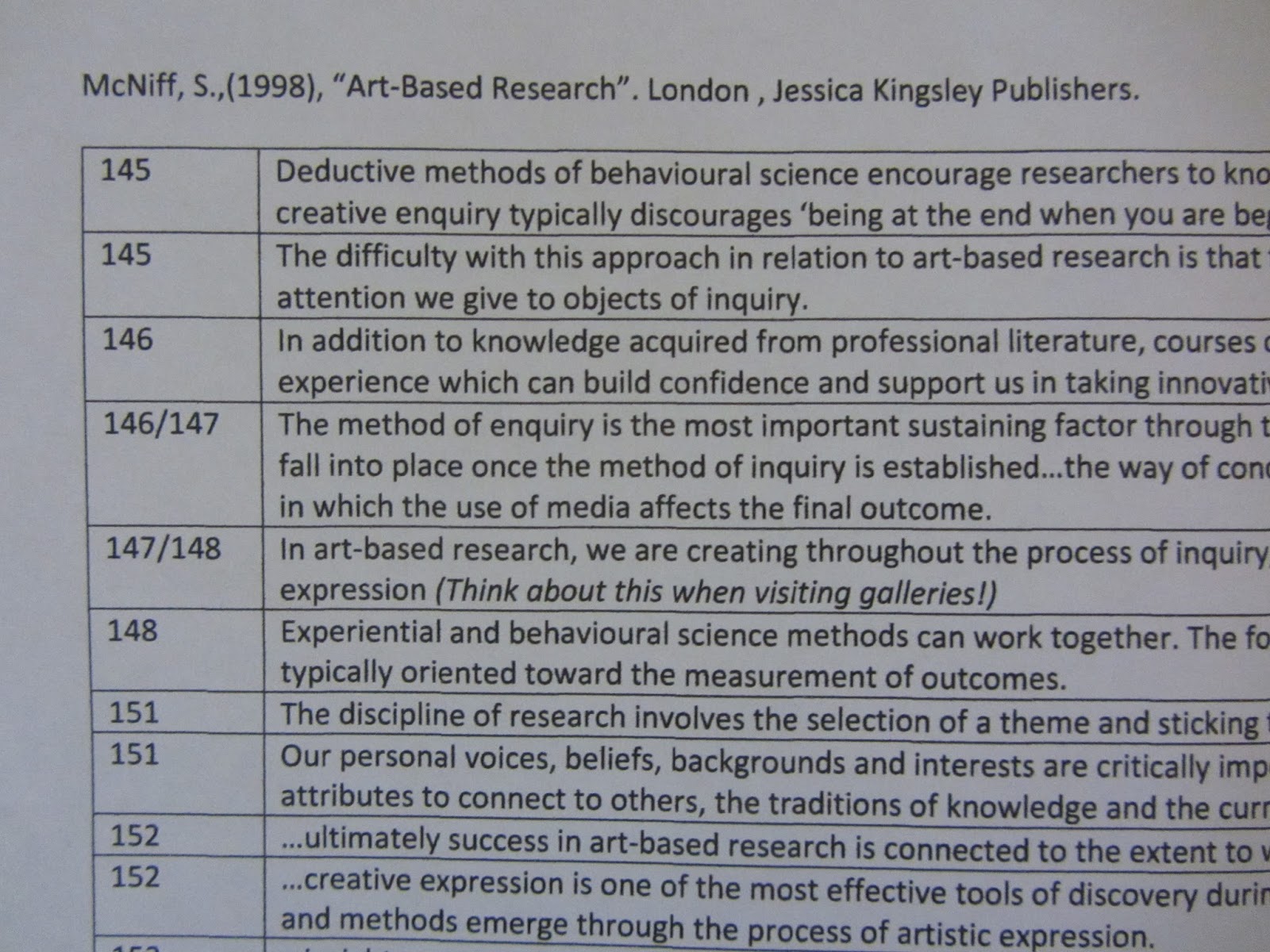
One of the things I need to get my head round PDQ is how to make notes on lectures, notes on books and papers I’m reading, and how to keep a Research Methods Journal. 

I am a maker of copious written notes. I already have multiple notebooks on the go for this MA course, which makes me feel mighty happy as I love notebooks. I love the blank pages, the joy of the lovely paper, the ability to write in them in my small, black writing, the physical action of writing. It helps me think. There are lots of arrows and bullet points and exclamations. I think in words and my thoughts transfer seamlessly to the paper. It’s a technique honed via many a lecture and meeting over the past whatever number of years. 


Writing notes in the taught sessions is fine, and I can review them at leisure and make connections and conclusions. Mind maps and ruminations about the presentations I need to do are also good in the notebook. However, I have been struggling a little with notes from textbooks. With the need to be able to quote and to give page numbers, I wondered about going straight into a word processor. The recommended text by Blaxter et al (2010, p. 121) suggests doing this. I gave it a go but it took far more time than handwriting (above)! Using the computer seemed to make me go into overdrive with detailed quotes, rather than my usual annotated scribbles. I also found, perversely, that I remembered less of what I’d read – presumably because I hadn’t physically written it. So, I’ve now reverted to my hand-written notes and hand-written quotes. I’ve introduced a new tactic of writing a short summary, a few sentences, at the end of each piece of reading. This seems to be working well for now.


I’ve decided I have to give blogging a try for the Research Methods Journal…. so here we are. This seems to be the best way to deal with being able to keep up the journal whilst having to have it “handed in” at the same time. It also makes it easier to insert images, rather than having to print them and physically cut and paste.
 
There are pros and cons though. I seem to associate using the computer with work- business- rather than anything for pleasure. On the other hand I can edit my past entries if I so desire, rewrite history, in a way that would be obvious in a written notebook. This could be useful in a positive way if I want to add something new to a previous post on a particular topic.

Let’s see how it goes.